


Sony confirmed on July 1 that it will discontinue physical disc production for all new PlayStation games starting January 2028, framing the move as a natural response to shifting consumer habits.
Sid Shuman, Senior Director of Content Communications at Sony Interactive Entertainment, wrote in the official announcement that “the general preference for digital media significantly outpaces physical discs.” The sales data on Sony’s own platform, however, tells a more complicated story than that statement suggests.
The data doesn’t back Sony’s story
Analytics firm Alinea Analytics published a breakdown this week comparing physical versus digital sales across ten major PlayStation titles released over the past few years, and the spread is significant.
Final Fantasy VII Rebirth leads with 48% of copies sold on disc, followed by Astro Bot at 45.8%, Assassin’s Creed Shadows at 36.3%, Marvel’s Spider-Man 2 at 34.8%, Clair Obscur: Expedition 33 at 32.2%, and Monster Hunter Wilds at 30.7%. Split Fiction sits at 26.6% and Assassin’s Creed Black Flag Resynced at 24.9%, while Madden NFL 26 and Black Myth: Wukong close out the list at 12.9% and 10.8% respectively.
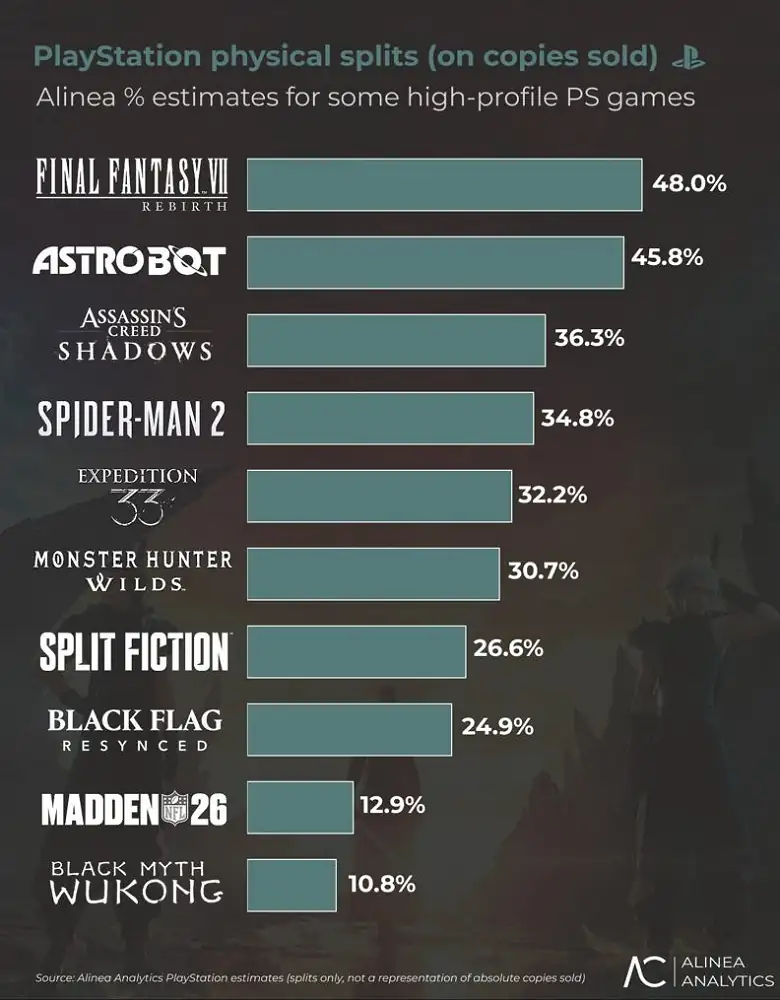
Analyst Rhys Elliott, who compiled the data, notes that the top of the list is “collector’s territory,” the prestige single-player titles players want physically on a shelf, while the bottom belongs to games built for digital audiences from the start. Black Myth: Wukong launched as a PC-first title with a massive Chinese player base already accustomed to downloads, and Madden is an annual sports release few buyers keep in box form.
That range undercuts the idea that physical sales have become negligible. Six of the ten titles Alinea tracked still sell between a quarter and nearly half their copies on disc, numbers that sit far from the 95-5 digital-to-physical split that would make Sony’s “natural direction” framing straightforward.
Why “Digital preference” isn’t the whole story
The broader industry trend toward digital is real. US physical game spending totaled $1.5 billion in 2025, the lowest figure recorded since market research firm Circana began tracking the category in 1995, down sharply from a 2008 peak of $11.6 billion, according to Circana’s senior director Mat Piscatella.
Sony’s own hardware decisions have tracked that shift for years: the PS5 Pro launched in 2024 without a built-in disc drive, selling one only as a separate add-on, and PlayStation raised the price of the disc-edition PS5 from $549.99 to $649.99 in April 2026. Journalist Jason Schreier reported that Sony sold roughly 318 million game units last year, with downloads accounting for 85% of that total.
The timing of the announcement complicated Sony’s messaging further. It landed days after fans learned that the physical edition of Grand Theft Auto 6 will ship with a download code instead of an actual disc, a decision that had already drawn criticism before Sony’s own announcement widened the same debate. Reaction to Sony’s blog post itself was largely negative: readers commenting directly on the announcement called it “really disappointing” and “terrible,” with one writing that players now “literally own nothing… but licenses.”
That ownership anxiety isn’t isolated to this one announcement, either. Sony is separately removing 551 film and TV titles from the PlayStation Store on September 1, and reporting on the disc decision has also resurfaced a UK and EU policy that permits Sony to close PlayStation Store access under certain circumstances.
Video game historian Frank Cifaldi, founder of the Video Game History Foundation, has warned that eliminating physical media removes players’ ability to permanently own a copy of a game, since digital titles can be delisted from storefronts entirely, something that has already happened to games no longer available for purchase. Taken together, the disc removal, the catalog delistings, and the store-access policy have compounded into a broader trust problem for Sony that goes beyond disc collectors specifically.
Sony itself has been notably cautious in how it talks about the decision internally. During the company’s FY26 Q1 earnings call, a Sony Corporate Communications executive named Ishii told investors that “we are not seeing any impact on our business as of now,” while acknowledging that players “have attachments” the company still has to account for. CFO Lin Tao echoed that caution, telling investors Sony would move forward but do so carefully. The PlayStation Store, the platform players are being pushed toward, has also faced multiple lawsuits over its business practices.
The PlayStation 6 question
The disc cutoff has also become a data point in speculation about Sony’s next console. Piers Harding-Rolls, senior games research analyst at Ampere Analysis, said the announcement “pretty much guarantees that PS6 won’t arrive until 2028 at the earliest,” and concluded that the base version of the PS6 likely won’t include a physical media drive at all, as Sony looks to control manufacturing costs on the next-generation hardware.

Not everyone in the industry agrees that PlayStation is done with discs entirely, though. Former PlayStation executive Shawn Layden has argued that the PS6 won’t fully abandon physical media, pointing out that while an all-digital approach has worked for Xbox in markets like the US, Canada, Australia, and New Zealand, much of the rest of the world still relies heavily on discs.
Given that PlayStation is the most popular gaming platform in more than 170 countries, Layden’s argument is that a full digital-only pivot risks alienating a large share of Sony’s global install base, even if the US and European conversation is dominated by digital-preference framing.
Follow the money
Elliott’s analysis points to margins as the real driver behind the decision. On a $70 first-party PlayStation game, a physical sale nets Sony roughly $45 after retailer cuts and manufacturing costs, while a digital sale through the PlayStation Store keeps close to the full $70, a 54% increase per copy. Third-party publishers see a similar, if smaller, gap: around $35 per disc sale versus $49 digital.
Elliott frames Sony’s strategy as chasing the kind of catalog-wide margins that storefronts like Steam already enjoy, achieved by cutting off the smaller, lower-margin retail channel and routing purchases through a store Sony fully controls. He also describes the 2028 timeline as more of a stopgap than a long-term strategy, betting that the current memory and component shortage, driven in part by AI data-center demand for storage, eases before a future PS6 launch, allowing Sony to keep margins intact once manufacturing costs normalize.

The risk in that bet is what disappears alongside physical media. Secondhand discs have historically served as a low-cost entry point for younger and budget-conscious players, and removing that pathway could push exactly that audience toward PC, mobile, and free-to-play alternatives instead of staying within the PlayStation ecosystem, even as international markets complicate how fully Sony can actually walk away from discs long-term.
What’s your take, does Sony’s math actually hold up, or is “consumer preference” doing a lot of heavy lifting here? Let us know in the comments.