



Microsoft officially confirmed on March 11, during its keynote at the Game Developers Conference, that its next-generation console, codenamed Project Helix, will run on a version of Windows, marking what the company itself is calling the most significant structural change to its gaming strategy since the original Xbox launched in 2001.
Jason Ronald, vice president of Next Generation at Xbox, delivered the announcement, revealing his team is deep in development on Project Helix in partnership with AMD, using FSR Next to push rendering and simulation forward.
The partnership with AMD is not new. Microsoft’s relationship with AMD’s graphics technology traces back to the Xbox 360’s ATI-built GPU in 2005, before ATI merged into AMD the following year, and deepened further when AMD became the console’s sole chip supplier starting with the Xbox One in 2013.
What is new is the philosophy behind the hardware: Microsoft framed Project Helix not as a simple hardware refresh, but as a platform pivot that formally merges console and PC gaming into a single cross-device ecosystem.
Reports throughout early 2026 had already pointed toward the next Xbox depending on the Windows full-screen experience for its navigation, blurring the line between console and gaming PC well before Microsoft put an official name to the project.
What changes for players, and what doesn’t
Microsoft reiterated at GDC that backward compatibility across four console generations remains a strategic priority, tying the commitment directly to Xbox’s 25th anniversary. That means titles from the original Xbox, the Xbox 360, the Xbox One, and the Series X/S are all expected to run on Helix, through a combination of native support and emulation depending on the game.
No one is being asked to rebuy their library to move into the next generation, a lesson Microsoft learned the hard way in 2013, when backlash over proposed always-online requirements and used-game restrictions for the Xbox One forced the company into an embarrassing reversal just months before that console’s launch.
What is genuinely new is where those games can come from. Microsoft confirmed the system will be able to boot straight into the Windows desktop and run PC games from outside storefronts, not just the Xbox Store.
For the first time, an Xbox console is expected to natively support both the traditional Xbox ecosystem and third-party PC storefronts such as Steam and GOG. Whether Valve’s store specifically makes the final list remains unconfirmed on the record, but the direction is unmistakable: Microsoft is opening the walls it spent two decades building around its platform.
Windows compatibility, already in motion
Xbox announced via Xbox Wire on July 22 the launch of Xbox Backward Compatibility on PC in Early Access, letting players run classic original Xbox titles on PC and handhelds for the first time.
The four launch titles, BLiNX: The Time Sweeper, Conker: Live and Reloaded, Crimson Skies: High Road to Revenge, and Fuzion Frenzy, are available for purchase on PC and included with every Xbox Game Pass tier, and players who already own digital licenses for these games on console can carry them over to PC at no extra cost.
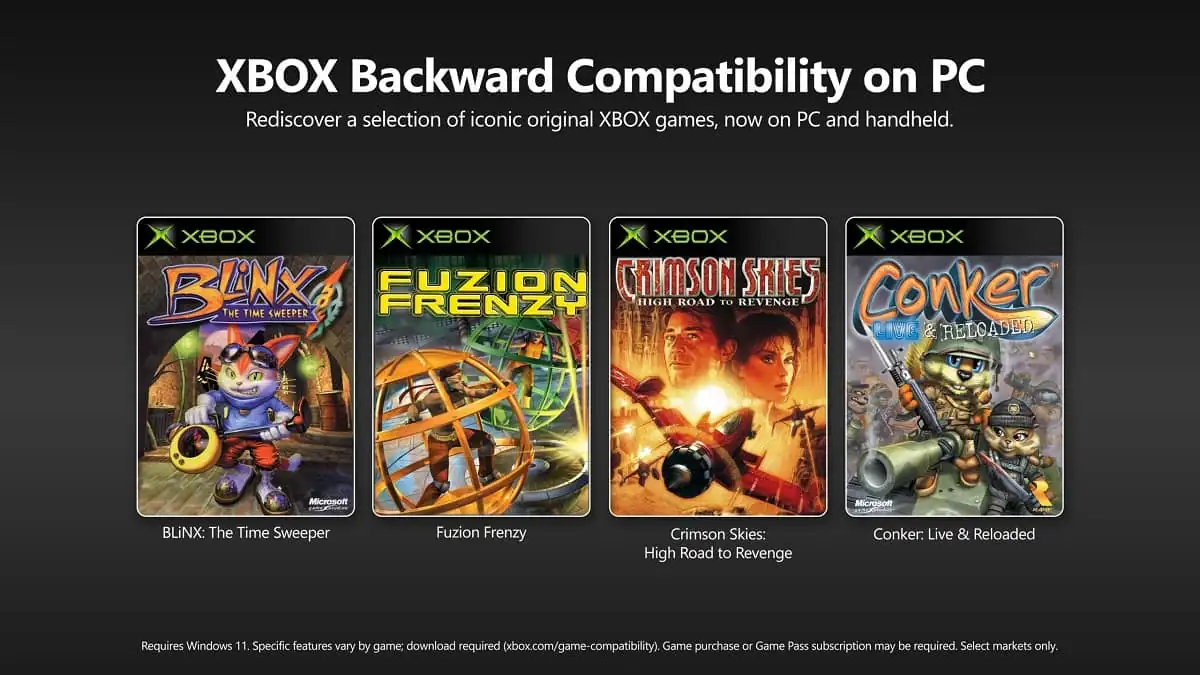
Xbox also added PC-specific options, including up to 4x resolution upscaling, VSync support, fullscreen and windowed display modes, anisotropic filtering, and enhanced anti-aliasing. Xbox described the launch as the beginning of a broader effort to preserve older Xbox games and bring them to PC over time, and Jason Ronald, Xbox’s vice president of Next Generation, said the team plans to add more features to eligible games going forward.
The rollout doubles as an early proof point for Project Helix’s core model. Migrating a classic Xbox license between console and Windows PC requires the same licensing, storefront, and technical plumbing that Helix will need at a much larger scale once its Unified GDK and four-generation backward compatibility promise reach players. A smooth Early Access rollout gives Microsoft real-world data on how backward compatibility performs across Windows, months before the next Xbox console itself ships.
One kit, two platforms
At the center of Project Helix sits a Unified Game Development Kit, replacing the separate Xbox and Windows kits studios previously had to maintain, and giving developers one set of APIs and tools that behave identically across console, PC, and cloud.
In theory, that should translate into better-optimized PC releases and less fragmentation across the platform, since studios are now building a single codebase instead of parallel versions.
Players did not have to wait for Helix hardware to see the shift begin. Microsoft and Windows + Devices corporate vice president Ian LeGrow announced on April 30, that “Xbox mode“, the same full-screen, controller-optimized interface first debuted on the ROG Xbox Ally handhelds, had begun rolling out to Windows 11 PCs, laptops, and tablets in select markets.
As of late June, that rollout was still gradual, expanding region by region as Microsoft verifies compatibility across different device configurations, rather than arriving everywhere at once.
Windows OS overhead and system performance
Windows Forum reported on March 13, that independent hands-on testing of the current Xbox Full Screen Experience on Windows 11 handhelds found the framerate gains from switching out of the standard desktop were modest at best and negligible at worst, with some testers recording a small decline rather than an improvement.
The same report noted that thermal limits, driver maturity, and game engine behavior appeared to be bigger factors in real-world performance than the interface layer itself, suggesting OS overhead is not the sole bottleneck it’s often assumed to be.
Microsoft’s proposed answer to that overhead is to have Windows 11 actively suspend non-essential background processes during gaming sessions, according to reporting from Damage & Armor in March 2026.
Coverage from Tech Bytes the same month described a lightweight “Windows Xbox Shell” interface Microsoft is building for dedicated gaming devices, reportedly targeting under 2GB of RAM overhead, though Microsoft has not confirmed that figure publicly.
A separate analysis published by Shattered.io in July 2026 argued that regardless of how much overhead Microsoft manages to trim, a Windows-derived console still inherits baggage that a purpose-built console operating system was never designed to carry in the first place.
The security tradeoff
The move toward outside storefronts also introduces a security question the Xbox brand has not had to face before. A tech analysis published by Shattered.io in July 2026 noted that a traditional console stays safe largely because of its closed design, a curated store and signed software keep its attack surface small, but that letting a console install software from Steam, Epic, GOG, and the open web means it inherits the PC’s threat model too, including malware hidden in pirated games, malicious mods, and phishing storefronts posing as legitimate ones.
Coverage of Digital Foundry’s GDC discussion in March 2026 pointed to the same concern, with the outlet arguing the Xbox side of Helix would need to run in its own walled-off partition, separate from the open Windows environment, to avoid exposing it to the same vulnerabilities as a regular PC.
Microsoft has not detailed the exact security architecture for Helix, but the approach would echo the containerization Microsoft already uses to separate the Xbox and Windows environments on the Xbox One and Series consoles.
Anti-Cheat and competitive integrity
Anti-cheat is another open question the hybrid design creates. In a Moore’s Law Is Dead podcast episode published on March 26, a developer from Alderon Games warned that Helix’s PC-style openness could expose studios to cheating problems they’ve never had to manage on a locked-down console, since games could soon launch from outside storefronts instead of a single curated store.
Coverage from ScreenRant in June 2026 echoed the concern, noting that even sophisticated anti-cheat software struggles to fully protect an open system, and warning the shift could turn into an ongoing game of whack-a-mole for developers trying to keep competitive matches fair. Microsoft has not yet detailed how it plans to enforce a consistent anti-cheat standard once games can run outside the traditional Xbox environment.
A multi-year transition
Leaked specifications point to a custom AMD chip, internally referred to as “Magnus,” pairing RDNA 5 graphics with Zen 6 CPU cores, a dedicated NPU rated up to 110 TOPS, AMD’s FSR Diamond upscaling with multi-frame generation, next-generation DirectX, and upgraded DirectStorage with Zstd compression, reportedly targeting native 4K at 120 frames per second.
Some of that graphics architecture is believed to have been co-developed with Sony under a separate initiative tied to the PlayStation 6, a notable crossover between two companies that have spent decades as direct rivals.
Ronald confirmed at GDC that early development hardware will not reach game developers until sometime in 2027, pushing any realistic consumer launch well beyond that. This is a multi-year transition rather than a single console drop, and Microsoft has been careful about how much control it is willing to hand over in the process.
According to insider Moore’s Law Is Dead, who has a strong track record on Xbox and AMD leaks, developer sentiment following GDC suggests the Unified GDK will still prioritize the Helix console first, with studios expected to confirm compatibility with the AMD-powered hardware before optimizing further for open Windows. The same insider reports that publishers will still be able to keep Xbox-exclusive titles locked to the dedicated console if they choose, though Microsoft has not confirmed that detail on the record.
The stakes behind the shift are larger than any single console generation. Sony continues iterating aggressively toward its own next-generation hardware, cloud gaming keeps eroding the assumption that a dedicated box is even necessary, and handhelds like the Steam Deck have already proven there is real demand for PC-flavored gaming outside the living room.
Microsoft’s strategy has moved decisively away from the fixed-hardware model that defined consoles for a quarter century, betting instead on flexibility across consoles, handhelds, PCs, and the cloud as a single connected ecosystem.
Whether the bet pays off will depend on execution that cannot be judged yet, a unified platform does not automatically mean a simpler one for the people holding the controller. But if Microsoft delivers on what it described at GDC, the next Xbox will not just be new hardware under the TV. It will be confirmation that the wall between “console” and “PC,” standing since 2001, is finally coming down.
What do you think, are you excited for a Windows-powered Xbox, or does this hybrid approach make you nervous? Drop your take in the comments, I’d love to hear it!