


A Facebook post shared on August 5 by the account Iglesia Católica introduced a small religious project taking shape inside Minecraft: the Orden de Frailes Menores de Minecraft (or Ordem dos Frades Menores de Minecraft in Portuguese), abbreviated as OFMM.
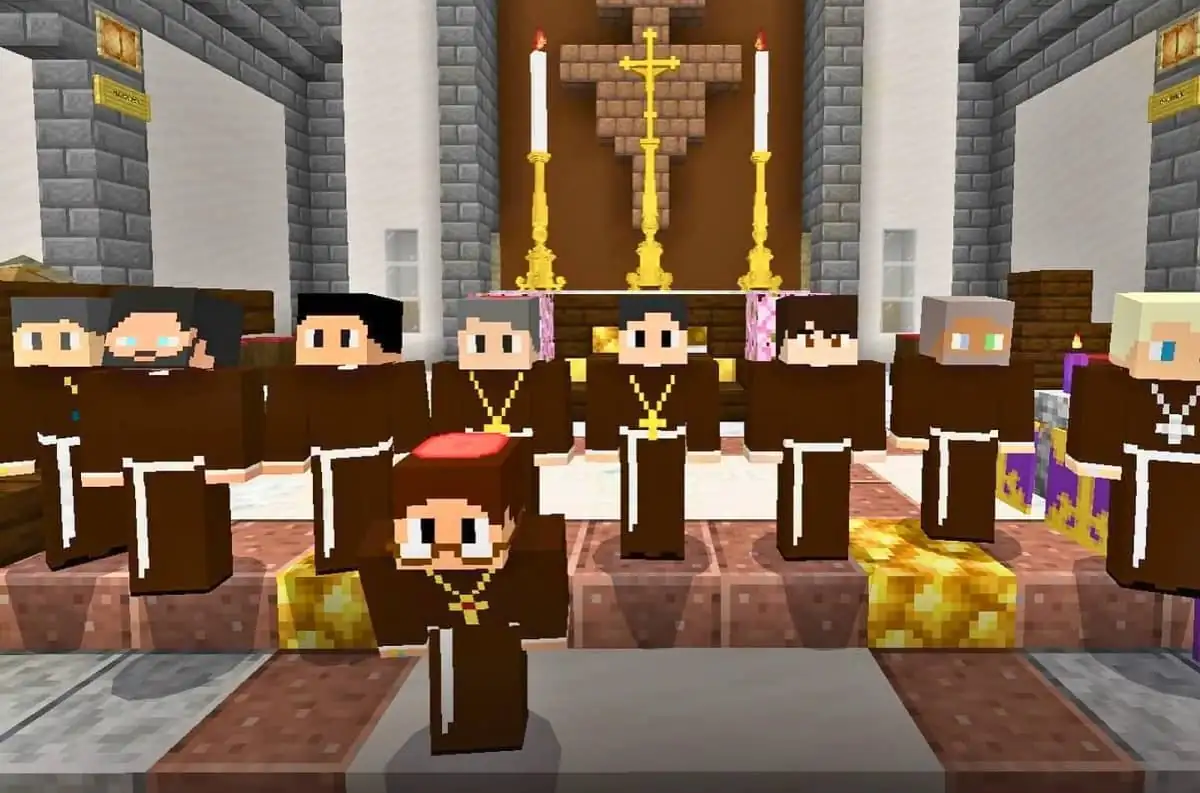
The accompanying image shows a group of in-game characters dressed in brown Franciscan habits, gathered inside a custom-built stone chapel complete with a golden cross, gold candlesticks, and a red-and-gold carpeted altar. The post frames OFMM as a youth-focused evangelization project that borrows both its name and its spirit from a religious order founded more than 800 years ago.
The reference is direct. The Order of Friars Minor, commonly called the Franciscans, is a mendicant Catholic religious order founded in 1209 by Francis of Assisi. The order today counts roughly 12,127 friars across 119 countries, making it one of the largest religious communities in the Catholic Church.
Over the centuries the order split into three branches, the Order of Friars Minor, the Conventuals, and the Capuchins, each observing the same Rule of Saint Francis with different emphases, though all built on the same foundation of poverty, humility, and fraternity. OFMM keeps the original acronym while swapping the final letter, pointing to where this particular branch operates: not in a friary or a parish hall, but inside a Minecraft world.
The account behind the post, Iglesia Católica, is tied to a real parish, Templo de Nuestra Señora del Pilar in Guadalajara, Jalisco, Mexico, whose usual activity centers on livestreaming Traditional Latin Mass. The church serves as the seat of a local Fraternidad Sacerdotal de San Pedro (FSSP) community, a traditionalist Catholic society dedicated specifically to the older Latin rite. That makes the OFMM post an outlier for the page, and it leaves open questions: how OFMM is organized, how it operates day to day, and whether the parish is formally behind the project or simply amplifying it. The post itself, however, is specific about what OFMM is trying to do.
A safe space built on cooperation
According to the description shared alongside the image, OFMM exists to bring evangelization into video games by having members construct detailed sanctuaries and historically inspired cities inside Minecraft. The stated goal is to give Spanish- and Portuguese-speaking youth what the post calls a safe refuge, built through cooperation rather than solo play. OFMM isn’t described as a place to log in and grind, but as a space where building something together, patiently, is the point.
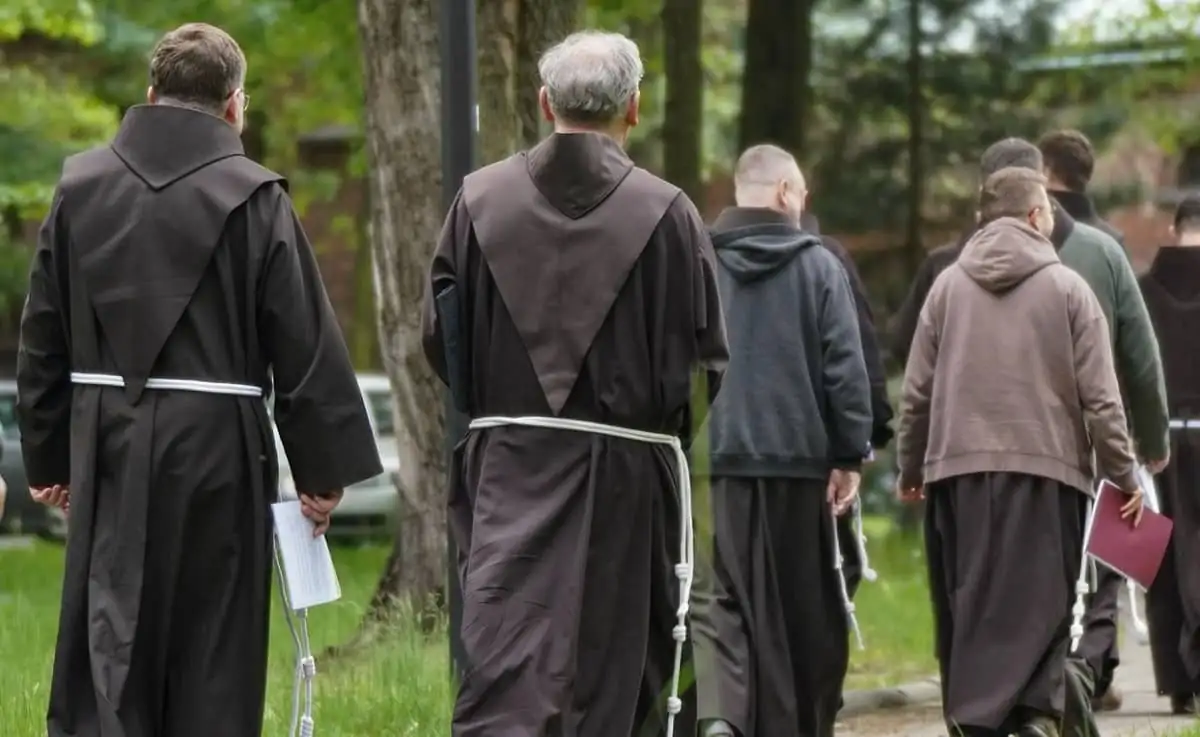
The post also describes an internal structure that brings friars, priests, and laypeople together, working side by side on what it calls a shared mission: integrating faith into today’s digital culture. That mix maps onto a real, longstanding Franciscan framework. Francis of Assisi founded not one order but three: the First Order for friars, the Second Order for nuns such as the Poor Clares, and a Third Order for laypeople and diocesan clergy who wanted to live by Franciscan values without leaving their existing lives behind.
That Third Order, created in 1221, is by far the largest branch of the Franciscan family today. Whether OFMM formally organizes itself around that same three-tier structure isn’t stated in the post, but the friars-priests-laypeople combination it describes echoes a division the real order has maintained for eight centuries.
That combination, clergy and laypeople collaborating inside a game world, isn’t unique to OFMM, either. Comunidade Católica de Minecraft, a bilingual Spanish-Portuguese project active since 2015 with almost 13,000 followers on Instagram, has explored similar ground for close to a decade, the OFMM account is also managed by them, officially confirming a link between the two projects, but OFMM’s post positions it alongside a wider current of Catholic communities treating Minecraft as an outreach tool rather than something to steer young people away from.
Inside the chapel: Stone, candlelight, and a kneeling friar
The screenshot itself carries much of the story. The chapel shown is detailed enough to pass for a dedicated, long-term build rather than a quick mockup: carved stone archways, a golden cross mounted above the altar, matching gold candlesticks on either side, and a floor pattern alternating red and gray brick. The characters gathered in front of it wear uniform brown robes with white sashes and small gold crosses, standing in loose rows facing the altar, with one figure kneeling at the front in a red cardinal-style cap. Builds like this require real coordination among multiple players: matching textures, aligning symmetry, and getting the lighting right so the space reads as solemn rather than decorative.
Even the smaller details in the image line up with real Franciscan tradition. The white cord belt visible on each character is modeled on the actual Franciscan cincture, traditionally tied with three knots representing the vows of poverty, chastity, and obedience. The brown color of the robes traces back centuries as well: undyed wool was simply the cheapest cloth available in medieval Italy, and Pope Leo XIII later standardized brown as the color across the order’s branches in 1897. Whoever built these character skins clearly did some homework on what a Franciscan habit is actually supposed to look like.
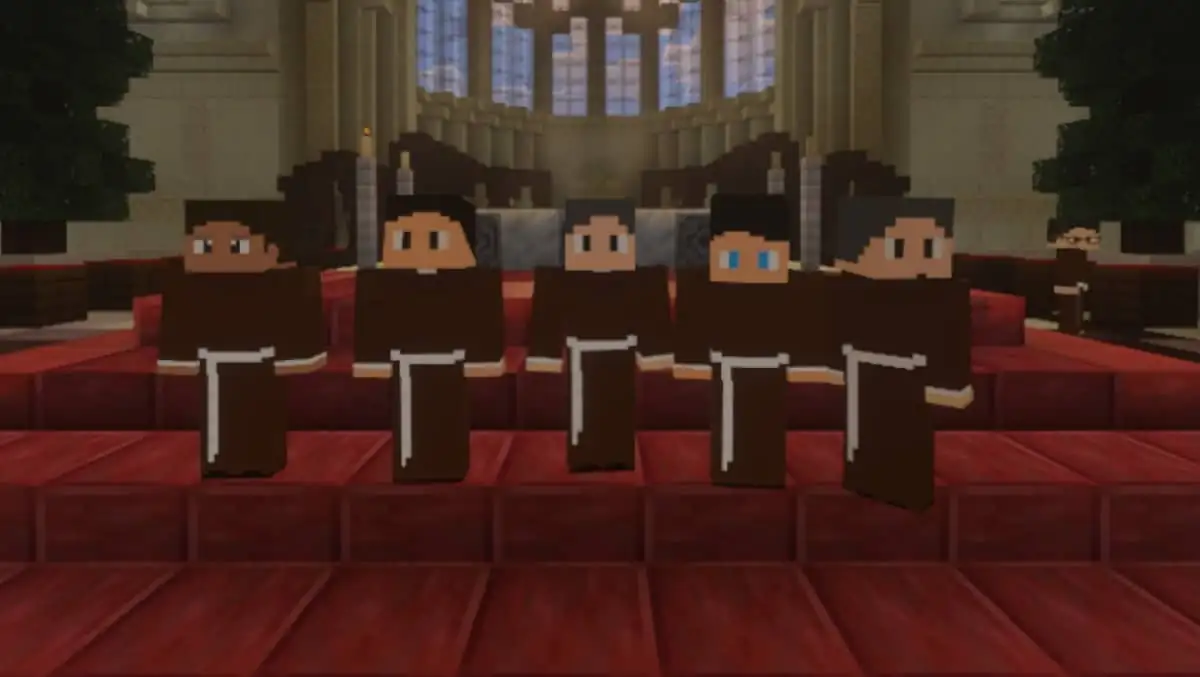
The choice of platform isn’t as unusual as it might first appear. Minecraft: Education Edition, launched in 2016, has spent close to a decade in classrooms, with program eligibility explicitly extended beyond schools to libraries, museums, and recognized home-school organizations.
The platform’s official build challenges lean heavily on the same instinct OFMM describes: designing a school, creating museum dioramas, or modifying a stadium’s playing surface, projects that come with academic components but tend to lead with creativity and collaboration.
Documentation on how educators have used the game over the years describes it as a tool to scaffold collectivity, resource sharing, and community building, standing in contrast to a culture that more often rewards consuming and competing, with student groups in some documented cases even building their own in-game museums as part of collaborative assignments. Applying that same logic to a chapel, raised collectively by a group of young players, follows a familiar internal logic, even if the setting is unusual for it.
The evidence behind OFMM, so far
As previously mentioned, the group’s Instagram account, @ofmcatolicosminecraft, is managed by Comunidade Católica de Minecraft, tying OFMM directly to that larger, longer-running project, establishing the project’s legitimacy. What’s still unconfirmed is OFMM’s total membership, which Minecraft server or platform it builds on, and the exact nature of its relationship to the Guadalajara parish whose Facebook account shared the original post.
Details are similarly sparse concerning how long the group has existed, whether it holds regular building sessions, or how members are recruited or organized day to day. That doesn’t make the project less real or the build less impressive; it just means the full picture remains thin from the outside, built from a handful of sources rather than a documented history.
If OFMM continues building out its public presence through a public server listing and increased interaction across social platforms, the story here could grow considerably, particularly around how faith communities are adapting to reach younger, terminally online generations.
The Order of Friars Minor has spent more than eight centuries adjusting how it reaches people while holding onto its core identity: poverty, humility, fraternity, service. A voxel chapel built collaboratively by a handful of young players isn’t as far a leap from that tradition as it might sound. It’s a current answer to an old question, how to meet people where they already are, and for at least one small community, that place is currently inside Minecraft.
So, what do you think, would you want to see more faith-based communities building inside games like Minecraft? Let us know in the comments!