
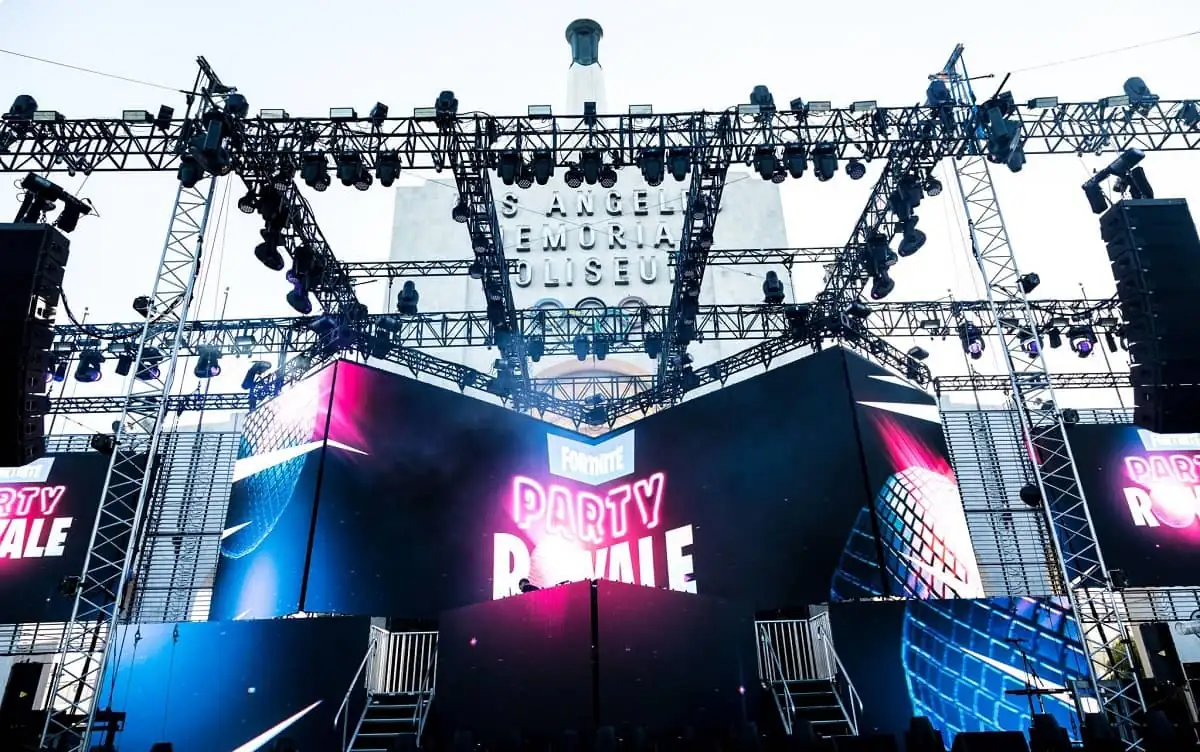

On September 25, 2020, Epic Games premiered BTS’ “Dynamite (Choreography Version)” music video inside Fortnite’s Party Royale mode, the no-combat social space where the game hosts concerts and movie screenings instead of firefights.
Two days earlier, Epic had already put a companion item pack on sale: two dance emotes choreographed by the band, priced at 800 V-Bucks. It wasn’t an isolated stunt. Over the following four years, BTS moved from licensed guest star in other studios’ live-service titles to a direct producer of its own mobile games, and the shift says as much about how publishers monetize fandoms today as it does about the band itself.
That transition mattered to the industry beyond K-pop circles. Game companies were no longer just buying a famous face for a skin; they were testing how far a music IP could stretch a live-service calendar, and how much of that value could be extracted through cosmetics alone, without touching core gameplay or competitive balance. BTS became one of the clearest test cases for that model.
Live-service crossovers: Selling cosmetics, not power
Fortnite’s “Dynamite” premiere arrived weeks after the song’s official video became the most-watched music video on YouTube in its first 24 hours, with 101.1 million views, giving Epic a built-in audience before the in-game event even aired. The show ran at Party Royale’s Main Stage on September 25 at 8 p.m. EDT, with a rebroadcast the following morning for players in other time zones, and Fortnite Creative released a fan-built recreation of the music video’s world three days ahead of the premiere.
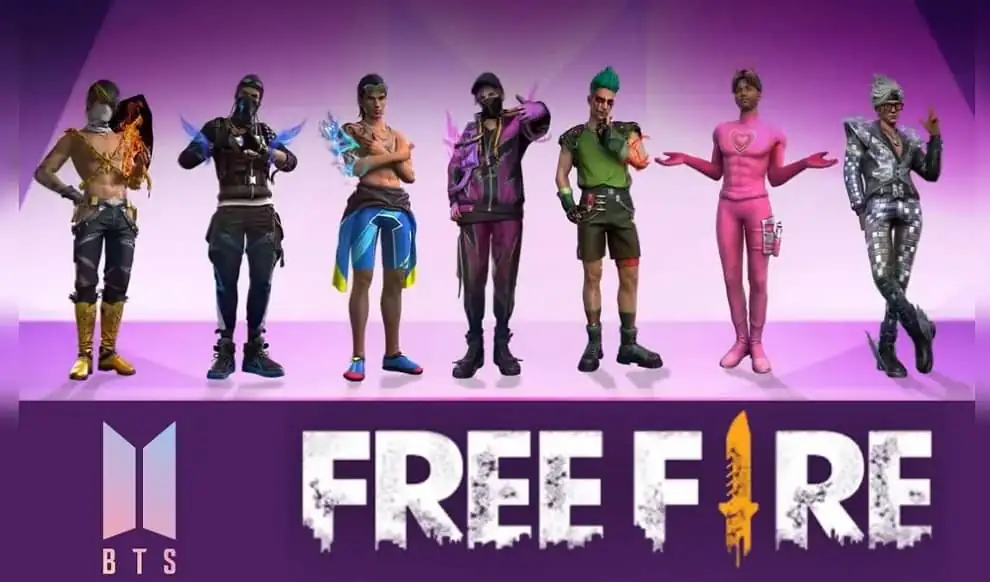
Garena took a heavier approach with Free Fire in 2022. The “Gen FF” (Generation Free Fire) campaign launched worldwide on March 23 and opened with a two-episode in-game miniseries, “The Free Fire x BTS Show,” featuring all seven members. The update added costumes hand-drawn by the band, new emotes, and a new lobby track, documented by Garena in an official BTS x Free Fire behind-the-scenes video showing the members sketching their skins, and Garena extended the campaign offline with a Times Square activation in New York that April.
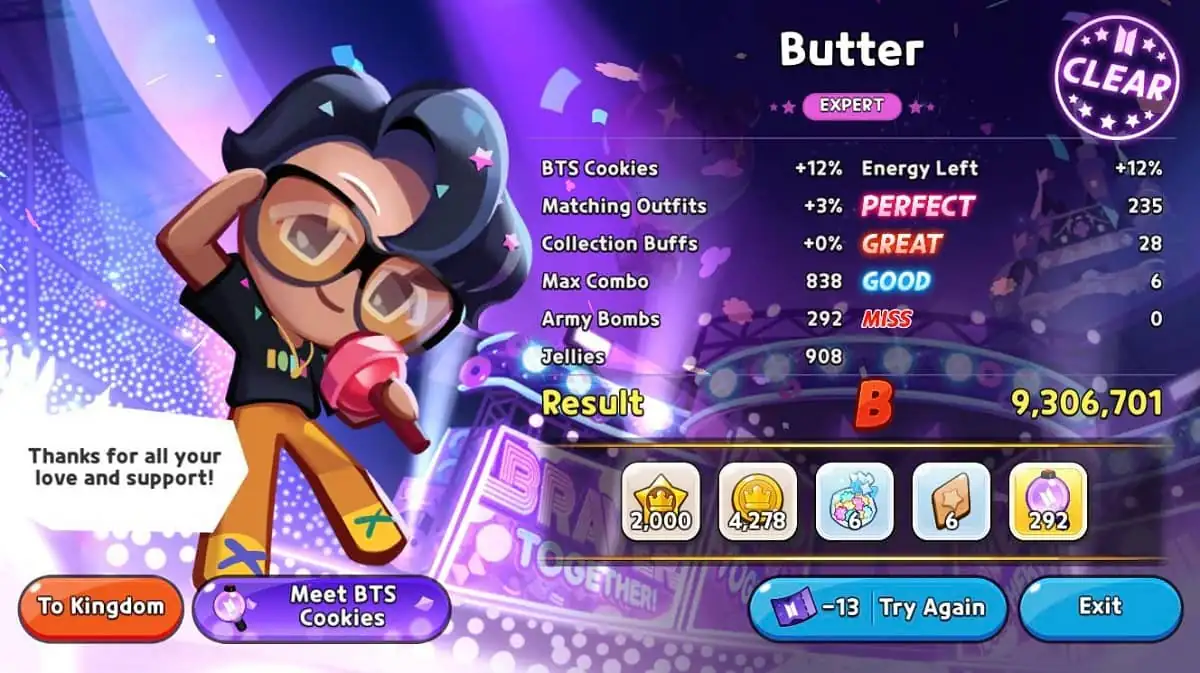
Devsisters followed in October 2022 with Cookie Run: Kingdom‘s “Braver Together” event, giving each BTS member a dedicated Cookie character built around outfits from the “Butter,” “MIC Drop,” and “Permission to Dance” eras. The event added a Performance Mode where players tap notes in rhythm to defend a virtual concert, plus a gacha system built around collectible ARMY Bomb currency. It was the first collaboration between Cookie Run and an existing idol group, and the first tie-in with a Korean IP in the franchise’s history.
Not every crossover put BTS inside a game. The BT21 x Among Us collaboration from November 2021 was a merchandise line only, figurines, hoodies, caps, mugs, and Innersloth’s own announcement stated plainly that the characters were “not in game.” It’s a distinction worth keeping straight: brand association doesn’t always mean a playable integration, and Among Us never got a functional BTS tie-in the way Fortnite or Free Fire did.
Company-made titles: The manager-sim era
The move toward direct production wasn’t spontaneous, it followed money. In April 2018, Netmarble invested roughly 201.4 billion won (about $190 million USD) to acquire a 25.71% stake in Big Hit Entertainment, becoming the label’s second-largest shareholder, just weeks after announcing it was building BTS World. The equity stake meant Netmarble wasn’t licensing a mascot for a single event; it had a direct financial interest in the band’s long-term success, which explains why it committed to a full mobile title instead of a limited-time in-game bundle.
BTS World, developed by TakeOne Company and published by Netmarble, launched globally on June 26, 2019. The visual-novel-style mobile game cast players as the band’s manager, guiding the members from their pre-debut years in 2012 through global stardom, with a simulated one-on-one chat system and a schedule-management mechanic layered on top.
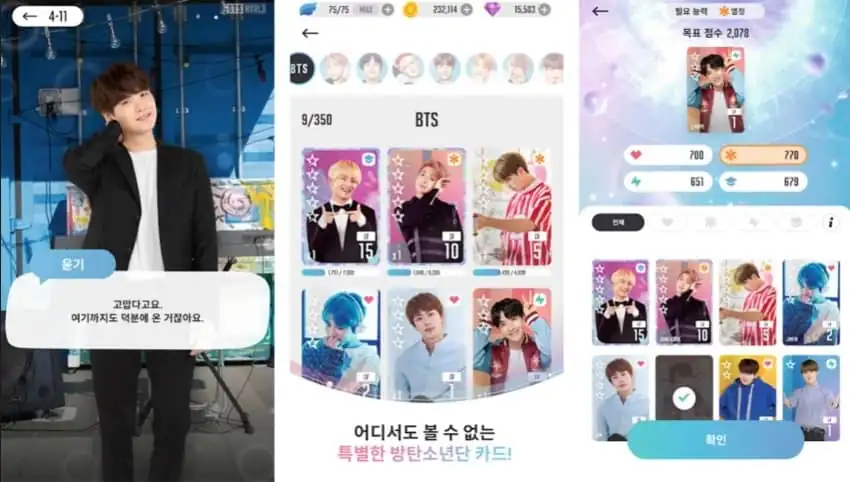
The results justified the investment quickly: the game became Netmarble’s first title ever to reach No. 1 on the U.S. iPhone charts, while also topping the App Store in South Korea, Japan, and every Southeast Asian market it launched in, and ranking among the top five apps in 36 additional countries.
By October 2020, BTS World had generated approximately $48.5 million in lifetime global revenue, working out to $4.10 per download, with South Korea alone contributing $7.7 million, or 23% of the total, and App Store users outspending Google Play users by a 54-to-46 margin. By its third year of operation, around 2022, the game’s monthly revenue had settled at a steady $1 million.
Netmarble discontinued the service on December 26, 2023, then relaunched it in December 2024 as “BTS World: Season 2,” swapping the visual-novel format for puzzle and card-collecting mechanics.
HYBE IM took a different genre with BTS Island: In the SEOM, a match-3 puzzle game released June 28, 2022. The members had direct creative input on the story, art style, puzzles, title, and logo, and SUGA composed the original soundtrack, “Our Island.” The premise follows the band shipwrecked on a deserted island they rebuild over the course of the story; clearing puzzle stages unlocks narrative chapters, and story progress raises the members’ in-game “happiness,” which grants items to clear further levels.
Not every title lasted, and the numbers explain why. BTS Universe Story, Netmarble’s sandbox game built around the band’s fictional “BU” storyline, launched September 24, 2020. It accumulated more than a quarter of a million dollars in its first week alone, and by early October 2020 had brought in roughly $310,000 total, with the US market, at $132,000, or 43% of the total, dominating spending far more than it had for BTS World.
Despite that early pace, the game shut down three years later, on September 22, 2023. SuperStar BTS, an earlier rhythm game, was discontinued in 2020 after roughly two years of service. Both cases point to the same structural weakness in single-artist mobile gaming: gacha-driven titles depend on a constant release calendar to keep monetization alive, and that pipeline gets expensive fast once the initial hype settles, even when the launch numbers look strong.
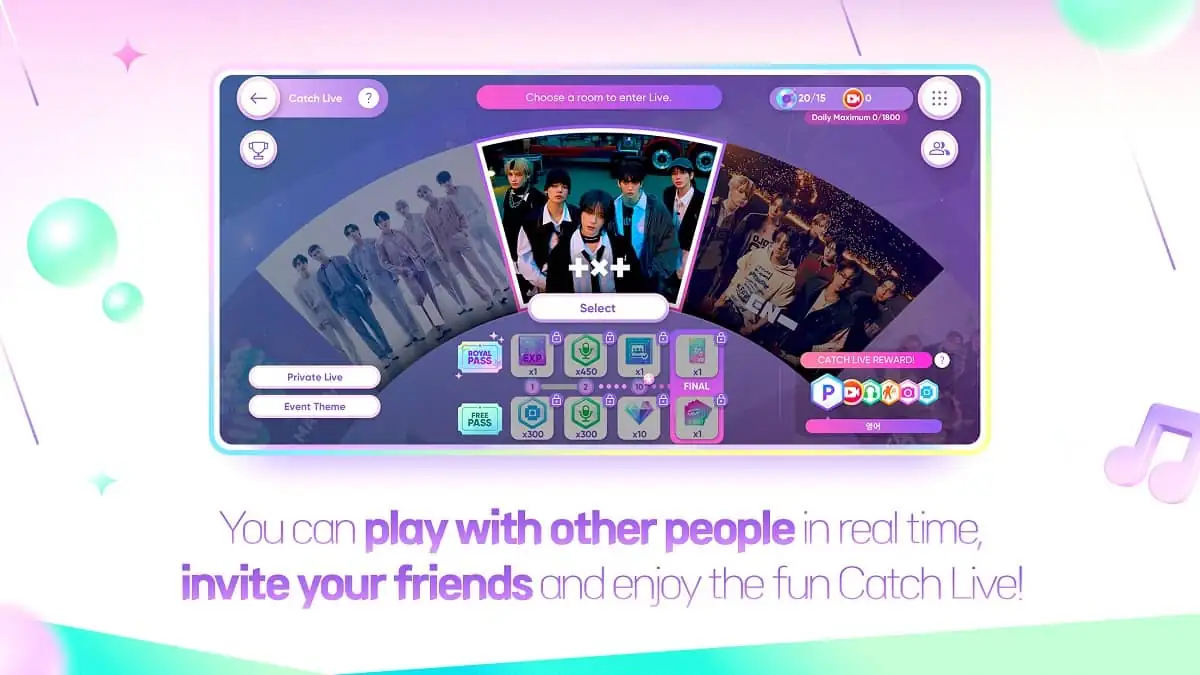
HYBE’s answer to that problem was to stop betting on one act. Rhythm Hive, launched February 4, 2021, spreads its content across the label’s full roster, BTS alongside TXT, ENHYPEN, SEVENTEEN, LE SSERAFIM, NewJeans, and others. The game has passed 10 million downloads and, as of mid-2026, ranks among the top titles in Google Play’s music category, still receiving monthly content and theme updates five years after launch, evidence that a shared-roster model outlasts a game tied to a single group’s release cycle.
Why publishers keep reaching for BTS
The pattern across every one of these deals is the same: acquisition first, retention second. A BTS crossover gives a live-service publisher a direct funnel into a fanbase with proven global purchasing power, ARMY, that doesn’t naturally overlap with a battle royale or puzzle game’s existing user base. Epic, Garena, and Devsisters weren’t selling BTS to players already inside their games; they were using BTS to bring in players who had no reason to open the app otherwise.
Netmarble’s case goes further and shows the ceiling of that logic: a $190 million equity stake in the band’s own label wasn’t a marketing budget, it was a bet that BTS’ commercial trajectory and the publisher’s mobile business could be tied together directly, and the near-$49 million BTS World alone generated by 2020 suggests that bet paid for itself well within the game’s first year and a half on the market.
The model also turns a game into more than a combat arena. Once a title hosts a concert, a costume line, or a narrative event built around a real artist, it starts functioning as a social venue rather than a battlefield, the exact bet Epic made with Party Royale, and one other platforms have chased with subsequent musician tie-ins.
The monetization stays consistent throughout: emotes, skins, costumes, and avatar decorations, almost never mechanics that touch competitive balance. That’s what makes the format repeatable, it sells identity and fandom rather than power, which keeps it low-risk for a publisher’s reputation while still generating recurring revenue, as BTS World’s steady $1 million-a-month run in its third year demonstrates.
The next level is already loading
BTS’ run through gaming shows something beyond a boy band selling skins, plenty of artists have done that. It shows a music IP with a large enough, digitally organized fanbase can move from guest appearance to full production partner, with publishers willing to build entire event calendars, and in Netmarble’s case an equity stake, around that shift.
The failures are as instructive as the hits: BTS World and BTS Universe Story prove single-artist mobile games have a short shelf life even when the opening numbers are strong, while Rhythm Hive’s five-year run suggests the better long-term bet is shared infrastructure across a full roster, not a single act.
That’s the template other labels are watching now. Games stop being one-off promotional stunts and start functioning as recurring, monetizable ecosystems that can outlive a single album cycle, as long as the content pipeline behind them doesn’t dry up.
What’s your take, do these crossovers actually add something to the games themselves, or is it mostly hype and merch? Let us know below!