



Sony confirmed today on the PlayStation Blog that an upgraded version of PSSR, PlayStation Spectral Super Resolution, the AI upscaling technology exclusive to PS5 Pro, is officially rolling out to players globally in the coming weeks.
The announcement came straight from Mark Cerny, lead architect of the PS5 and PS5 Pro, who revealed that the new version completely overhauls both the neural network and the underlying algorithm.
The first game to launch with this improved tech is Resident Evil Requiem, which released today, February 27.
The upgraded PSSR has already been used to boost the effective resolution of more than 50 PS5 Pro titles, but the old version had known issues, artifacts, shimmering, and inconsistent handling of fine details.
The new one is built to fix all of that, and early results in Resident Evil Requiem are already turning heads.
What the new PSSR actually changes in practice
Capcom’s Masaru Ijuin, Senior Manager of Engine Development Support at the company, explained what the upgrade meant specifically for Resident Evil Requiem.
With the new version of the RE Engine working alongside the improved PSSR, each individual strand of hair and beard on the protagonist is
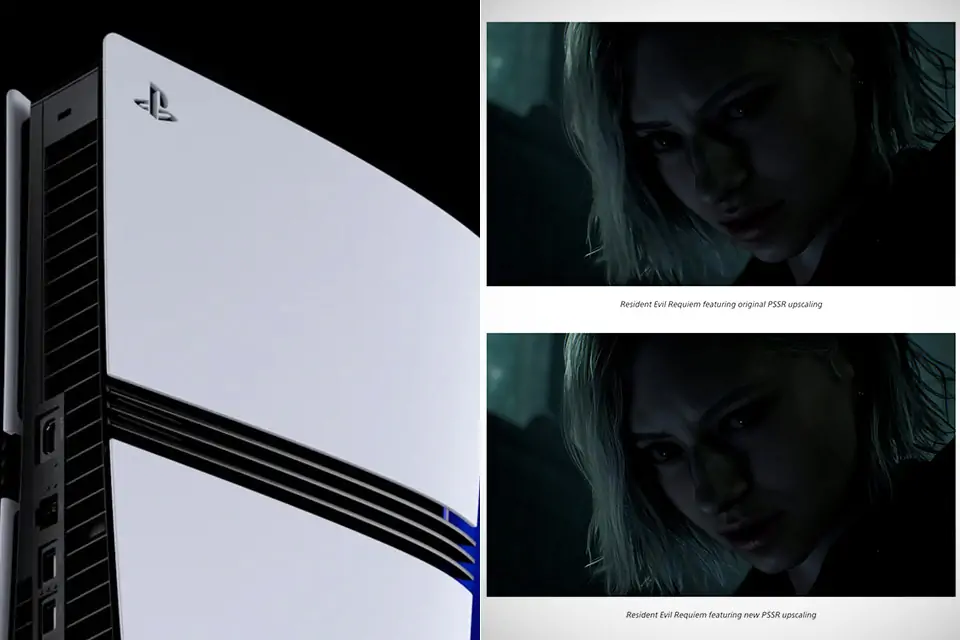 rendered as a separate polygon, reacting realistically to movement, wind, and light.
That kind of fine detail is traditionally very difficult to upscale cleanly, the old PSSR would often blur or distort it. The new version handles it without issues.
On the performance side, a Sony patent filed in July 2025 revealed another key improvement: during graphically intense moments that would normally cause frame rate drops, the new system intelligently reduces upscaling precision just enough to maintain smooth performance, without the player ever seeing a difference.
Sony calls the technology Multi-Frame Super Resolution internally, and this smarter load management is one of its core additions.
When the system software update arrives in March, PS5 Pro owners will find a new “Enhance PSSR Image Quality” option inside the Video Output settings. Turning it on will apply the upgraded upscaler to any game that already supports the current version of PSSR, no developer patch required.
Sony says some titles may look noticeably sharper just from flipping that switch.
So what about AMD’s FSR 4, is it coming or not?
This is where a lot of confusion has been floating around, so it’s worth being clear. The upgraded PSSR shares its DNA with AMD’s FSR 4, both came out of Project Amethyst, the joint collaboration between Sony and AMD that has been in development since late 2023.
PC players already saw the results of that partnership when FSR 4 launched for RDNA 4 graphics cards earlier this year. But what’s coming to PS5 Pro is not FSR 4 itself.

Sony has been upfront about this: the PS5 Pro runs on a custom architecture closer to RDNA 3, not the RDNA 4 hardware that FSR 4 was built for. Running that algorithm on different hardware required a full reimplementation from scratch, which is exactly what Sony’s team has spent months doing.
According to Cerny, the result takes the same inputs and produces essentially the same outputs as FSR 4, it just runs on PS5 Pro hardware and carries the PSSR name, not AMD’s branding.
Digital Foundry’s technical analysis of Resident Evil Requiem on PS5 Pro confirms the results are serious: the console runs the game at an internal resolution of just above 1080p with ray tracing enabled, and the final image comes out close to native 4K at a steady 60 frames per second.
Their direct comparison of the new PSSR against FSR 4 and DLSS 4.5 puts it roughly on par with FSR 4, falling just slightly behind DLSS 4.5 in certain scenarios, a result that would have seemed impossible on console hardware even a year ago.
What’s coming in March and what games are already confirmed
The big rollout happens in March. That’s when the system software update goes live and multiple existing PS5 Pro titles will be upgraded to use the new PSSR.
Games already confirmed to receive the enhancement include Kingdom Come: Deliverance 2, Alan Wake 2, Death Stranding 2: On the Beach, Baldur’s Gate 3, Stellar Blade, Stalker 2: Heart of Chernobyl, and Clair Obscur: Expedition 33, among others.

Upcoming titles like 007: First Light, launching March 27, have already confirmed PSSR support as well.
As for the future of the Sony and AMD partnership, Cerny has made clear that Project Amethyst is a long-term commitment, the breakthroughs coming out of it are being developed with future PlayStation hardware in mind, not just the PS5 Pro.
That long-term vision also reflects a broader industry shift, where AI-driven graphics workloads and memory demands are increasingly shaping the direction of gaming hardware, something we recently explored in our analysis of how advanced GPU memory is becoming a new performance bottleneck for the industry.
Whatever comes next is still years away, but the foundation being built right now is clearly pointing toward something much bigger.
What do you think, does this upgraded PSSR finally make the PS5 Pro worth it for you, or were you expecting more? Leave your take in the comments!