



Micron just published a blog post on its official website titled “The new performance bottleneck: How more GPU memory unlocks next-gen gaming and AI PCs”, in which the company argues that GPU memory has become the critical limiting factor for modern gaming performance, and that higher VRAM capacity is no longer a luxury, it’s a necessity.
The post details the company’s latest evolution of GDDR7 memory, introduces new 24Gb density modules running at up to 36 Gbps, and paints a picture of a future where GPUs pack up to 96GB of graphics memory. It’s an exciting announcement on paper. The problem is the context surrounding it.
This is the same Micron that, on December 3, 2025, officially announced its exit from the Crucial consumer business, its line of memory and storage products sold directly to everyday consumers at retail, in order to, in the company’s own words, “improve supply and support for our larger, strategic customers in faster-growing segments.”
In other words, Micron pivoted fully toward AI data centers. And now, just a few months later, they’re publishing detailed breakdowns of how more GPU memory will transform PC gaming. The PC hardware community noticed the irony immediately.
Micron’s new GDDR7: Impressive specs, uncertain availability
The technical details behind Micron’s announcement are genuinely noteworthy.
The new GDDR7 modules operate at 36 Gbps, a significant step up from the first-generation GDDR7 chips that debuted at 32 Gbps, chips that, in most consumer GPU implementations like the RTX 50 series, were already running below their rated speed at around 28 Gbps for thermal and reliability reasons. The bigger story, though, is density.
Micron’s new modules use 24Gb (3GB) chips instead of the previous 16Gb (2GB) configuration. That shift matters because GPUs can only fit a fixed number of memory chips depending on their bus width.
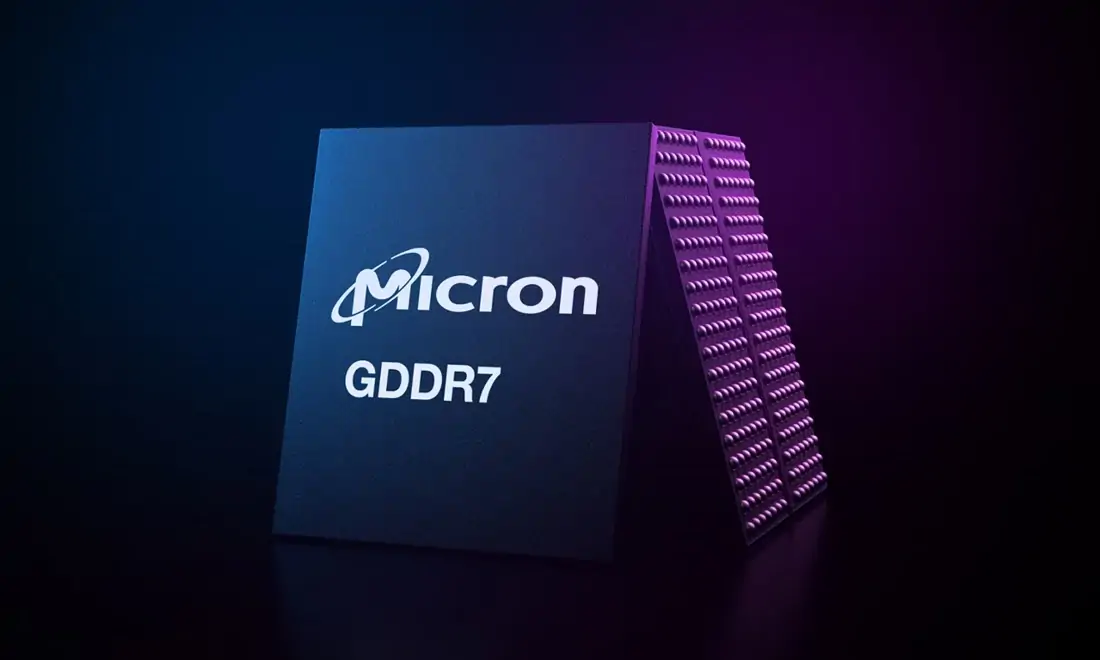
With 3GB chips instead of 2GB, a GPU with the same physical layout can offer 50% more VRAM without any other changes to the board design. At a 512-bit bus width, the kind found on flagship GPUs, configurations of up to 96GB of GDDR7 become theoretically possible.
In their blog post, Micron makes the case for why this matters for gaming specifically. Modern titles with real-time ray tracing demand continuous access to enormous datasets, geometry, material maps, lighting data, shadow information, and as resolutions push toward 4K, 5K, and 8K, the volume of data a GPU must process per frame grows substantially.
When VRAM runs out, the system begins swapping assets in and out of memory, producing the texture pop-in, frame time spikes, and mid-scene stutters that have become a familiar frustration for PC gamers. Micron’s argument is that their new generation of GDDR7 addresses that problem at the hardware level.
The post also references “the next wave of discrete GPUs”, a phrase that, given the timing and the specs being described, reads as a clear reference to Nvidia’s long-rumored RTX 50 SUPER series. Those are the GPUs that were supposed to bring these exact modules to consumers.
The RTX 50 SUPER that never arrived
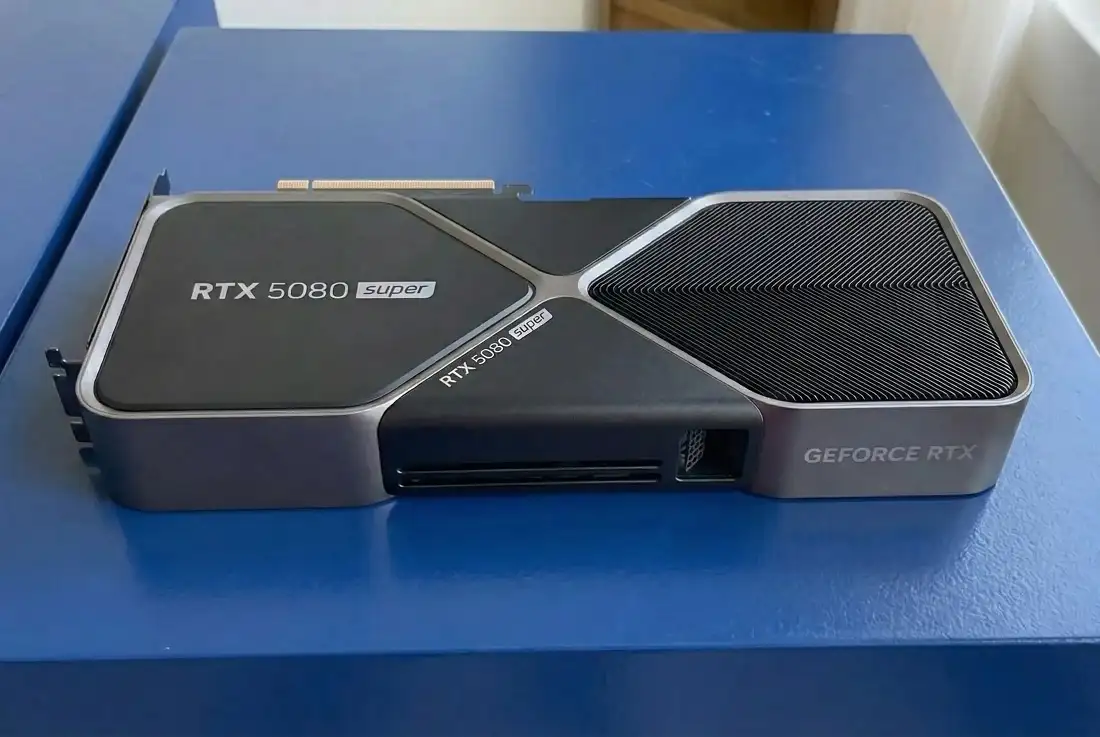
Reports began circulating in late 2025 that Nvidia had completed the design work for an RTX 50 SUPER refresh, a lineup that was expected to include the RTX 5080 SUPER, RTX 5070 Ti SUPER, and RTX 5070 SUPER, all built around those same 3GB GDDR7 chips.
The upgrade would have given each card 50% more VRAM compared to their standard counterparts: the RTX 5080 SUPER reportedly targeting 24GB, and the RTX 5070 SUPER targeting 18GB.
These numbers would have directly addressed one of the loudest criticisms of the Blackwell generation, that cards like the RTX 5070 shipped with less memory than many gamers expected at that price point.
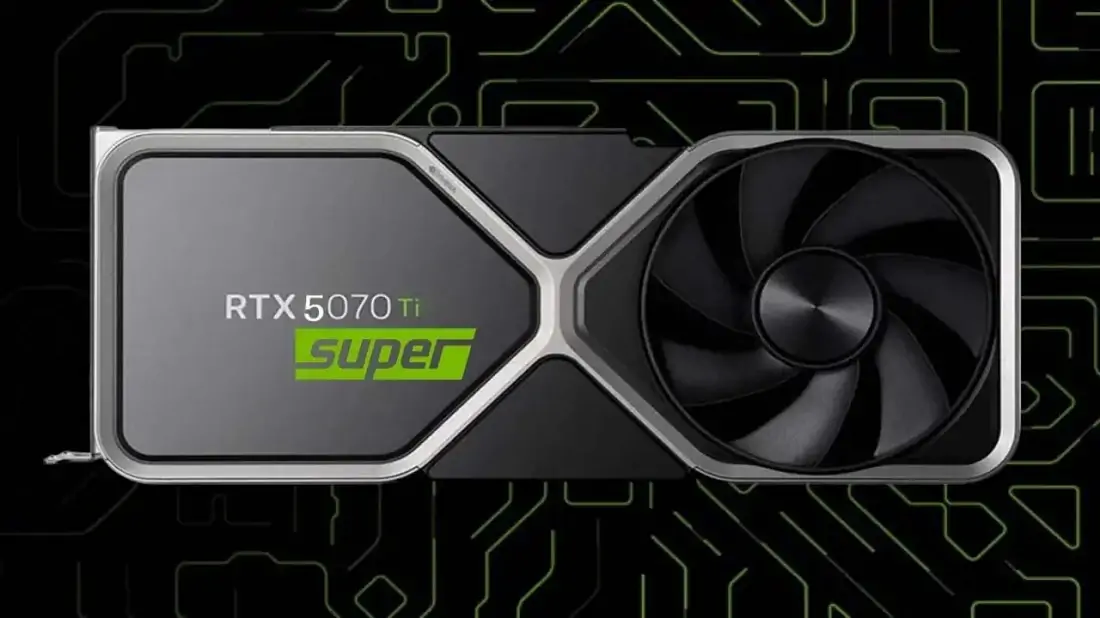
Instead, according to a report from The Information citing people with direct knowledge of the matter, Nvidia will not release any new consumer graphics cards in 2026. The RTX 50 SUPER refresh has been delayed indefinitely or scrapped outright.
This would mark the first time since the early 1990s that Nvidia has gone an entire calendar year without launching a new gaming GPU, a streak that survived the crypto mining boom, the pandemic-era supply chain crisis, and every other disruption in between.
The reason is the same one driving most hardware headlines right now: the global memory shortage.
With AI data center demand consuming the overwhelming majority of available GDDR7 supply, there simply isn’t enough high-density memory left over to build gaming GPUs at scale.
Nvidia’s own CFO Colette Kress stated during the company’s most recent earnings call that supply constraints are expected to remain a headwind for the gaming segment through at least the first quarter of fiscal 2027 and beyond. Nvidia’s official response to questions about the delays has been measured: “Demand for GeForce RTX GPUs is strong, and memory supply is constrained.”
The economics behind Nvidia’s prioritization are stark. In Q3 of fiscal year 2026, the company’s Data Center segment generated $51.2 billion in revenue, accounting for roughly 89% of total revenue.
Gaming, by comparison, brought in $4.3 billion, representing around 7.5% of the total. During that same earnings call in November 2025, Jensen Huang described Nvidia as having “evolved over the past twenty-five years from a gaming GPU company to now an AI data center infrastructure company.”
With those numbers on the table, the allocation decisions practically make themselves.
How AI is reshaping memory allocation
To understand why gamers are losing access to memory that technically exists and is actively being produced, it helps to look at what AI actually demands from memory hardware, and why those demands have completely overturned the supply chain dynamics that governed the industry for decades.
Training and running large AI models requires moving massive volumes of data at extreme speeds, continuously and without interruption. The larger the model, the more memory it needs, not just in raw capacity, but in bandwidth.
A single AI training cluster can consume thousands of high-bandwidth memory modules simultaneously, and the buildout of AI infrastructure globally has been happening at a pace that no memory manufacturer anticipated just a few years ago.

Companies like Microsoft, Google, Amazon, and Meta are investing hundreds of billions of dollars into AI data centers, all of which need to be filled with the most advanced memory chips available.
This is where the conflict with consumer hardware becomes structural. GDDR7 and HBM, the two memory types at the center of the current shortage, are manufactured on the same advanced fabrication nodes, competing for the same wafer capacity at TSMC and the same packaging resources at Samsung, SK Hynix, and Micron.
When an AI hyperscaler places an order large enough to consume an entire quarter’s worth of production, consumer products simply don’t get allocated. The margins on AI memory are also significantly higher than on consumer GDDR7, which makes the business case for prioritization straightforward from a manufacturer’s perspective.
What makes the current situation particularly disruptive is that this isn’t a temporary spike in demand, it’s a sustained structural shift. AI model sizes have been doubling roughly every few months, and inference workloads, which require memory to run models in real time rather than just train them, are scaling even faster than training.
Every new generation of AI applications, from image generation to code assistants to real-time video processing, adds another layer of memory demand that didn’t exist the year before.
Memory manufacturers are building new fabrication facilities to expand capacity, but those plants take years to come online, and most analysts don’t expect meaningful relief before 2028 at the earliest.
For the gaming market, the practical consequence is that the upgrade cycle has effectively been placed on hold by forces that have nothing to do with GPU architecture or game development. The memory that would have powered the next generation of gaming cards is already spoken for, allocated to systems that will never run a video game.
What gamers are left with
The situation puts PC gamers in a difficult position heading into 2026. Existing RTX 50 series cards are already facing tighter supply and elevated prices as Nvidia cuts production to manage the memory shortage.
The RTX 60 series, originally targeted to begin mass production by late 2027, is also reported to be pushed back, potentially to 2028, as the same constraints affecting current cards bleed into next-generation planning.

Micron’s GDDR7 technology is real, the performance numbers are real, and the argument that more VRAM improves gaming is well-founded. The 36 Gbps modules with 24Gb density chips represent a meaningful leap that could enable a genuinely new tier of GPU performance when it eventually reaches consumer products.
SK Hynix and Samsung are working on comparable and even faster modules, Samsung has already begun mass production of 24Gb GDDR7 chips and sampled 36 Gbps variants to partners, so the supply chain for this technology is developing.
The issue is timing. All of that cutting-edge memory is being absorbed by AI infrastructure before any of it reaches a gaming GPU.
Micron publishing a detailed breakdown of how this memory will transform PC gaming, weeks after abandoning the consumer market and amid a shortage that has indefinitely delayed the very GPUs it would have powered, is a combination that landed poorly with the hardware community, and understandably so.
For now, the advice from most analysts and outlets covering the space is the same: if you already own a capable GPU, hold onto it.
The upgrade cycle that once refreshed every two to three years has been fundamentally disrupted, and there is no clear timeline for when the memory market will stabilize enough to change that.
Do you think GPU memory has already become the real bottleneck holding gaming back, or is this just Micron playing marketing games? Let us know what you think in the comments!