



Micron officially began mass production of the 9650 NVMe SSD this February 2026, marking it as the world’s first PCIe 6.0 solid-state drive to hit the market.
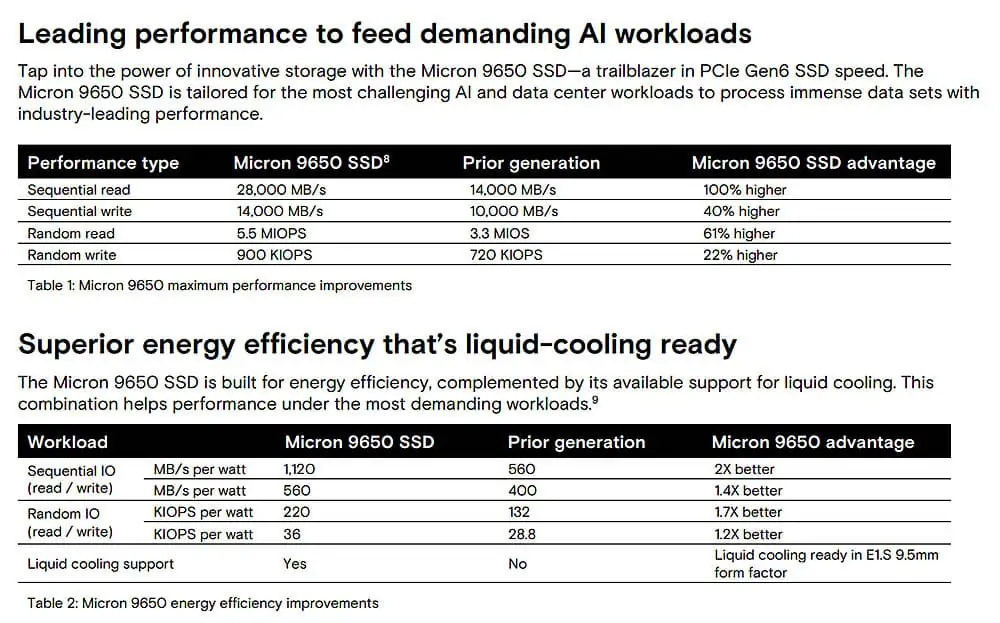
The drive doubles the sequential read speeds of current PCIe 5.0 SSDs, reaching up to 28,000 MB/s for reads and 14,000 MB/s for writes, positioning itself as a game-changer for AI data centers and enterprise deployments.
Built for the AI era
The 9650 series leverages a PCIe Gen6 x4 interface combined with Micron’s proprietary controller and 9th Generation 276-layer 3D TLC NAND. Beyond the raw speed bump, the drive delivers record-breaking random read performance at 5.5 million IOPS and up to 900,000 IOPS for random writes.
These numbers matter significantly for AI workloads, where large language models and retrieval-augmented generation systems need sustained high-throughput access to massive datasets.
Micron Vice President Alvaro Toledo explained that storage has evolved from a secondary concern into a defining factor in overall system performance, particularly as AI infrastructure demands data move continuously and predictably at massive scale.
The 9650 is designed specifically to communicate peer-to-peer with Nvidia’s Blackwell GPUs using retimers and switches from Astera Labs and Broadcom, bypassing CPU intervention entirely.
The drive comes in two variants: the 9650 Pro with capacities of 7.68 TB, 15.36 TB, and 30.72 TB, and the 9650 Max offering 6.4 TB, 12.8 TB, and 25.6 TB. Both are available in data center-focused E1.S and E3.S form factors, with some models supporting both traditional air cooling and liquid cooling systems.
Performance without the power penalty
What’s remarkable is that despite doubling sequential read performance, the 9650 maintains the same 25-watt power envelope as the most demanding PCIe 5.0 enterprise SSDs. Sequential read efficiency hits 1,120 MB/s per watt, roughly double that of Gen5 equivalents, allowing data centers to extract significantly more performance without increasing their energy budgets.
The drive is currently being qualified with key OEMs and AI data center customers, a critical validation step before larger deployments begin ramping up. Micron has spent the past 18 months ensuring interoperability across the emerging PCIe Gen6 ecosystem.
As for consumer availability? Don’t hold your breath. Consumer platforms aren’t expected to adopt PCIe 6.0 until around 2030, and with AI servers consuming NAND flash at an extraordinary rate, enterprise demand will dominate production for years.
The 9650 represents a shift where, for once, the SSDs arrived before motherboards even supported the standard, reversing the usual pattern seen with previous PCIe generations.
So, what’s your take, are we finally hitting the point where storage keeps up with compute demands, or will AI workloads just keep pushing the limits higher? Drop your thoughts below.