



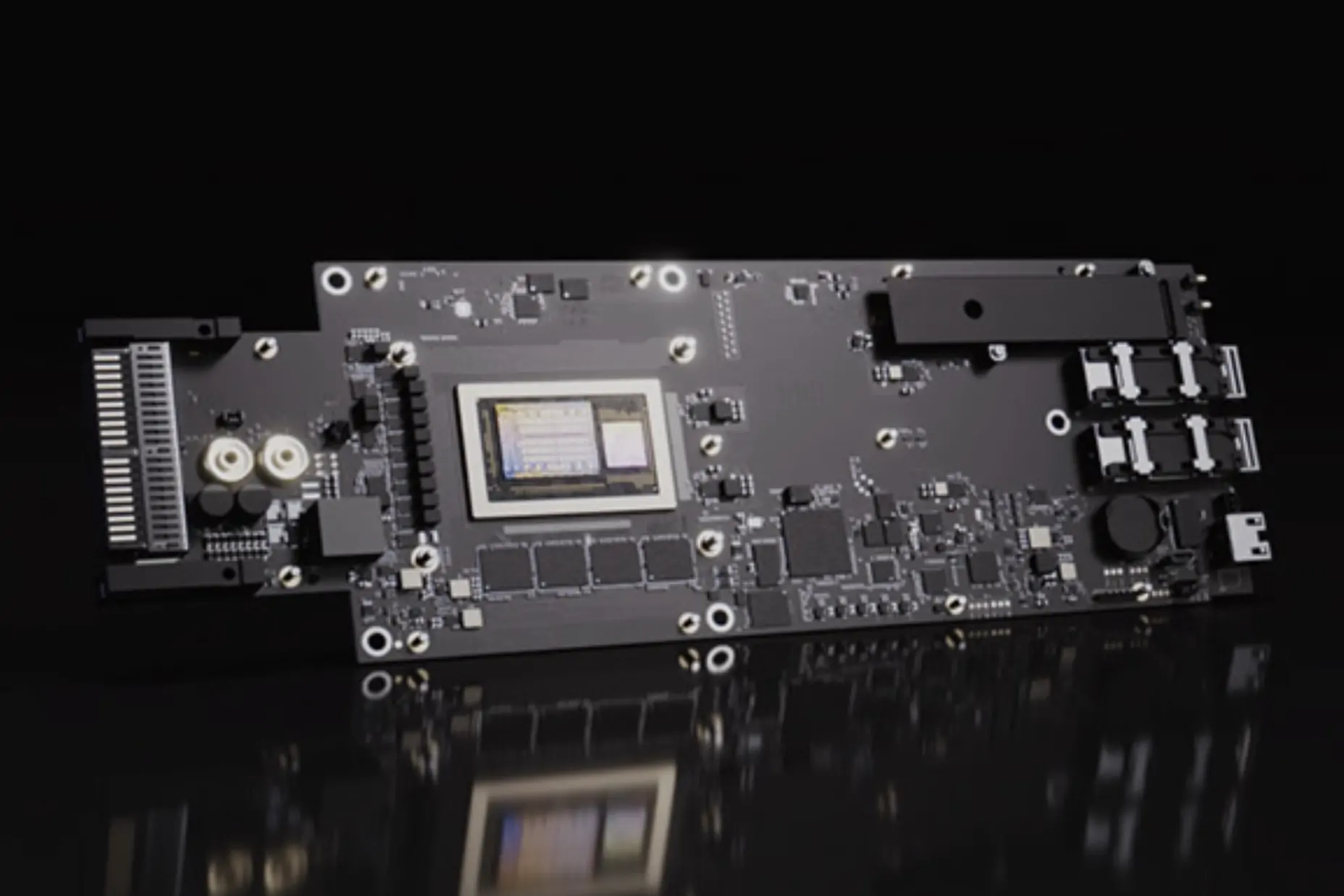
While NVIDIA’s GPUs grab most of the headlines in the AI revolution, the company is quietly building the critical infrastructure that makes massive AI deployments actually work. Enter the BlueField-4, NVIDIA’s latest Data Processing Unit (DPU) that’s set to reshape how AI data centers operate behind the scenes.
Think of it this way: if GPUs are the brains running AI models, the BlueField-4 is the nervous system keeping everything connected, secure, and running smoothly. Rather than crunching AI algorithms directly, this processor handles the unglamorous but essential tasks of networking, storage management, and security across large-scale AI facilities facing unprecedented demands from trillion-token workloads.
Breaking down the performance leap
The BlueField-4 tackles three fundamental infrastructure challenges with impressive specs: it delivers 800 Gb/s throughput, positioning itself as the engine for a new generation of AI storage platforms. NVIDIA’s vision here is clear—process data more efficiently at scale and boost inference performance across the board.
What makes this possible is an ingenious combination: NVIDIA has integrated a Grace CPU core with their brand-new ConnectX-9 networking technology inside the BlueField-4. The results speak for themselves—six times more computational power than its predecessor and the capability to support AI data centers up to four times larger than what the previous BlueField-3 generation could handle.
The supporting cast
NVIDIA didn’t stop at the DPU. They’ve also unveiled the ConnectX-9 SuperNIC, an 800 Gb/s network card built specifically for Spectrum-X Ethernet infrastructure. Its mission is straightforward but critical: deliver ultra-low latency and optimize data movement for the most demanding AI workloads, with enhanced RoCE (RDMA over Converged Ethernet) performance.
On the software side, the NVIDIA DOCA platform ties everything together through containerized microservices that, according to NVIDIA, simplify and secure AI deployment and operations while enabling better scalability. Security gets special attention too—the BlueField-4’s architecture allows service providers to create secure bare-metal instances with robust isolation between different clients, all built on a zero-trust model.
Industry adoption on the horizon
NVIDIA has lined up an impressive roster of industry partners ready to embrace this new generation. Major server and storage manufacturers including Cisco, Dell, HPE, IBM, Lenovo, Supermicro, VAST Data, and WEKA are all planning to integrate BlueField-4 into their upcoming platforms. The cybersecurity sector is on board too, with Palo Alto Networks and Check Point committing to the platform, alongside cloud and AI providers like CoreWeave, Oracle Cloud Infrastructure, and xAI.
As for availability, NVIDIA expects the BlueField-4 to start shipping in early 2026 as part of their future Vera Rubin platforms. While that might seem distant, the groundwork being laid today will define how AI infrastructure scales in the years ahead.