

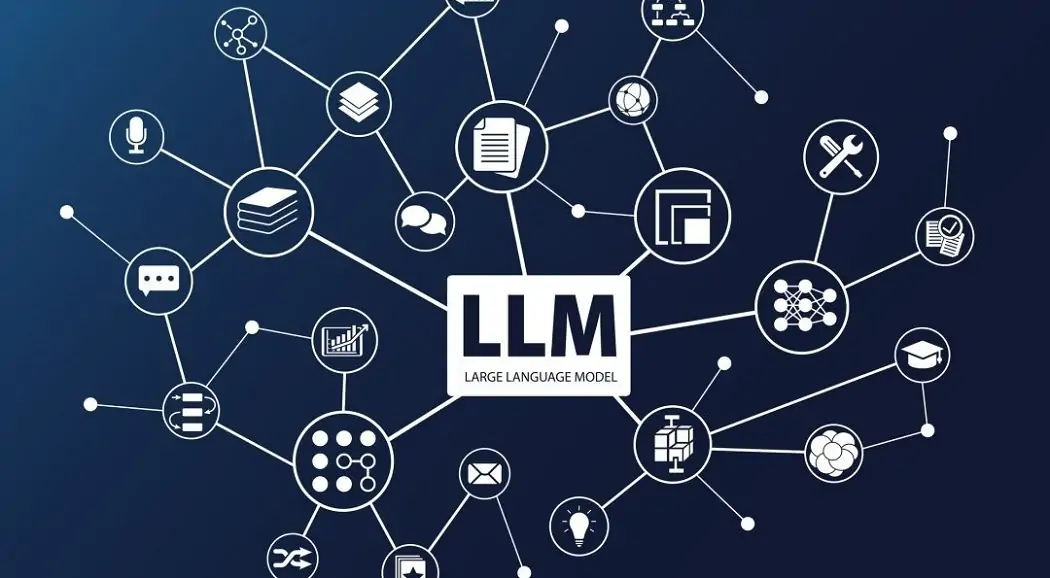

If you’ve typed a question into ChatGPT, Claude, or Gemini recently and gotten back an answer that felt almost human, you’ve already interacted with a Large Language Model, or LLM.
This technology has become the backbone of most of the AI tools flooding our daily lives, and understanding what’s actually happening under the hood makes the whole thing a lot less mysterious.
What an LLM actually is
A Large Language Model is a type of artificial intelligence trained on massive amounts of text: books, websites, articles, forums, code, essentially everything written that its creators could get their hands on. The goal is for the model to learn how human language works and generate it naturally.
Every time a question is asked, the model is doing one thing repeatedly: predicting the most statistically probable next word based on everything it was trained on. That’s the entire mechanism. Text gets broken into chunks called “tokens”, and from there the model guesses, word by word, what comes next.
The word “Large” isn’t just marketing. These models contain hundreds of billions of parameters, the numerical values the model adjusts during training to capture everything it has learned. These parameters act like millions of tiny internal dials, fine-tuned to produce coherent text instead of noise.

An LLM is not a search engine, and it doesn’t store facts in a filing cabinet somewhere. It learns statistical patterns from billions of words and doesn’t store facts as such, but encodes them as weighted connections between parameters. When a question is asked, the model isn’t retrieving an answer, it’s reconstructing one in real time based on absorbed patterns.
The lineage of conversational AI begins with ELIZA, created by Joseph Weizenbaum at MIT in 1966, a rule-based chatbot that used simple pattern matching and substitution rules to simulate conversation. For nearly 45 years, that approach defined the field, with bots limited to narrow, scripted scenarios.
Traditional chatbots operate using predefined conversation flows, pattern matching, or rule-based decision trees, meaning every possible user input had to be anticipated in advance. LLMs broke that constraint by generating responses dynamically based on what the user is actually asking, instead of relying on predefined rules or scripted workflows.
How the training process works
LLMs are built on transformer architecture, and one of its core components is called “self-attention.” This mechanism allows the model to analyze each word in the context of the entire sentence or document, enabling it to understand long-range relationships, such as what a pronoun refers to or how different paragraphs connect.
Before the transformer arrived, RNNs in the 1990s and LSTMs in 1997 were the dominant tools for processing language sequentially, but they struggled with a persistent “forgetting problem” over longer stretches of text. The transformer’s attention mechanism computes relationships across an entire input simultaneously rather than working through it step by step, solving that bottleneck.
During training, the model processes enormous volumes of text and repeatedly tries to predict the next word in a sentence. Wrong guess, adjust the internal parameters. Wrong again, adjust again. This repeats trillions of times across mountains of data until the model internalizes grammar rules, factual associations, reasoning patterns, and even coding conventions. None of this makes the model “conscious,” it simply optimizes its parameters to better predict text.
After this initial phase, known as “pre-training,” most models go through additional fine-tuning. Human reviewers rate the model’s responses for helpfulness and accuracy, and the model adjusts based on that feedback.
This stage often includes reinforcement learning from human feedback, marking the difference between a raw base model and the polished assistant most people interact with. This combination of instruction tuning and reinforcement learning from human feedback is what allowed ChatGPT to launch in November 2022, a moment widely seen as the tipping point that brought LLMs into mainstream use.
Context windows, meaning how much text a model can process in a single conversation, have grown from around 4,000 tokens in early versions of GPT-3.5 to over a million tokens in some 2026 models. That means current systems can read and reason about entire books, lengthy contracts, or massive codebases in a single session.
Running your own LLM at home
Not every LLM lives in the cloud. Running local LLMs means downloading open-weight AI models and running them entirely on a personal laptop or desktop instead of paying per token to a cloud provider. The appeal is straightforward: API costs add up fast, data never leaves the machine, and a one-time GPU investment of $300-$500 can replace the same amount in monthly API bills.
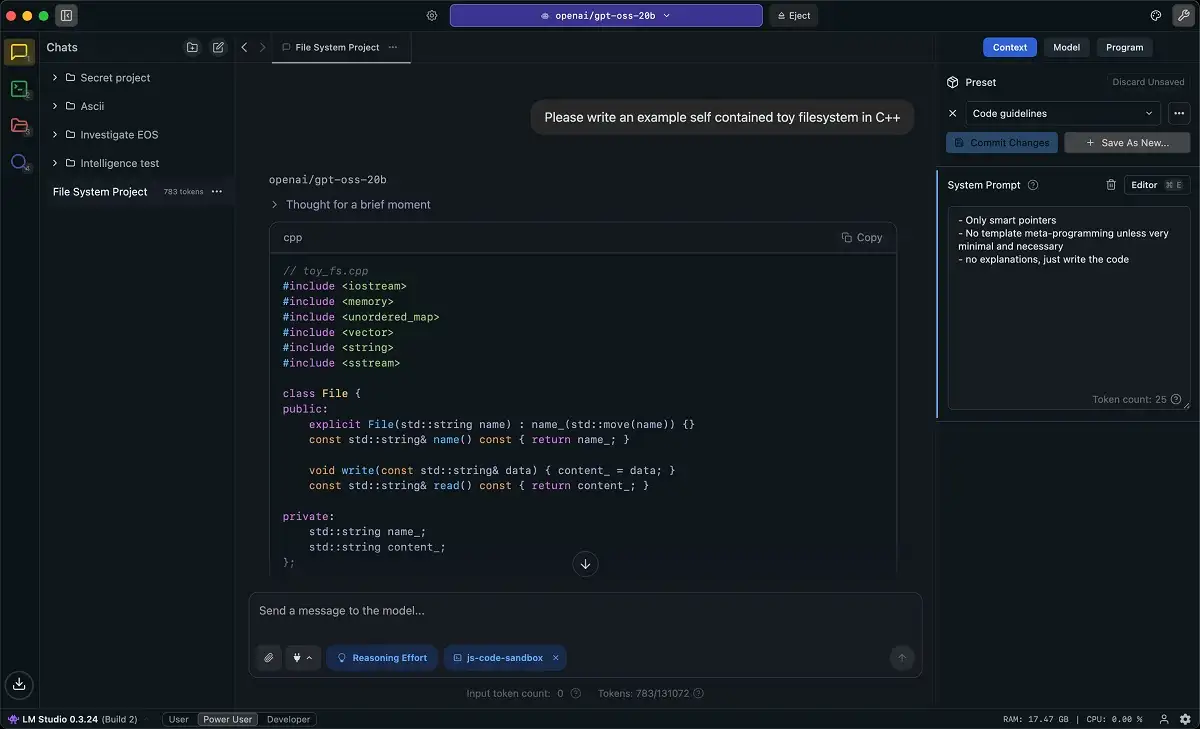
Two tools have made this accessible to non-developers. Ollama offers dead-simple setup with automatic quantization selection and an OpenAI-compatible API that runs as a background service. LM Studio, on the other hand, provides a graphical interface for browsing, downloading, and running local models, making it ideal for non-technical users who want to test different models without touching a terminal.
As of April 2026, the two names dominating local AI conversations are Gemma 4 and Qwen 3.6. Gemma 4 is Google DeepMind’s latest generation of open-weight models, released on April 2, 2026, marking a significant leap from Gemma 3 with a new mixture-of-experts architecture, support for text, image, and audio on smaller models, and a full shift to the Apache 2.0 license. Qwen 3.6, released by Alibaba Cloud on April 11, 2026, ships with open weights under Apache 2.0, native tool-calling, and a 256K context window.
Community consensus from r/LocalLLaMA and X in April settled into a clear pattern: Gemma 4 is considered the king of daily use and general balance, while Qwen 3.6 is seen as the king of serious coding and agentic tasks. For coding agents specifically, Qwen 3.6 wins HumanEval by a wide margin and leads SWE-bench Verified on its A3B mixture-of-experts variant, which translates into actual merged pull requests rather than stalled drafts.
Hardware is the real gatekeeper, and it comes down mostly to memory. A 7B model at 4-bit quantization needs roughly 4-6 GB of VRAM, a 13B model needs 8-10 GB, and a 70B model needs 40-48 GB. The realistic minimum to run a capable local model is 16 GB of system RAM, a modern CPU, and either a GPU with 6+ GB of VRAM or an Apple Silicon Mac.
Both Gemma 4 and Qwen 3.6 are designed as MoE models that achieve fast speeds and high performance on consumer GPUs in the RTX 4090/5090 class or on M4 Macs, while a mid-size variant like Qwen3.6-35B can idle around 14 GB of VRAM and peak near 14.7 GB even at very long context lengths.
Llama, Qwen, and Gemma each have distinct license terms, so it’s worth reviewing the license for the chosen model before using it for anything beyond personal experimentation, though as of these releases, both Gemma 4 and Qwen 3.6 ship under the permissive Apache 2.0 license.
Why it matters, and where it falls short
LLMs are already embedded across most of the technology used daily. Customer service chatbots, increasingly accurate phone autocomplete, tools helping students with homework or developers ship code faster, all run on this same underlying technology.
Modern chatbot software now relies heavily on LLMs instead of rigid rule-based flows, meaning developers no longer need to anticipate every possible conversation path and maintain endless decision trees. This architecture gives LLMs the ability to generate text that researchers across multiple studies have found can be indistinguishable from human-written content in many situations.
But LLMs aren’t infallible. Because they work by predicting the most probable next word rather than verifying facts, they can produce what’s known as a “hallucination,” a confident, plausible-sounding statement that’s actually false. An AI hallucination occurs when a large language model produces output that looks plausible but is factually wrong or unsupported by evidence.
A recent study from the University of Hamburg found that 31.4% of query-response pairs in real-world human-LLM interactions contained hallucinations, a proportion that jumps to 60% in challenging domains like math and number problems.
Part of the explanation lies in how these models are trained and evaluated: benchmarks tend to reward confident answers over cautious, accurate ones, and the models are trained on internet data full of contradictions and misinformation.
Every model also has a knowledge cutoff, a point after which it has no information, and when asked about anything beyond that date, it can fill the gap with plausible-sounding fabrications. Augmenting these models with external knowledge sources is one way developers try to address this limitation, allowing them to act more reliably in real-world scenarios.
There’s no formal hallucination metric for “AI” as a whole, and actual rates vary widely depending on the model, the domain, the language, and the benchmark design. Recent benchmarks evaluating dozens of models found hallucination rates ranging from 15% to 52%, with most models falling between 20% and 27%, a significant gap between the best and worst performers available.
Have you found a real use for any of these AI tools yet? Drop a comment and let us know what you’re using it for.