



GDC 2026 is in full swing, and while most companies are there to talk about game design or new engines, Valve showed up with something that’s been on everyone’s radar since the hardware reveal last November: a detailed breakdown of exactly how games will get verified for the Steam Machine and Steam Frame. No pricing, no release date still, but at least now we know what developers need to hit to land that badge.
If you’ve been following the Steam Deck since launch, this whole verification system will feel familiar. Valve essentially built the same framework, adjusted the dials for different hardware, and applied it to both new devices. Smart move, honestly. Here’s what went down.
Steam Machine Verified: Your Deck library is already ready
The good news for anyone with a solid Steam Deck library? You basically don’t have to do anything extra. All Steam Deck Verified games will automatically carry that status over to the Steam Machine, with the same input expectations and the ability to hold a stable 30 frames per second at 1080p.
That’s a huge deal because it means the Steam Machine launches with a massive compatible library right out of the box, which is exactly the kind of thing that’s made or broken console launches throughout history.
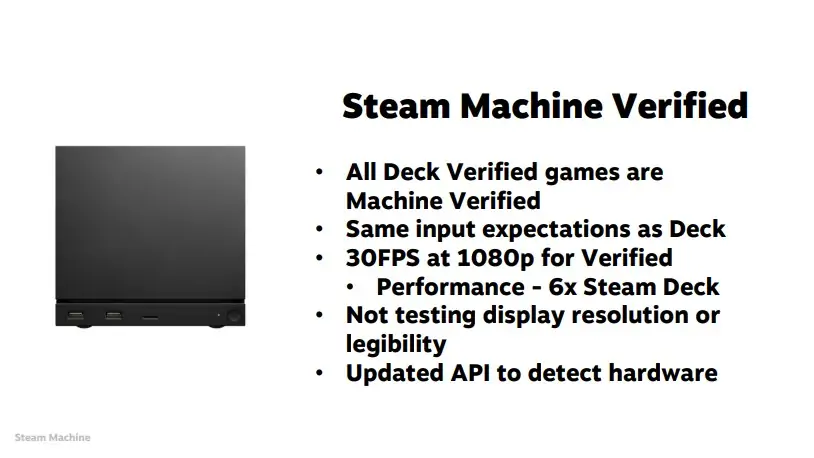
Valve also confirmed it is not planning to test for display resolution or legibility on the Steam Machine, which makes sense when you think about it, this thing is designed for the living room and a big TV, not a 7-inch handheld screen where you’re squinting at tiny menus. The assumption is that whatever works on a large display will be fine, so that whole layer of testing gets skipped entirely.
Now here’s something interesting that GamingOnLinux flagged in their coverage: Valve’s own advertising on the official Steam Machine page says it supports “4K gaming at 60 FPS with FSR,” but for the Verified status they’re only expecting 30 FPS at 1080p. That gap raised some eyebrows in the community, with speculation that Valve might lean on frame generation tech to bridge that difference. Nothing confirmed yet, but it’s worth keeping an eye on.
The verification tiers for the Steam Machine mirror what Deck users already know: Verified, Playable, Unsupported, and Test. Games that aren’t supported on the Steam Deck will also be listed as unsupported on the Steam Machine, while games that are playable on Deck will carry that status over as well. Clean, consistent, no surprises.
Under the hood, the Steam Machine packs a semi-custom AMD Zen 4 processor alongside RDNA 3 graphics, 16 gigabytes of DDR5 system memory and 8 gigabytes of GDDR6 video memory. That’s significantly more muscle than the Deck, which is exactly why the Verified threshold can be set relatively conservatively, the hardware is overkill for most of what’s already been tested and certified.
Steam Frame Verified: A whole different animal
The Steam Frame situation is where things get more interesting, because this is genuinely new territory for Valve. The Steam Frame is described as a “streaming-first” wireless VR headset, but it does offer standalone gaming with its ARM64 Snapdragon 8 Gen 3 chip, running on SteamOS.
The key word there is standalone. The Verified badge only applies to standalone play, streaming from a PC over WiFi doesn’t require any kind of test or verification program. As Valve puts it: “If it runs well on your host PC, it will run well on Steam Frame.” That’s a nice clean separation. If you’re streaming, you’re good. The badge is for when the headset is running on its own.
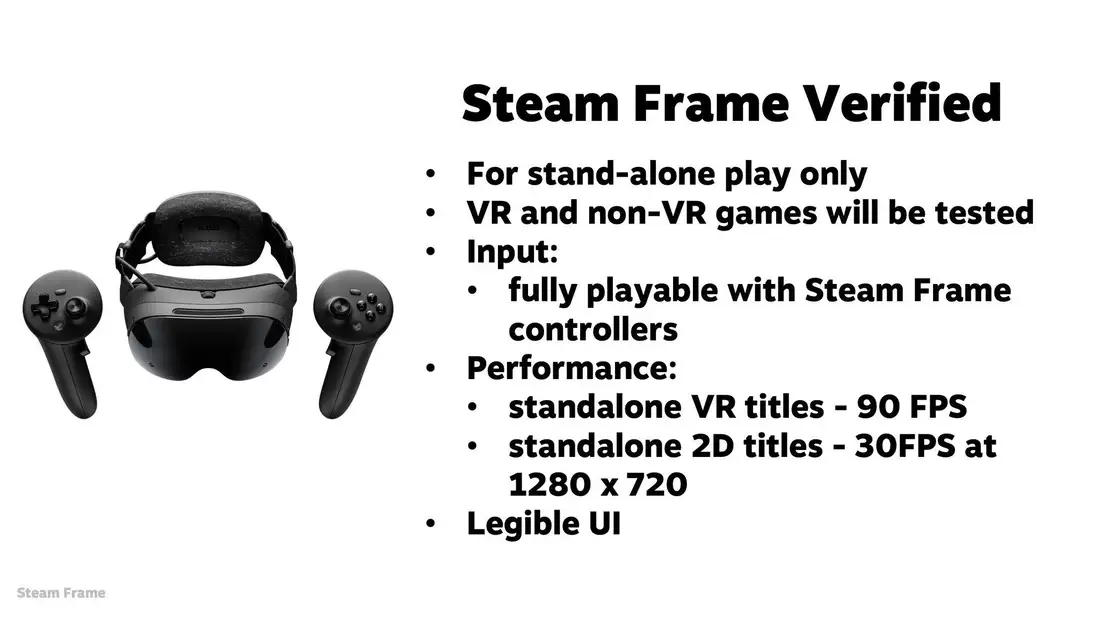
For standalone play, the targets break down like this: VR games need to hit 90 FPS on the Snapdragon chip, while non-VR 2D titles target 30 FPS at 1280×720. The VR bar is notably high, the jump from 72 FPS to 90 FPS represents roughly a 25% increase in rendering workload, meaning developers hoping to port directly from Quest may need to optimize their titles more than expected.
Verified games must also be fully playable with the Steam Frame’s controllers, and the UI has to be legible, which is a reasonable ask for any piece of software you’re literally strapping to your face.
Getting x86 games running on an ARM chip is where the technical side gets a little wild. The Frame includes Proton for Windows games, FEX-Emu for emulating x86 software on ARM, and Lepton, a fork of Waydroid, as an Android-based runtime environment with sideloading support. Developers can also submit native Android builds directly to the Steam store, which opens up an interesting path for studios already working in that ecosystem.
Games that are Verified or Playable on Steam Deck are automatically tested for the Frame Verified badge. Games that aren’t supported on Deck due to performance or lack of SteamOS compatibility won’t be considered for standalone Frame certification. Same logic as the Machine, the Deck library serves as the baseline filter.
Still no pricing, still no date, but things are moving
All of this is great context, but the elephant in the room is still the stuff Valve hasn’t said. Valve acknowledged earlier in February that it cannot yet provide final pricing or release dates for its upcoming hardware products, citing surging demand from the AI industry putting significant pressure on memory and storage supply chains.
There was a brief scare earlier this year when Valve’s Steam Year in Review post said the company “hoped” to ship the hardware in 2026, which sent the community into a spiral. Valve quickly edited the post to definitively state all three products will ship in 2026, with Valve PR representative Kaci Aitchison Boyle confirming to The Verge that nothing had changed internally regarding their timeline.
So the Steam Machine, Steam Frame, and new Steam Controller are still coming this year. The verification frameworks are now public, developers have clear targets to hit, and Valve’s slide deck from GDC is available for anyone who wants to dig into the finer details. The pieces are coming together, we’re just still waiting on the price tag that will determine whether any of this actually lands.
What do you think, does the verification system Valve laid out make sense to you, or do you think the bars are too low, too high, or just right? Drop your take in the comments, we want to hear it!