



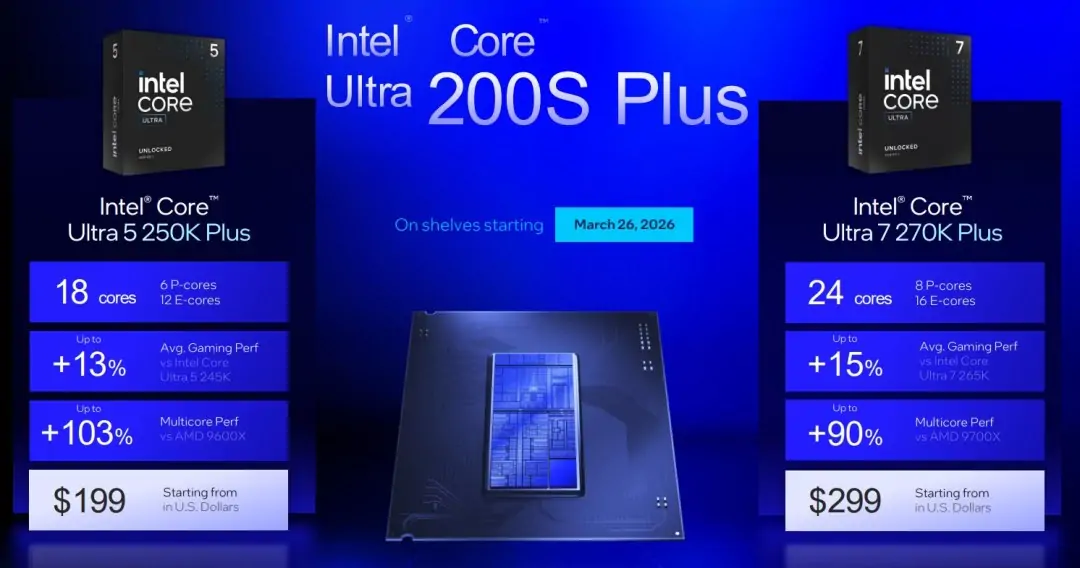
Intel officially announced on March 11 the Core Ultra 7 270K Plus and the Core Ultra 5 250K Plus, two new desktop processors that the company is calling the fastest gaming CPUs it has ever made. Both chips arrive under the Core Ultra 200S Plus banner, internally known as the Arrow Lake Refresh, and are set to hit store shelves on March 26, 2026, with suggested prices of $299 for the 270K Plus and $199 for the 250K Plus.
Those price points aren’t accidental. Intel is going directly after AMD‘s most popular gaming processors at the exact same cost, a strategy that signals a very deliberate shift in how the company wants to compete in the desktop market.
The messaging alone is telling. After spending most of 2024 pushing AI-centric narratives around the original Core Ultra 200S launch, Intel is back to talking about frames per second. Robert Hallock, VP of Intel’s Client Computing Group, described the new chips as “the fastest desktop gaming processors Intel has ever built” and positioned the launch as “the first steps in a new era of enthusiast performance.” Whether the benchmarks hold up to that claim once independent reviews drop on March 26 is another matter, but the intent is clear.
More cores, lower latency and faster memory, what actually changed
The Core Ultra 7 270K Plus arrives with 24 total cores in an 8 performance-core and 16 efficiency-core configuration. The Core Ultra 5 250K Plus comes with 18 cores, split into 6 performance cores and 12 efficiency cores. Compared to their direct predecessors, the 265K and 245K, both chips add four extra efficiency cores each. Peak P-core clock speeds remain unchanged, the 270K Plus tops out at 5.5GHz and the 250K Plus at 5.3GHz, so the raw frequency ceiling isn’t what’s driving the performance story here.
What Intel is actually betting on is a fix to one of Arrow Lake’s most criticized weaknesses since its 2024 debut: memory latency. The die-to-die frequency, the internal communication speed between the CPU cores, cache, and memory controller, has been increased by up to 900MHz compared to the 265K and 245K. Intel says this reduces latency and directly improves gaming performance in CPU-limited scenarios, which was precisely the area where the original Arrow Lake chips struggled most against AMD.
On the memory side, the new processors officially support DDR5-7200, up from the previous DDR5-6400 standard. Intel’s 200S Boost BIOS profiles push that ceiling to DDR5-8000 for overclockers, and the chips also introduce early support for 4-rank CUDIMM modules, with compatible 800-series motherboards eventually supporting up to 128GB per DIMM. For those already on an LGA1851 platform, the new chips drop into existing 800-series motherboards with a UEFI firmware update, no new board required.
Intel is also launching the Binary Optimization Tool alongside the hardware, a software layer that works at the binary level to improve instructions per cycle in select games and applications. The company says it is particularly effective on workloads originally optimized for older x86 architectures or console targets. Full performance metrics for the tool are expected by end of March.
Intel vs. AMD: Same price, very different core counts
The pricing strategy here is the headline. The 270K Plus at $299 goes directly against the AMD Ryzen 7 9700X, which carries a similar price tag. The 250K Plus at $199 lands squarely against the Ryzen 5 9600X at roughly the same cost. Intel is offering 24 cores where AMD offers 8, and 18 cores where AMD offers 6, and that gap shows up dramatically in multithreaded workloads.
Intel claims the 250K Plus delivers up to 103% better multithread performance than the Ryzen 5 9600X, and the 270K Plus up to 92% better than the Ryzen 7 9700X, both tested on Windows 11 25H2.
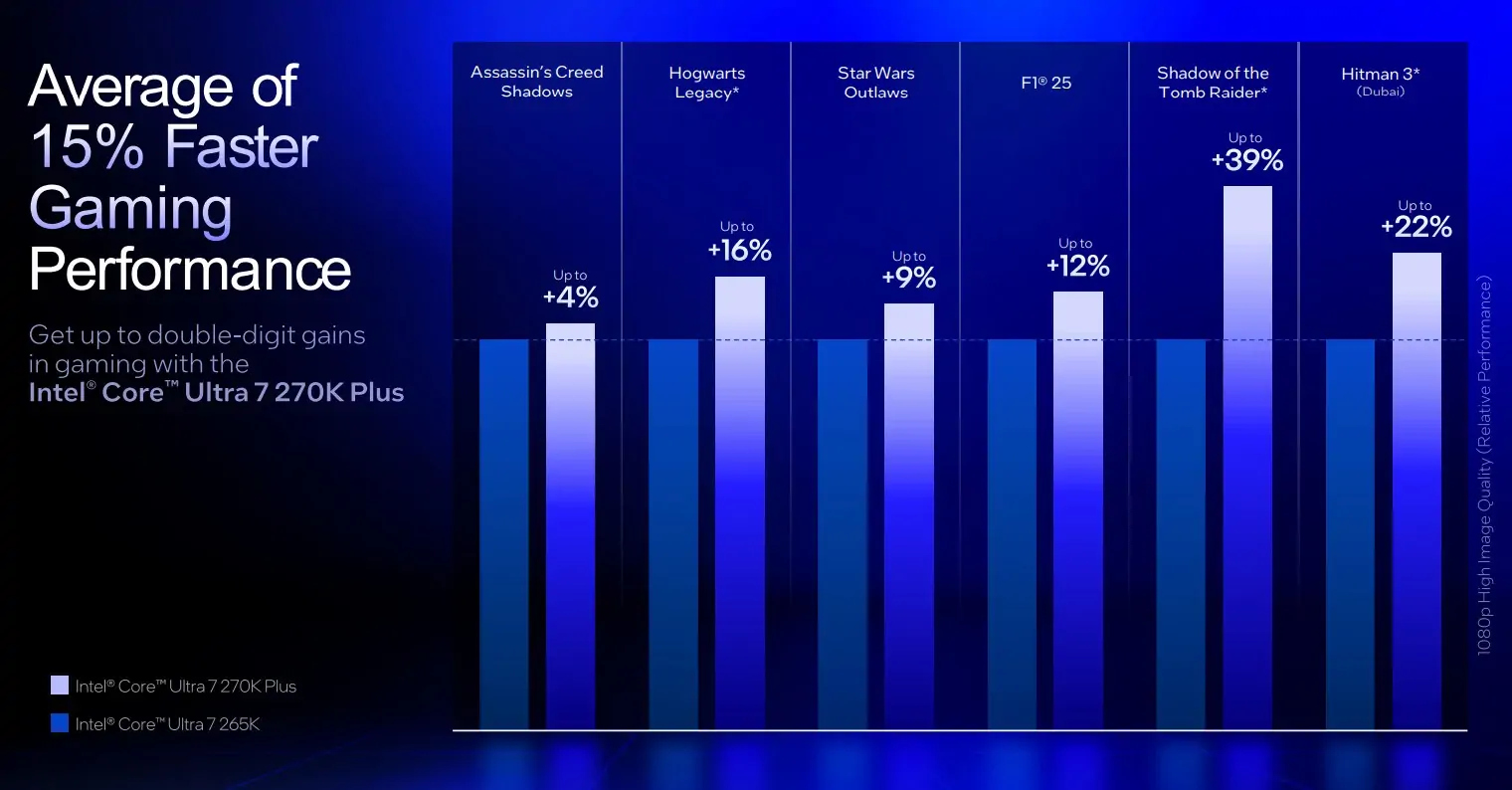
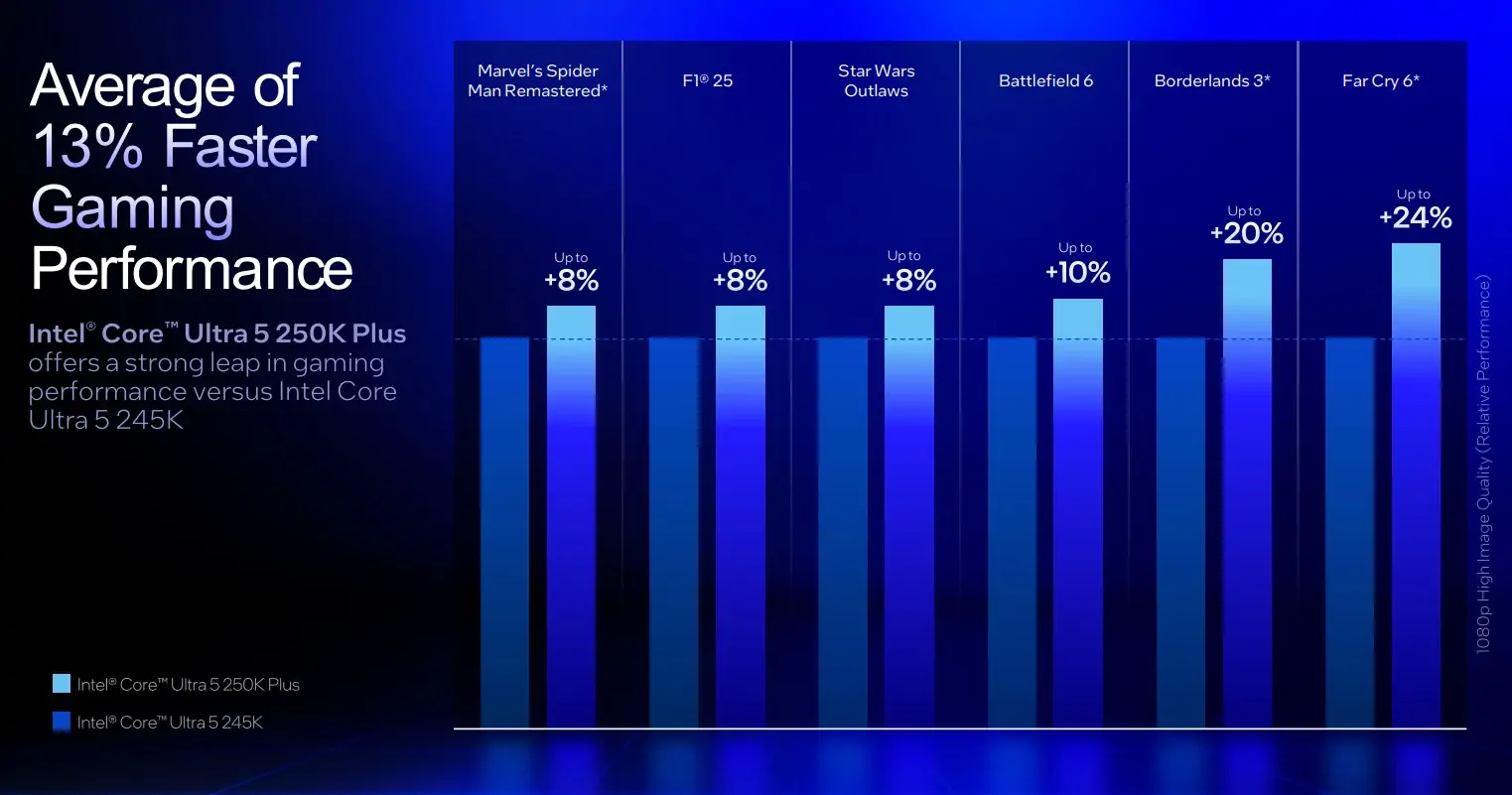
The gaming picture is more nuanced. Intel’s own figures show the 270K Plus running up to 39% faster than its predecessor in Shadow of the Tomb Raider, up to 16% faster in Hogwarts Legacy, and up to 12% faster in F1 25 at 1080p on high settings. The 250K Plus shows up to 24% gains over the 245K in Far Cry 6, 20% in Borderlands 3, and 10% in Battlefield 6.
These are meaningful improvements over the previous generation, but Intel notably avoids direct gaming comparisons against AMD’s Ryzen 9000 chips in its official data, which is a detail worth keeping in mind when reading the benchmarks. AMD’s X3D lineup, headlined by the Ryzen 7 9800X3D, remains the gaming performance king and neither of these chips is positioned to challenge it for raw frame rates.
What the 270K Plus does do is make Intel’s own lineup look interesting again. At $299, it delivers the same 24-core configuration that was previously exclusive to the Core Ultra 9 285K, which launched at $589 and still retails around $549. The 285K gets only 200MHz more on the P-core boost clock, that’s it.
The gap between the two in real-world gaming and productivity is going to be almost impossible to justify once reviews start comparing them side by side. There was also talk of a Core Ultra 9 290K Plus joining this refresh, but Intel officially confirmed it was canceled, leaving the 270K Plus as the top of the Plus stack.
For PC builders weighing their options right now, the value proposition is straightforward on paper: more cores and a fixed latency problem at the same price as the chips being replaced. Whether Intel’s internal benchmarks translate into genuine gains across a wider range of games is what the next two weeks of independent testing will reveal.
So, are you team Intel or team AMD for your next build? Tell us in the comments, this CPU war is heating up and we want your take!