



The dream of every alchemist just became reality at CERN, and honestly, Edward Elric would be losing his mind right now.
Scientists working at the Large Hadron Collider weren’t trying to transmute anything, they were literally recreating conditions from moments after the Big Bang, but ended up turning lead into gold anyway. Yeah, you read that right. Modern alchemy is real, and it happened by accident.
The ALICE collaboration at CERN published their findings in Physical Review C back in May 2025, but the buzz around this accidental transmutation reignited in January 2026 when the world collectively realized we’ve been living in a Full Metal Alchemist timeline this whole time.
The scientists were smashing lead nuclei into each other at nearly the speed of light, pushing them to 99.9999991% light speed to mimic the extreme conditions of the early universe. Their goal? Study quark-gluon plasma, that wild state of matter that existed microseconds after the Big Bang. Gold production was absolutely not on the agenda.
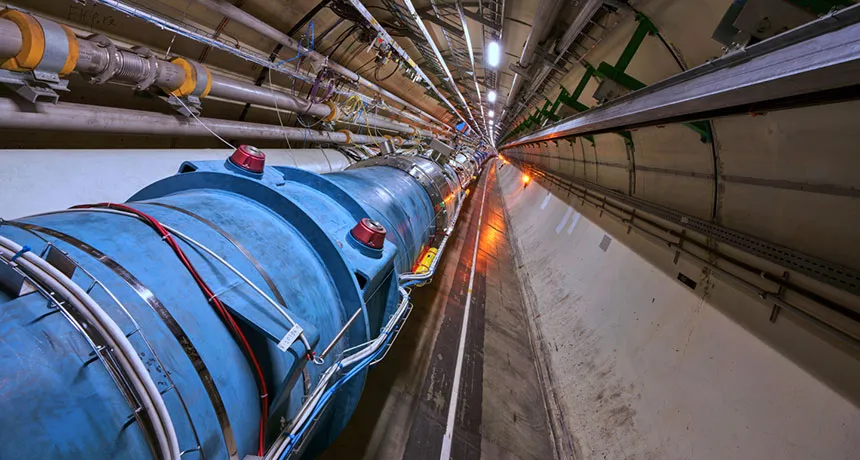
When near-misses make precious metals
Here’s where it gets fascinating. Most people assume particle collisions mean atoms crashing head-on like a cosmic demolition derby, but the reality is way more interesting. In most cases at the LHC, lead nuclei just barely graze past each other in what physicists call “ultraperipheral collisions.”
When this happens, the electromagnetic fields between the nuclei become so insanely intense, about a million times stronger than lightning—that they can literally rip protons out of the lead atoms.
Lead has 82 protons. Gold has 79. Do the math. When exactly three protons get knocked out during these near-miss encounters, boom, you’ve got gold. The ALICE team used specialized zero degree calorimeters to detect this process, and they calculated that between 2015 and 2018 alone, the LHC produced around 86 billion gold nuclei.
Run 3, which is still ongoing, has nearly doubled that number. Before you start planning your heist, though, we need to talk about scale.
The law of equivalent exchange hits different
If you’re a Full Metal Alchemist fan, you know the cardinal rule: equivalent exchange. To obtain something, something of equal value must be lost.

In the anime, the Elric brothers learned this the hard way when human transmutation went horribly wrong. Turns out, real-world alchemy follows a similarly brutal logic, just with different costs.
All that gold the LHC produced? It totals about 29 trillionths of a gram from Run 2, with maybe 60 picograms total when you include Run 3 data. That’s trillions of times less than what you’d need for a single wedding ring.
At the current rate of 89,000 gold nuclei per second, it would take literally billions of years to produce just one gram. Plus, the gold only exists for about one microsecond before the unstable nuclei smash into the collider walls or decay into other particles. So yeah, no philosopher’s stone here.
Professor Ulrik Egede from Monash University put it perfectly when he noted that for scientists, this gold production is actually kind of annoying. Every time lead transforms into gold or other elements like thallium and mercury, those nuclei fall out of their perfect orbit and crash into the beam pipe walls.
This makes the particle beams less intense over time, which is actually a major headache for experiments. It’s like trying to run a precision experiment while your equipment keeps accidentally making gold. First world problems, scientific edition.
More than just a cool physics flex
Before you write this off as a cool but useless party trick, here’s the thing: understanding electromagnetic dissociation, the process that creates this accidental gold, is crucial for making the LHC and future colliders work better.
These experiments help physicists understand how particle beams behave, predict beam losses, and improve overall efficiency. John Jowett from the ALICE collaboration emphasized that these results test and improve theoretical models that are essential for controlling beam quality and stability.
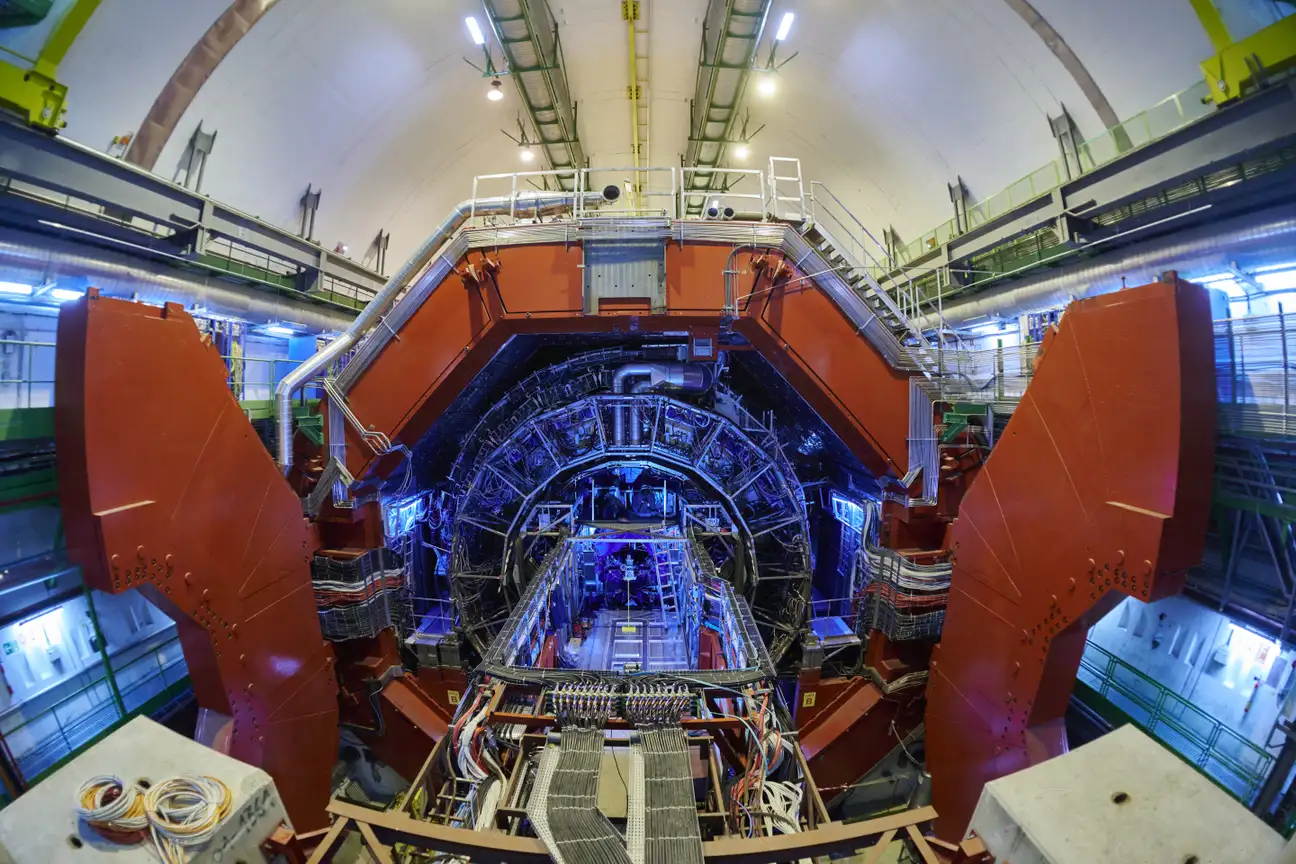
The ALICE experiment involves nearly 2,000 scientists from 174 physics institutes across 40 countries, all working together to probe the universe’s earliest moments. Their ability to detect both massive head-on collisions producing thousands of particles and these subtle near-miss events producing just a few is genuinely impressive. It’s like having a detector sensitive enough to hear a whisper in the middle of a concert.
While medieval alchemists spent centuries trying to turn lead into gold through chemistry, which we now know is impossible because you can’t change an element’s proton count with chemical reactions, modern physics found a way.
It just requires a multi-billion-dollar particle accelerator, electromagnetic fields millions of times stronger than lightning, and speeds approaching light itself. The equivalent exchange here isn’t a human soul or a limb, it’s just an absurd amount of energy and technological infrastructure. Edward and Alphonse would probably argue that’s a better deal.
So no, we’re not about to crash the gold market or solve the world’s economic problems with particle physics. But we are learning fundamental truths about how matter behaves under extreme conditions, how elements can transform at the subatomic level, and how the universe worked in its first moments. That’s way cooler than a gold rush anyway.
Stay connected with Geek Realm Hub for more mind-blowing science stories where reality meets anime! Follow us on Facebook and let’s geek out together over the crazy stuff happening in our universe.