



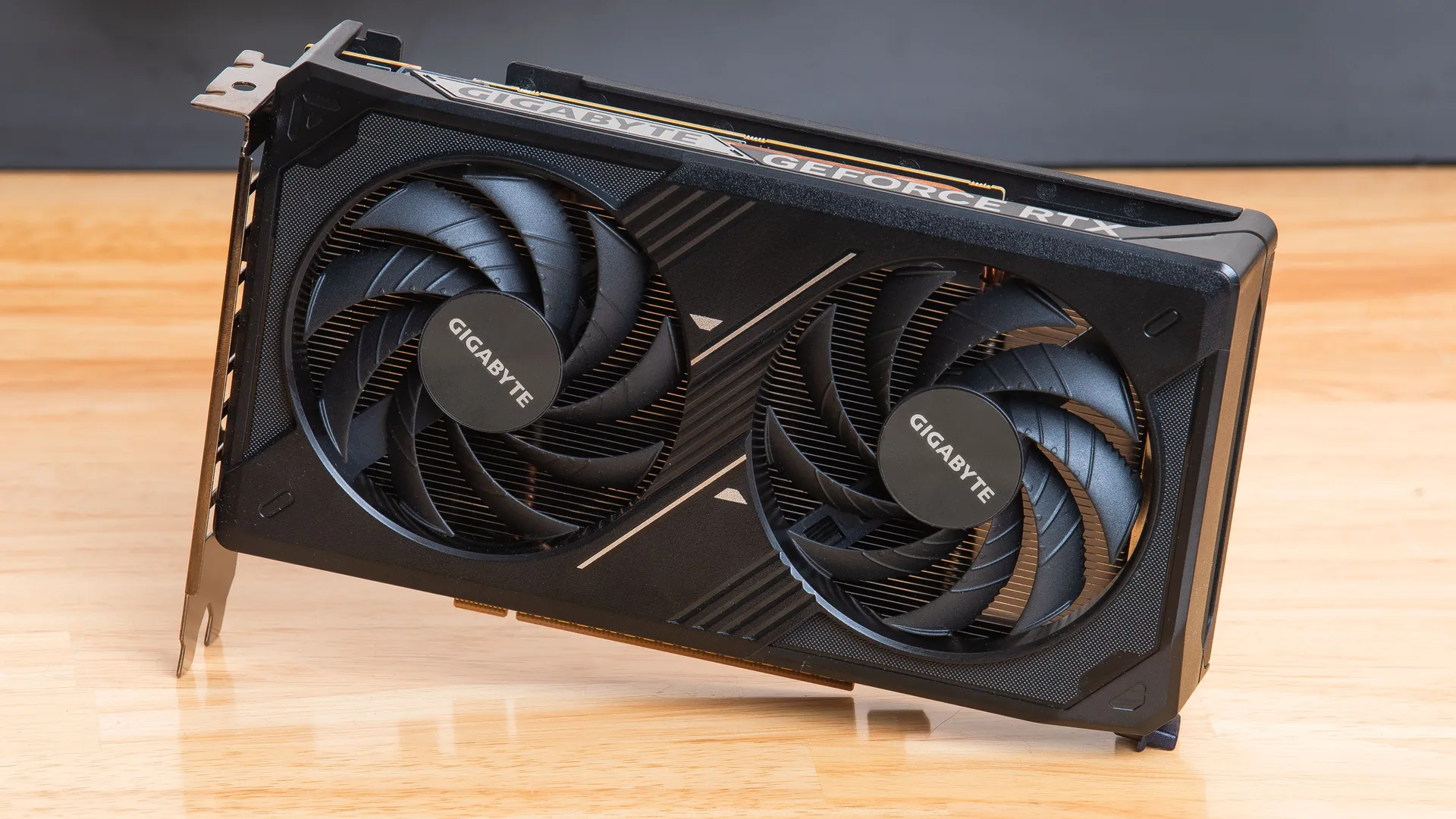
Less than a year after Nvidia quietly launched the RTX 5050 as the entry-level card of its Blackwell lineup, the company is apparently already preparing a revised version, and the timing is no coincidence. According to hardware leaker MEGAsizeGPU, Nvidia is working on an RTX 5050 with 9GB of GDDR7 memory, and Taiwanese outlet Benchlife has since corroborated the report and pointed to a launch window around Computex 2026, which runs from June 2 to June 5 in Taipei.
Meanwhile, on the other end of the spectrum, the RTX 5000 Super series that enthusiasts have been waiting on for months continues to exist purely in the realm of rumors and delays, with zero official acknowledgment from Nvidia anywhere in sight.
Two very different stories, one about a modest budget GPU refresh, and another about a mid-cycle upgrade that keeps slipping further away, that together paint a pretty clear picture of where the GPU market stands right now.
An extra Gigabyte, a new memory type, and a narrower bus
The original RTX 5050 launched in July 2025 with 8GB of GDDR6 memory on a 128-bit bus running at 20 Gbps, making it the only card in the entire Blackwell lineup to use GDDR6. Every other RTX 50-series GPU runs on the faster GDDR7. That distinction is apparently about to disappear, but not in the way anyone would have expected.
According to MEGAsizeGPU, the new RTX 5050 will use three 3GB GDDR7 modules running at 28 Gbps, landing the card at 9GB of total VRAM across a 96-bit memory bus. That narrower bus is a 25% downgrade compared to the current 128-bit configuration, and it’s the reason this card lands at 9GB instead of 12GB.
Had Nvidia used its full memory bus with those same 3GB modules, the card would have come out with 12GB. The leaker wasn’t shy about pointing that out, noting on X that Nvidia “knows they can give you a 5050/5060 128-bit 12G with the new 3G GDDR7 dies”, but instead, gamers are getting the 9GB version, complete with a skull emoji.
Despite the narrower bus, the math actually works in favor of the upgrade. The faster GDDR7 modules push bandwidth from 320 GB/s to approximately 336 GB/s, roughly a 5% improvement over the current model. The rest of the card stays unchanged: same GB207 die, same 2,560 CUDA cores, same 130W TDP. This is purely a memory configuration change driven by supply constraints, not a performance redesign.
The reason Nvidia is making this move is straightforward: GDDR6 is becoming harder to source. Benchlife confirmed that supply and demand issues around GDDR6 are what’s pushing Nvidia toward this 9GB GDDR7 configuration rather than simply keeping the existing setup. It’s a classic supply-chain workaround dressed up as a refresh.
One thing worth keeping in mind is that the RTX 5050 has never been a traditional retail card. It launched primarily targeting OEM builders and system integrators, and Nvidia didn’t send review samples to the press for either the RTX 5050 8GB or the RTX 5060 8GB. A full media launch for the 9GB model seems unlikely to follow a different script. Availability might trickle into retail channels, but don’t expect a big press event or Day 1 benchmarks flooding the web.
Pricing also remains a question. The original RTX 5050 launched at a $249 MSRP, but it’s currently sitting around $299 on Nvidia’s own storefront, and that’s before any changes in memory cost get baked in. With GDDR7 supply tight across the board, it would not be surprising to see this refresh come in at a higher price point than its predecessor.
The RTX 5000 super keeps getting pushed further away
Back when the RTX 50 series was first announced in early 2025, the rumor mill was already spinning about a Super refresh. The plan sounded solid: new 3GB GDDR7 modules would allow Nvidia to significantly bump VRAM across the lineup, with the RTX 5070 Super jumping from 12GB to 18GB, and both the RTX 5070 Ti Super and RTX 5080 Super going from 16GB to 24GB.
It was the kind of mid-cycle upgrade that Nvidia had pulled off before with the RTX 4000 Super series, and there was every reason to expect the same playbook this time around.
Then the AI memory crisis hit and turned those plans upside down. The 3GB GDDR7 modules that were supposed to define the Super lineup became incredibly scarce, with manufacturers prioritizing production for AI accelerators and compute cards over consumer GPUs. Rumors of cancellation started circulating in November 2025, though multiple sources, including MEGAsizeGPU, HKEPC, and Benchlife, pushed back and insisted the cards were merely delayed to Q3 2026, not killed outright.
That optimism didn’t last. Nvidia arrived at CES 2026 in January and made zero mention of any Super cards, with the company’s own GeForce account explicitly confirming ahead of the show that no new GPUs would be announced. According to sources from Asian graphics card manufacturers cited by HWCooling, Nvidia has since halted preparations for the Super refresh entirely. Board partners were informed the models are no longer part of current plans for the foreseeable future.
Making things worse, there’s a timing problem that’s nearly impossible to get around. For a Super refresh to make sense, it needs to hit shelves at least six to nine months before the RTX 6000 series, and a release after mid-November 2026 would miss the holiday season completely. That window is closing fast. AMD’s absence from the 2026 consumer GPU race also removes the competitive pressure that would normally push Nvidia to release new hardware sooner rather than later.
Benchlife summed it up bluntly: based on what board partners have told them, the probability of the RTX 5000 Super making any kind of appearance at Computex 2026 is close to zero. The 3GB GDDR7 modules that were supposed to fuel the Super lineup are, ironically, now trickling into the cheapest card in the RTX 50 family instead.
For budget shoppers, the RTX 5050 9GB might be a marginally better card when it arrives, and for 1080p gaming, which is the only thing this GPU was ever designed to handle well, the extra gigabyte could extend its useful life a little. For everyone else, the GPU market in 2026 is shaping up to be a very quiet year.
What do you think, is a 9GB RTX 5050 even worth your attention, or are you just frustrated that the Super series seems to be going nowhere? Let us know below!