



An analysis published by Boiling Steam on October 26, 2025, based on community data from ProtonDB, placed Windows-to-Linux game compatibility at 89.7%, the highest figure recorded at the time. The study confirmed that the share of games refusing to launch at all had dropped to a historic low, coming close to just 10% that month, exactly the origin of the “nearly 90% compatible” headline.
Boiling Steam noted that the combined share of Platinum and Gold ratings, meaning games that run perfectly or need only minor adjustments, remained consistently high, although the pace of improvement in those two categories cooled somewhat compared to what was observed in 2022 and 2023, likely because that earlier period was driven by the initial push to get everything ready for Steam Deck. Proton, Valve’s compatibility layer built on Wine, continues to erase the technical excuses studios once cited for skipping Linux support.
Steam’s own hardware survey backs the trend
Valve’s Steam Hardware Survey confirmed the phenomenon with its own numbers. In March 2026, Linux reached 5.3% of Steam’s user base for the first time in the survey’s history, while Windows usage dropped below 93% for the first time as well. That jump represented more than double the share recorded six months earlier, and it marked the largest single-period increase Linux has ever recorded in the survey.
The figure did not hold without fluctuation: Linux fell to 4.52% in April and settled around 3.99% in May, mainly due to a worldwide Steam Deck stock shortage. That shortage carries real weight given how much of Linux’s Steam presence still traces back to a single device: Valve has sold an estimated 4.95 million Steam Decks by mid-2026, capturing roughly 48% of the tracked handheld gaming PC market. When that supply chain hiccups, the entire Linux share on Steam visibly wobbles with it.
Even so, the underlying trend remains upward, and it is no longer just a Steam Deck story. SteamOS Holo accounts for around a quarter of all Linux installations on Steam, but standard desktop distributions are carving out real space too, with Arch Linux and Linux Mint each holding meaningful single-digit shares of the Linux user base. That spread suggests the growth isn’t confined to handheld owners who happen to be running Linux without necessarily choosing it; a real slice of it comes from desktop users actively picking a distro.
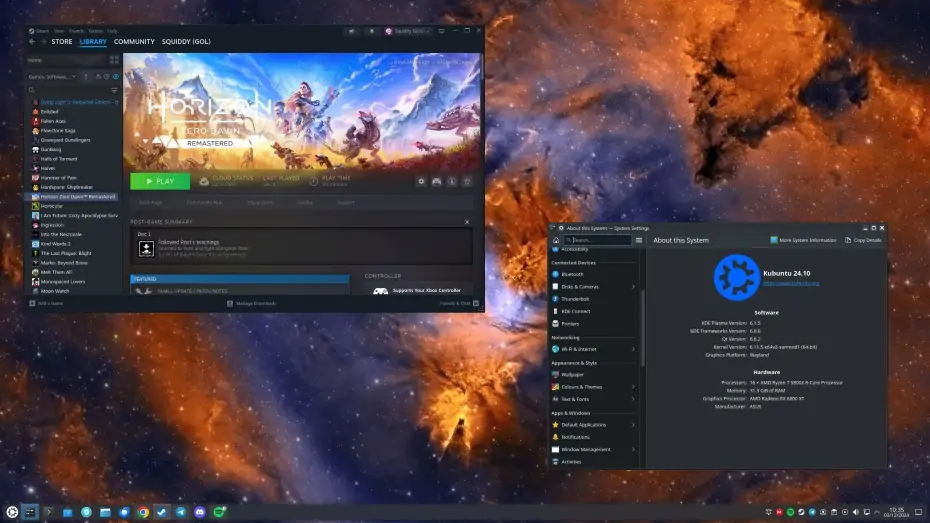
The hardware profile of that user base looks distinct from the rest of Steam, too. AMD processors power roughly 70% of Linux gaming systems, compared to about 39% of the general Steam population, a gap largely explained by AMD’s open-source driver commitment and the custom AMD silicon inside the Steam Deck itself. Linux gamers also trend toward heavier RAM configurations, with 32GB setups nearly twice as common among them as among the broader Steam base.
On March 22, 2026, Steam also logged a new all-time record of 42,318,602 concurrent users, confirming that even a 5% share translates, in absolute terms, into millions of real players.
The catalog backs up the numbers: around 106,000 of Steam’s roughly 117,881 games now run through Proton, up from about 9,000 native Linux titles a few years ago, a 12-fold jump, and Valve has certified nearly 21,700 games as Deck Verified.
Bazzite outpaces Windows in direct testing
A widely shared comparison by YouTuber Cyber Dopamine put this to the test on the ASUS ROG Xbox Ally X, Microsoft’s premium Windows-based handheld, pitting its factory Windows 11 install against Bazzite, a Fedora-based Linux distribution built to mirror the SteamOS experience.
In Kingdom Come: Deliverance 2 at 17W, Windows averaged 47 FPS while Bazzite reached a consistent 62 FPS, and in Hogwarts Legacy at the same wattage, the jump went from 50 FPS on Windows to 62 FPS on Bazzite. At higher, plugged-in power levels, the gap narrowed: Hogwarts Legacy went from 60 FPS on Windows to 65 FPS on Bazzite at 35W.
At the lowest power setting, 13W, the pattern flipped slightly for Hogwarts Legacy, where Windows edged ahead by a single frame (38 versus 37 FPS), though Kingdom Come: Deliverance 2 still favored Bazzite even at that wattage (37 versus 35 FPS). Windows also showed erratic frame-rate swings during testing, while Bazzite remained noticeably more stable.
The phenomenon is not new. Back in December 2023, a comparison by German outlet ComputerBase had already found that Arch Linux, Pop!_OS, and Nobara Linux all outperformed Windows 11 across a batch of Windows-native games run through Proton, with Nobara Linux leading the pack and Windows finishing last in that round of testing. It is not a universal rule, translation overhead carries a real cost, and demanding DirectX 12 titles still tend to favor Windows, but it confirms that the assumption that “Linux always performs worse” stopped being true a while ago.
Valve’s SteamOS 3.8 update, which reached stable release in June 2026, is part of that push. The system reduced handheld controller input latency from 5-8 milliseconds down to just 100-500 microseconds, while also expanding support to competing handhelds such as the Lenovo Legion Go 2 and the ROG Xbox Ally line.
None of this is happening in a vacuum. The handheld gaming PC market alone was valued at $4.6 billion in 2024 and is projected to reach $11.3 billion by 2035, which helps explain why manufacturers keep pouring engineering resources into squeezing extra performance out of the same silicon through software.
What still holds back the remaining 10%
The main obstacle remains the same: kernel-level anti-cheat systems. On Linux, Easy Anti-Cheat operates entirely in user space, through Wine or Proton, without using any kernel driver, which gives it more limited detection capabilities than on Windows.
The picture is the same across the industry: both Easy Anti-Cheat and BattlEye offer Linux support, but only in user-mode, with no kernel-level option, something many competitive shooter studios still aren’t willing to accept. The decision comes down more to licensing negotiations between studios and anti-cheat developers than to any real technical limitation. In fact, once a studio approves Steam Deck compatibility, the desktop Linux version typically works immediately, confirming the underlying code was already unified.
Valve, meanwhile, is backing this momentum with new hardware, and part of that rollout is already underway. The Steam Machine, Valve’s compact PC built for the living room, began reaching buyers on June 29, 2026 through a randomized reservation system, priced at $1,049 for the 512GB model and $1,349 for a 2TB version. Valve has described the console as roughly six times more powerful than the Steam Deck, built to play the entire Steam library, AAA titles included, the moment a user signs in, running on custom AMD silicon paired with SteamOS, the same foundation that already carries the compatibility work Proton has built over the years.
The Steam Frame VR headset, announced alongside the Machine back in November 2025, has not been as fortunate. As of early August 2026, it still has no confirmed price and no firm shipping date, even though Valve cleared its final US regulatory hurdle on July 29, receiving FCC equipment authorization for commercial sale.
Analyst estimates and early retailer listings cluster the expected price for the base 256GB model between roughly $899 and $1,199, though nothing is official. The ongoing global memory shortage, the same one that pushed the Steam Machine to a higher price than Valve originally wanted, is the most likely reason the Frame’s numbers still aren’t locked down.
A broader shift inside the Windows ecosystem
Part of what makes the March 2026 numbers notable is what was happening on the Windows side at the same time. Windows 10 usage among Steam users dropped sharply that month, while Windows 11 gained only modestly in the same period, which suggests that at least some of that movement wasn’t gamers simply upgrading within Microsoft’s own ecosystem. A portion of that churn appears to be genuine exploration of alternatives, and Linux, still a small player overall, is one of the platforms picking up some of that traffic.
That context matters for reading the headline number correctly. Linux gaming isn’t overtaking Windows, and for the most demanding ray-traced, kernel-anti-cheat-locked AAA titles, Windows remains the safer bet by a wide margin. But the fact that Valve has already shipped one piece of new SteamOS-powered hardware and is closing in on a second, right as Linux hits record highs in its own survey and Windows shows real cracks in its own transition between versions, confirms where the company sees this heading.
Would you make the jump to Linux for your next gaming setup, or is Windows still non-negotiable for you? Let us know, we’re really curious!