


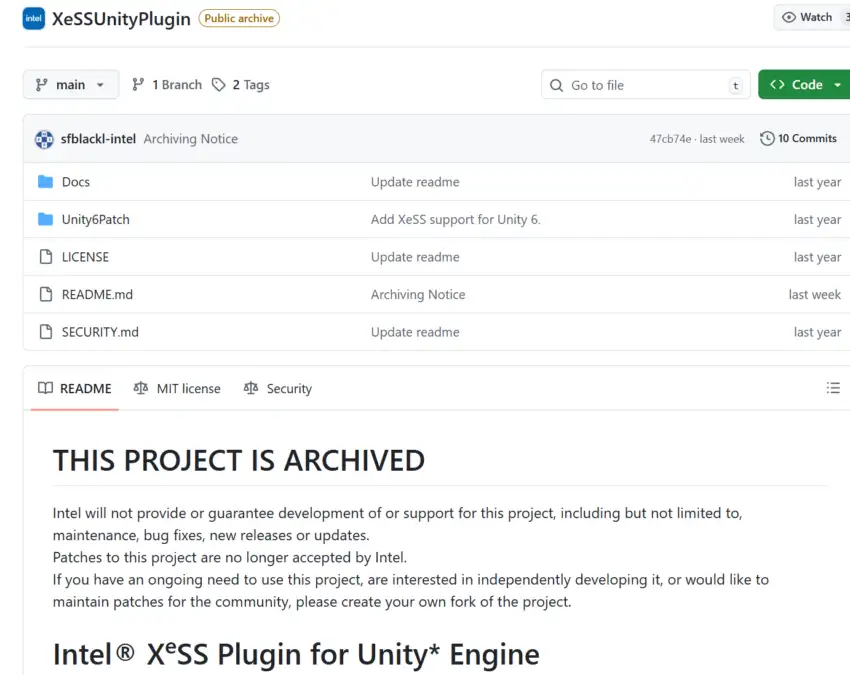
If you’re a game developer using Intel’s XeSS upscaling plugin for Unity, here’s something you need to know: Intel has officially ended all support for it. The GitHub repository was archived on March 30 and Intel made very clear what that means, no more development, no bug fixes, no new releases, no updates, and no patch acceptance going forward. The plugin is frozen exactly as it is, and Intel won’t touch it again.
The last version released was v2.0.5, published on March 26, 2025. That’s the final snapshot of the project. Interestingly, even with the archival notice attached, the repo still contains Unity 6 patch files and HDRP integration instructions, materials that hint at a future that was never fully developed. For Unity developers, that codebase is now theirs to manage alone, or fork if they choose to go that route.
What’s XeSS and why did it matter for Unity developers?
For those who aren’t deep in the graphics tech world, XeSS stands for Xe Super Sampling, and it’s Intel’s answer to NVIDIA’s DLSS and AMD’s FSR. It’s an AI-powered upscaling technology that allows games to render at a lower resolution internally and then reconstruct a sharper, higher-quality image in real time, the result being better frame rates without a significant drop in visual quality.
The Unity plugin made it straightforward for developers to integrate this technology directly into their projects. It supported the HDRP and SRP render pipelines, and was compatible with DX12, Vulkan, and DX11 graphics APIs. For smaller studios and indie developers working in Unity, a very large portion of the game development community, having a ready-made, officially supported plugin from Intel was a real advantage. It removed a lot of the heavy lifting involved in implementing upscaling pipelines from scratch.
With the plugin now abandoned, any studio that has already shipped a game with XeSS integrated is on its own if something breaks in a future Unity update. And developers who were in the middle of integrating it will have to decide whether to commit to a frozen codebase or reconsider their approach entirely.
Intel is going all in on Unreal Engine
The archival of the Unity plugin isn’t just a discontinuation, it’s a signal of where Intel is directing its resources. While Unity gets left behind, the Unreal Engine side of XeSS is actively moving forward. Intel’s Unreal Engine plugin recently received a v3.0.1 update with full XeSS SDK 3.0.0 support and compatibility with Unreal Engine 5.7.
The main XeSS SDK itself has also been updated to support XeSS 3, which now includes three components: XeSS Super Resolution (XeSS-SR), XeSS Frame Generation (XeSS-FG), and Xe Low Latency (XeLL).
So Intel isn’t stepping back from XeSS as a technology, far from it. It’s simply choosing to concentrate its developer support where it sees the most impact, and that’s clearly Unreal Engine. From a business perspective, that makes sense.
Unreal powers the most graphically demanding AAA titles, which are exactly the games where a technology like XeSS gets showcased, benchmarked, and talked about. That’s where Intel can make the biggest case for XeSS adoption.
The problem, of course, is that this leaves Unity developers in an awkward spot. Unity is home to a massive number of developers, including many indie studios and mid-sized teams, who don’t have the resources to build custom upscaling solutions from scratch or migrate to a different engine.
AMD did the same thing, and nobody noticed
Here’s something worth putting on the table: Intel isn’t the first to do this. AMD took the exact same path with its own FSR technology. The AMD FSR Unity plugin has been sitting untouched for five years, still referencing FSR 2, while AMD’s active development focus has shifted entirely to its Unreal Engine 5 plugin, which already supports FSR 4.
If you look at AMD’s latest FSR SDK today, the Unreal Engine 5 plugin is the only one being actively mentioned and updated.
So what’s happening here is bigger than just Intel making a one-off decision. Both of the major GPU upscaling technologies outside of NVIDIA’s DLSS have essentially walked away from Unity as an officially supported platform.
NVIDIA handles things differently, DLSS is integrated into Unity through the High Definition Render Pipeline rather than as a standalone plugin, so it’s not in the same situation.
For Unity developers, this means the landscape of officially supported, vendor-maintained upscaling options is narrowing fast. That’s not a great position to be in, especially as upscaling becomes an increasingly standard expectation in PC games.
What can Unity developers do now?
The XeSS Unity plugin was released under an MIT license, which means the source code is open and anyone can fork it and make their own modifications. That’s genuinely useful. Whether a community fork actually materializes and stays maintained over time is a different question, one that depends entirely on whether developers step up to do that work voluntarily.
For studios currently working on Unity projects, the most pragmatic paths forward are evaluating whether XeSS is still worth integrating given the lack of future support, looking at what Unity’s own built-in upscaling options offer, or exploring third-party solutions. It’s not an impossible situation, but it does add friction that wasn’t there before.
What is clear is that Intel made a calculated call here. XeSS is not going away, it’s actually moving forward aggressively on Unreal Engine. But for Unity, the chapter is closed, and Intel isn’t planning to reopen it.
What do you think about Intel dropping XeSS support for Unity? Is this a smart move or a bad call for developers? Let us know in the comments!