

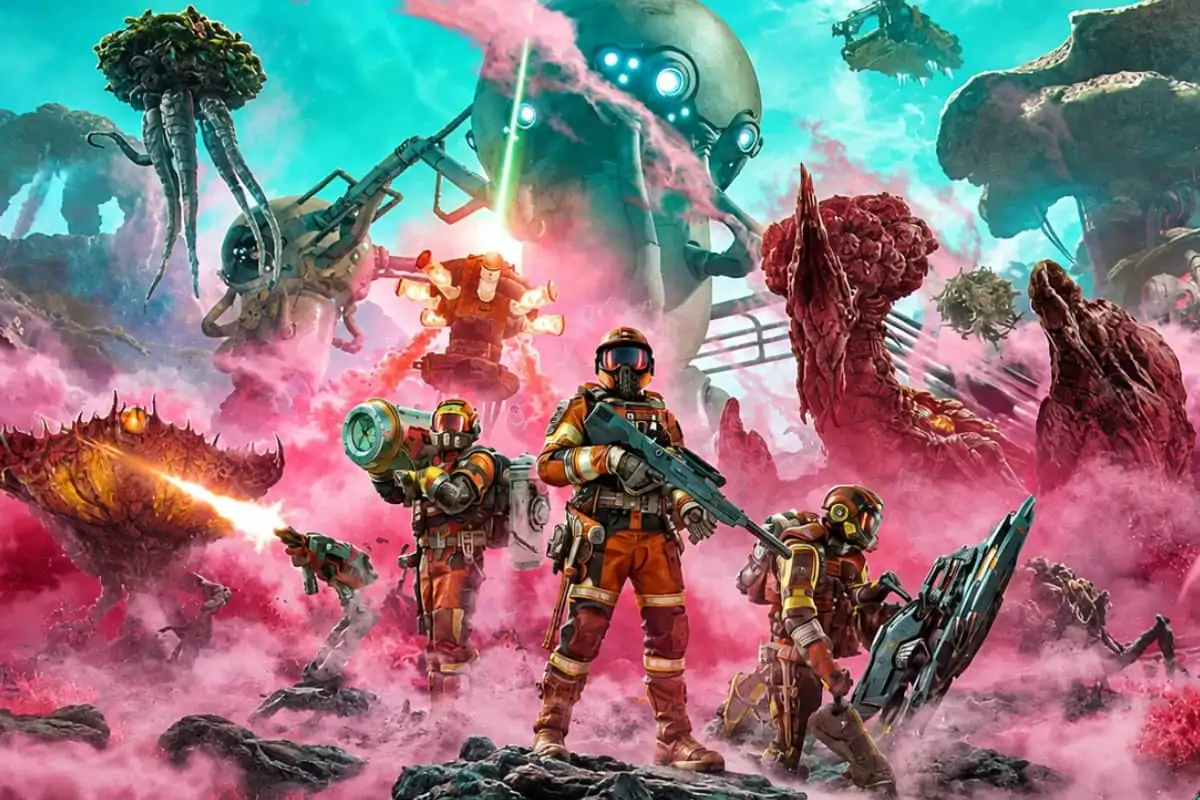

“This already looks like Helldivers” was the first message in my Twitch chat, as we at Geek Realm Hub participated in the Exterminauts creator program during their recent closed beta.
I hadn’t even started my first mission yet, and already viewers were getting a familiar vibe from the game. So what is it about Exterminauts that people find so very reminiscent of Helldivers 2, and what does this new game have to do in order to compete with it?
In the arena of cooperative PvE shooters, few titles have had such an effect on the genre’s landscape as Arrowhead Game Studios’ Helldivers 2. Its chaotic four player drops onto hostile alien worlds, “friendly fire” mayhem, satirical military propaganda, and stratagem-driven spectacle turned it into a cultural and commercial phenomenon.
Now Behaviour Interactive, the studio behind Dead by Daylight, is preparing its own entry with Exterminauts: a three player, third person, co-op shooter scheduled for release in 2027 on PlayStation 5, Xbox Series XS, and PC.
Developed in partnership with Level Infinite and Team Shooter & Creative, Exterminauts casts players as blue-collar galactic field technicians… part exterminator, part repairman, part first responder… and deploys them to the alien planet Tian. Their job is straightforward on paper: complete corporate contracts by clearing infestations of aggressive “Pests,” repairing critical infrastructure, handling odd jobs, and extracting before the living ecosystem overwhelms the worksite. The marketing tagline says it all: “Punch In. Clean Up. Get Paid.”
The comparisons to Helldivers 2 are immediate and inevitable. Both games drop small teams onto hostile planets swarming with alien threats. Both lean into chaotic co-op, friendly fire, and tongue-in-cheek satire. Both reward communication, improvisation, and surviving spectacular failures. Yet Exterminauts deliberately reframes the fantasy. Where Helldivers 2 sells the glorious (and expendable) defense of Managed Democracy, Exterminauts sells the grind of a dangerous 9 to 5 for interstellar megacorporations competing over a resource called Polymorphic Plasma. As creative director Vincent Regimbart put it, “Our game is not war: It’s work. It’s a workplace that fights back.”
Gameplay: Chaos, contracts, and tool-based firepower
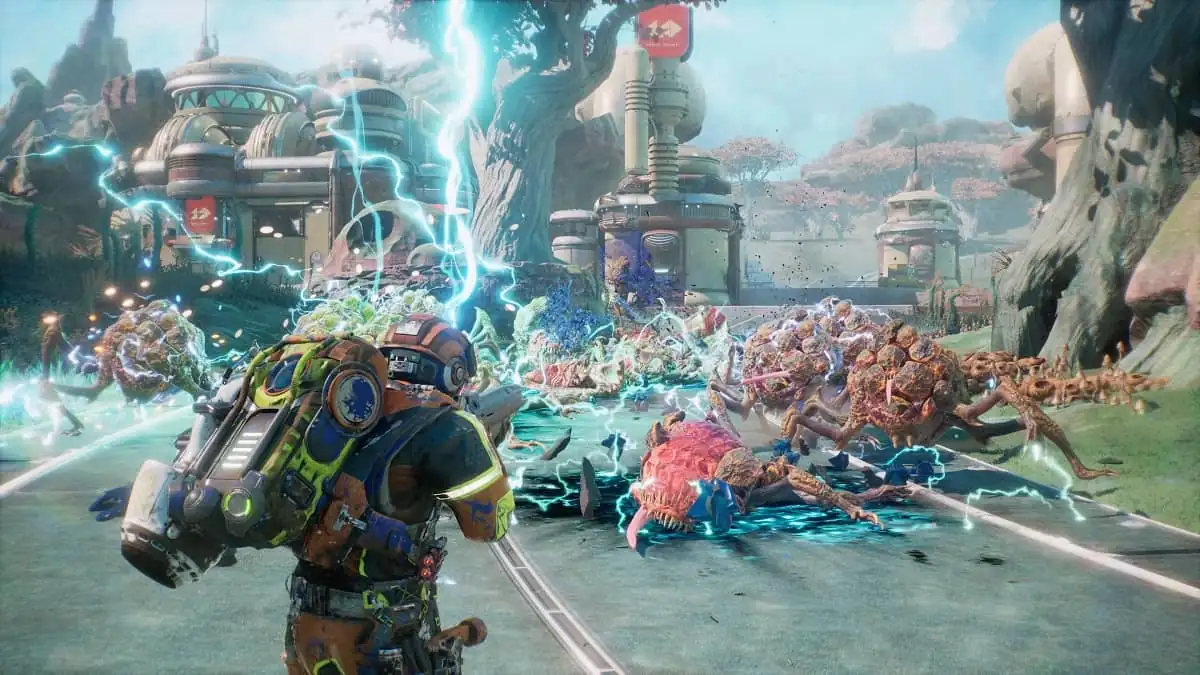
Missions in Exterminauts involve dropping from an orbital “RIG” depot onto worksites, completing primary objectives while secondary threats escalate, and holding out for extraction. Enemy density ramps up, environmental hazards appear, and the final extraction sequence often becomes a desperate last stand. Friendly fire is always on, turning every overcharged shot or poorly placed gadget into potential comedy or catastrophe. Using ziplines, sliding while shooting, and rolling all add mobility, while “overdriving” abilities let players push specialized weapons beyond normal limits for big moments.
While the gameplay definitely has a similar vibe to Helldivers 2, the differences become clearer in the details. Helldivers 2 centers on fourplayer squads calling in powerful stratagems: orbital strikes, support weapons, and defensive emplacements. Exterminauts is limited to three players; and emphasizes loadouts of kinetic firearms paired with “weaponized power tools.” The likes of a plasma launcher, stasis collider, industrial saw blade launcher, and ice canon make up the tools of the trade.
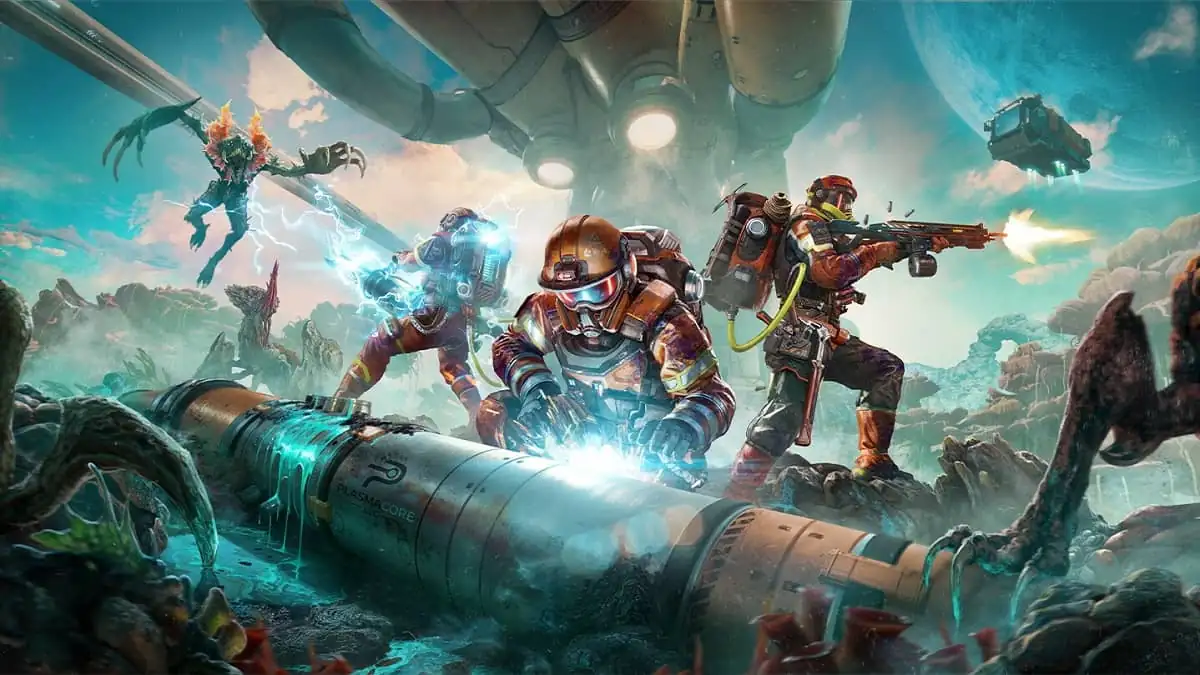
Objectives lean harder into the “work” fantasy. Beyond pure combat, crews must repair pumps, patch pipes, reboot terminals, clear goop from machinery, and keep facilities operational…often while under attack. These repair sequences require one player to focus on interaction minigames while the others provide cover, creating distinct roles within the small team. The three-player limit intensifies this: when one person is locked into a repair, only two remain free to fight, raising the stakes compared to a four-player Helldivers squad covering a terminal. Difficulty scales significantly, with higher tiers adding tougher pests, more environmental hazards, and greater chaos.
Sponsorships available back on the RIG function somewhat like a class system, granting unique passives and access to specialized gear. And players are able to save & swap multiple loadouts.
Combat itself feels more grounded and industrial. Enemies (the Pests) are varied and often bizarre. Floating balloon-like creatures, multi-limbed horrors, and adaptive wildlife drawn to the plasma resource. Indeed, this sets Exterminauts apart from many other games including Helldivers, as the enemies are far more “alien” than the typical bots or bugs.
Weak-point targeting and limb destruction adds tactical layers. The brighter & more colorful art style of Tian contrasts with the grimmer & more militaristic presentation of many Helldivers 2 planets, giving Exterminauts a distinct visual identity.
Progression in Exterminauts appears more elaborate than that of Helldivers 2. Successful contracts feed into equipment upgrades, mods, certifications, promotions, and corporate sponsorships. This depth is something the developers have highlighted as an intentional improvement.
Game design philosophy: Satire of the workplace vs. Satire of the mMilitary
The design philosophies diverge most sharply in tone and player fantasy. Helldivers 2 wraps its carnage in patriotic propaganda, endless war, and the dark humor of expendable soldiers dying for Super Earth. It is satire of nationalism and the military-industrial complex delivered through over the top heroism and catastrophic friendly fire. Exterminauts swaps the battlefield for the worksite. Players clock in, receive corporate directives, manage expenses, and try to finish the shift. The humor is workplace comedy mixed with body-horror pests and industrial accidents. You are not a hero of democracy, instead you are a contractor just trying to keep the lights on and get paid.
Helldivers 2 missions often feel like military operations with clear primary and secondary objectives that feed a larger galactic war. Exterminauts frames everything as contracts and odd jobs on a colonized (and largely abandoned) resource world. The living ecosystem reacts and adapts and the corporate overlords remain a constant, slightly detached presence.
Both games thrive on emergent storytelling; the hilarious and tragic moments that arise when plans collapse under friendly fire, bad timing, or overwhelming numbers. Exterminauts simply roots those moments in blue-collar absurdity rather than military bravado.
What Exterminauts must focus on to compete
Helldivers 2 remains a high bar. It has deep community engagement, regular content updates, a living galactic war that gives player actions a sense of larger consequence, and a tone that resonates widely. For Exterminauts to carve out lasting space rather than being dismissed as a “similar but lesser” alternative, several factors will be critical.
First, leaning hard into its own fantasy. The blue collar corporate satire and repair-focused objectives are the clearest differentiators. The developers should expand the workplace comedy, corporate politics, and the tangible feeling of “just trying to finish the shift.” If the game feels like Helldivers 2 with a reskin and fewer players, it will struggle. If it feels like a distinct job on a hostile planet, it has a shot.
Second, deliver exceptional co-op feel and chaos in the three-player format. The smaller squad size is both a limitation and an opportunity. Requiring tighter coordination & more meaningful role differentiation could create intense, memorable sessions.
Having said that, the biggest request I’ve personally heard is “make it four players.” While I understand wanting to play with more friends, a smaller group was clearly a deliberate choice by the game devs. However, I would propose adding an optional “larger group size” mode. Perhaps one that increases the group size to SIX players while also providing a sharp difficulty increase for the ultimate challenge!
Third, visual and audio identity that stands apart. The colorful, industrial sci-fi aesthetic and tool-based weapon feel are strengths. But I’ve seen calls for “more personality” via background story, quotes from the characters, etc.
Fourth, accessibility and onboarding without diluting the challenge. Helldivers 2 has a steep learning curve that becomes part of the appeal. Exterminauts should ensure new crews can understand the work-order structure and tool synergies quickly while still offering high difficulty content that rewards mastery and tight teamwork.
And finally, community and humor that feels authentic. The best co-op shooters become shared cultural experiences. If Behaviour can foster a community around the absurdity of dangerous interstellar blue-collar work: memes about bad shifts, corporate jargon, and spectacular extractions, then the game will gain a staying power beyond pure mechanics.
Final thoughts
Its important to remember that Exterminauts doesn’t need to dethrone Helldivers 2 to succeed. The market has room for multiple strong co-op PvE experiences, especially when one emphasizes military satire and the other workplace grind.
With its industrial tool combat, “repair and exterminate” loop, three player intensity, and corporate “9 to 5” fantasy, Behaviour Interactive has the ingredients for a distinctive and highly replayable shooter.
The question is whether the final product, and the post-launch support that follows, can turn a promising second shift on Planet Tian into a long and profitable career. For players already clocking countless hours in the fight for Super Earth, a new worksite may be exactly what the next contract calls for.