



President Donald Trump confirmed something that caught the tech world off guard: China is refusing to buy NVIDIA’s H200 AI chips, even though Washington had officially approved the sale.
After wrapping up his two-day summit with Chinese President Xi Jinping, Trump told reporters aboard Air Force One that China “chose not to” approve the purchases because “they want to develop their own.” Not a diplomatic snag, not a pricing issue, China simply decided it didn’t want American chips.
The U.S. Commerce Department had cleared roughly 10 major Chinese tech firms to purchase H200 chips, including Alibaba, ByteDance, Tencent, and JD.com, through intermediaries like Lenovo and Foxconn, with each approved customer allowed to buy up to 75,000 units.
The terms weren’t exactly generous, chips had to physically pass through U.S. territory for inspection before re-export, and a 25% fee applied to every sale. Still, the U.S. side had done its part. China’s answer was a firm no.
NVIDIA CEO Jensen Huang wasn’t originally on the delegation list for the Beijing summit, but Trump personally called him and invited him at the last minute. Huang was seen boarding Air Force One during a refueling stop in Anchorage, Alaska, en route to Beijing.
His presence raised expectations that a breakthrough on H200 sales was close. It wasn’t. Trump’s post-summit comments suggest the impasse remains, with U.S. Trade Representative Jamieson Greer stating that any movement on H200 purchases is now up to China.
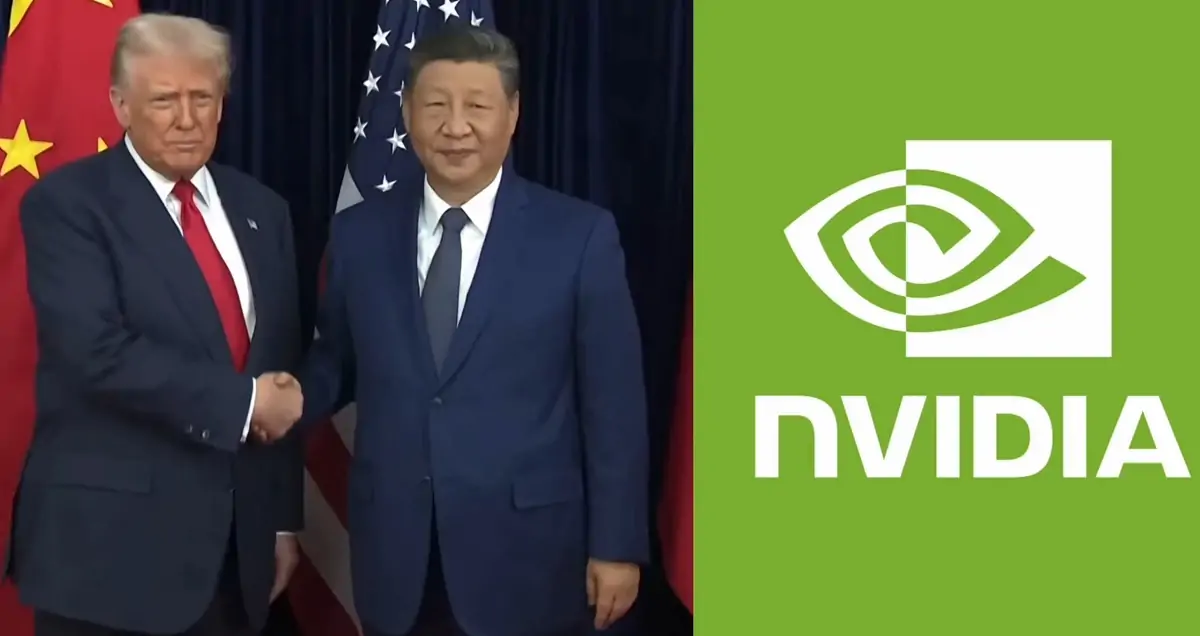
NVIDIA has already lost the Chinese market
The H200 rejection is the latest chapter in a story that has been building for months. NVIDIA’s position in China didn’t just weaken, it collapsed. Jensen Huang himself confirmed that NVIDIA’s share of the Chinese AI accelerator market has fallen to zero percent. Just 18 months ago, NVIDIA supplied the vast majority of AI training and inference silicon used by Chinese cloud providers.
NVIDIA confirmed in its FY2026 10-K filing that the company is “effectively foreclosed from competing in China’s data center computing market” and is not assuming any data center compute revenue from the region in its current outlook. China once represented over 13% of NVIDIA’s total revenue, and Huang has estimated the Chinese chip market could be worth $50 billion. That opportunity is now effectively gone.
The shift didn’t happen overnight. On September 17, 2025, the Cyberspace Administration of China issued guidance to Chinese firms advising them against purchasing certain Nvidia chips, effectively banning their import and use throughout the country’s tech sector. Beijing’s message to its domestic companies was clear: buy Chinese, not American. And Chinese companies have been doing exactly that.
In 2025, Chinese domestic manufacturers shipped a combined 1.65 million AI accelerator cards, capturing 41% of China’s AI chip market for the first time, with Huawei’s Ascend series leading the domestic camp with 812,000 units, while NVIDIA’s share tumbled from 95% to 55%. The numbers tell the story on their own.
RELATED: RTX 5090 beats $30,000 NVIDIA H200 in password cracking benchmarks
China is building its own chip ecosystem, from the ground up
Huawei is the most visible part of China’s domestic chip push, but it’s far from the only one. Huawei is set to capture the largest share of China’s AI chip market in 2026, with AI chip revenue projected to hit $12 billion this year, driven primarily by orders for the Ascend 950PR, which entered mass production in March. Morgan Stanley forecasts China’s AI chip market will reach $67 billion by 2030, with 86% expected to be supplied by Chinese players.
Beyond Huawei, a whole ecosystem of domestic players is scaling up fast. China’s AI chip landscape now features Alibaba’s T-Head, Baidu’s Kunlun Core, Cambricon, and a group of rising startups, Moore Threads, Muxi, Biren Technology, and Enflame Technology, all competing for a share of a market that is growing rapidly.

And the ambition doesn’t stop at AI chips. Loongson Technology, one of China’s most prominent chip designers, recently announced updates on its 3B6600 CPU and 9A1000 GPU, two products aimed squarely at China’s domestic PC market. The 3B6600 is an eight-core processor targeting performance comparable to Intel’s 12th Generation Alder Lake chips, while the 9A1000 GPU targets performance similar to AMD’s Radeon RX 550, with both products expected to reach retail in 2027.
They aren’t competing with the latest Intel or AMD hardware, but that’s not really the point. Both chips are built on a 12nm process node, a mature technology that China can still manufacture using DUV lithography tools, the kind it hasn’t been cut off from, unlike the EUV equipment required for 7nm and below. For China, building chips it fully controls matters more right now than chasing benchmark records.
Beijing has reportedly instructed Chinese tech companies to limit their use of NVIDIA chips to their overseas operations, while supporting domestic manufacturing inside China. Meanwhile, U.S. regulators require that all NVIDIA chips ordered by Chinese clients only be used within China, two contradictory demands that have created a stalemate in customs clearance for H200 shipments.
The software side of this equation is also shifting. While Huawei has been developing its CANN platform as a domestic alternative to NVIDIA’s widely used CUDA software, developers say it still lags behind in usability and maturity. CUDA is the one area where NVIDIA still holds a major advantage, it’s deeply embedded in how AI is built globally and hard to replace quickly. But even that is being challenged.
Jensen Huang said it plainly on the Dwarkesh Podcast: “The day that DeepSeek comes out on Huawei first, that is a horrible outcome for our nation.” Eight days later, that is exactly what happened, DeepSeek launched its V4 model optimized for Huawei’s Ascend 950PR, with Huawei receiving early optimization access that neither NVIDIA nor AMD got.
The NVIDIA H200 situation isn’t just a story about one blocked shipment. It reflects a much larger shift happening in the global semiconductor industry. U.S. export controls, intended to slow China’s AI progress, ended up accelerating China’s push to build its own independent chip ecosystem.
China would rather have its companies buy domestic chips, even if they lag the current state of the art, because the goal is supporting domestic champions and eliminating dependence on foreign technology. The strategy is working, and the rest of the industry is watching closely.
Do you think China’s homegrown chip industry can truly close the gap with NVIDIA and the U.S., or is the technology lead too big to overcome? Tell us what you think in the comments!