



Loongson Technology, one of China’s most prominent fabless chipmakers, officially confirmed during its 2025 annual and 2026 Q1 earnings calls that its next-generation processor, the 3B6600, and its upcoming graphics card, the 9A1000, are both on track to hit the retail market in 2027.
The announcement came straight from Hu Weiwu, Chairman and General Manager of Loongson, and the targets are clear: the 3B6600 is aiming for performance parity with Intel’s 12th Generation Alder Lake processors, while the 9A1000 is going after AMD’s Radeon RX 550. That’s a 2021 CPU and a 2017 GPU, respectively, and yes, there’s a lot more to this story than those numbers suggest.
Loongson has been steadily developing chips for China’s domestic PC and server markets for years. Their previous desktop CPU, the 3A6000, already showed respectable results in single-core workloads when compared to Intel 10th Gen and AMD Zen 2 chips. The 3B6600 is the next step, and it’s a significant one.
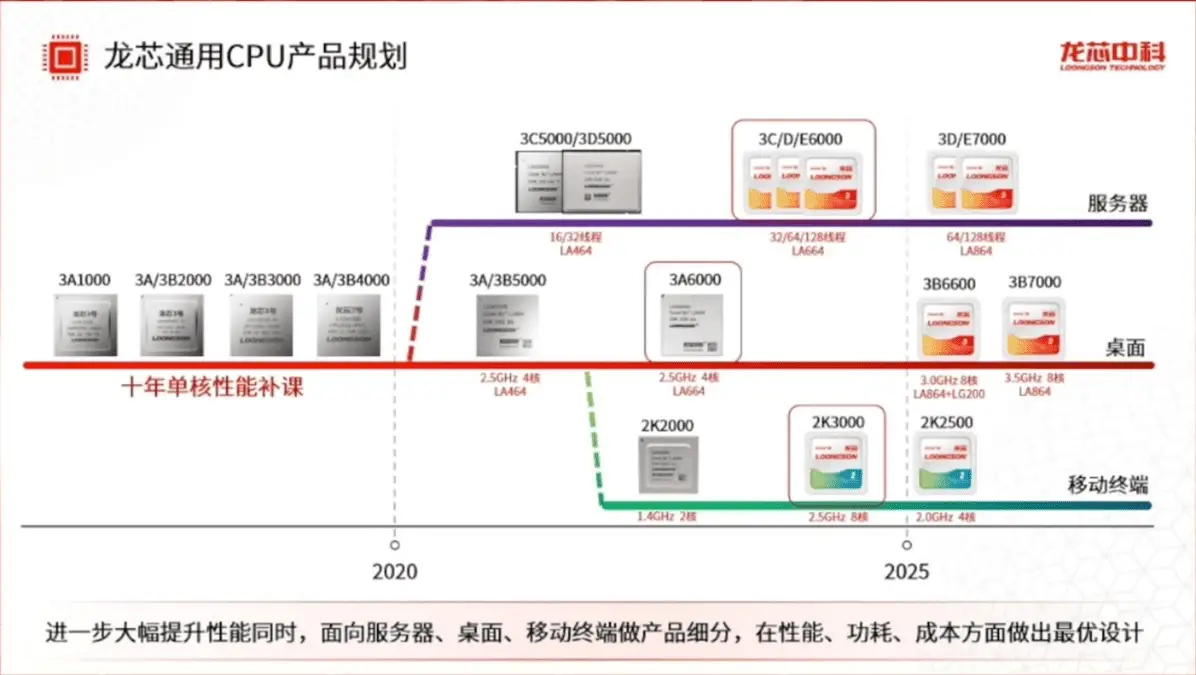
Loongson 3B6600: Eight cores, DDR5, and a 30% performance jump
The 3B6600 maxes out at eight cores and 16 threads, with a base clock of 2.5 GHz and a boost clock of up to 3 GHz. The chip supports DDR5 memory, PCIe 4.0, and HDMI 2.1. It’s built on the LA864 CPU architecture and comes with integrated LG200 graphics cores baked right into the die.
Compared to the older 3A6000, Loongson says the new chip delivers around 30 percent better performance at the same clock speed in pre-silicon testing, with the 8-core configuration expected to reach between 60 and 80 points in SPEC 2006 single-core testing. According to Loongson’s early benchmarks, those figures put the 3B6600 in the same ballpark as Intel’s Alder Lake Core i5 and Core i7 chips.
Development on the 3B6600 started in 2024. Hu Weiwu recently confirmed the chip has completed its design phase and is now ready for tape-out, with engineering samples planned for the second half of 2026.
One key detail that explains a lot about Loongson’s timeline: both the 3B6600 and the 9A1000 are built on a mature 12nm process node, manufactured using DUV (Deep Ultraviolet) lithography tools, the same technology China still has access to.
EUV (Extreme Ultraviolet) tools, required for 7nm and below, remain off-limits. That manufacturing constraint shapes everything about how Loongson develops its chips, from design cycles to production timelines.
Loongson 9A1000: An entry-level GPU with bigger plans behind it
The 9A1000 is an entry-level graphics card designed to offer performance comparable to the Radeon RX 550, aimed primarily at providing basic display capabilities across mainstream Chinese PCs running Loongson processors.
Development on the 9A1000 began in 2023, with an original target of reaching the market by 2025. The project faced several delays, and Loongson ultimately completed tape-out in September 2025. The chip is now in its final delivery stages, with Loongson planning to share tape-out results at the upcoming first-half earnings call in August.
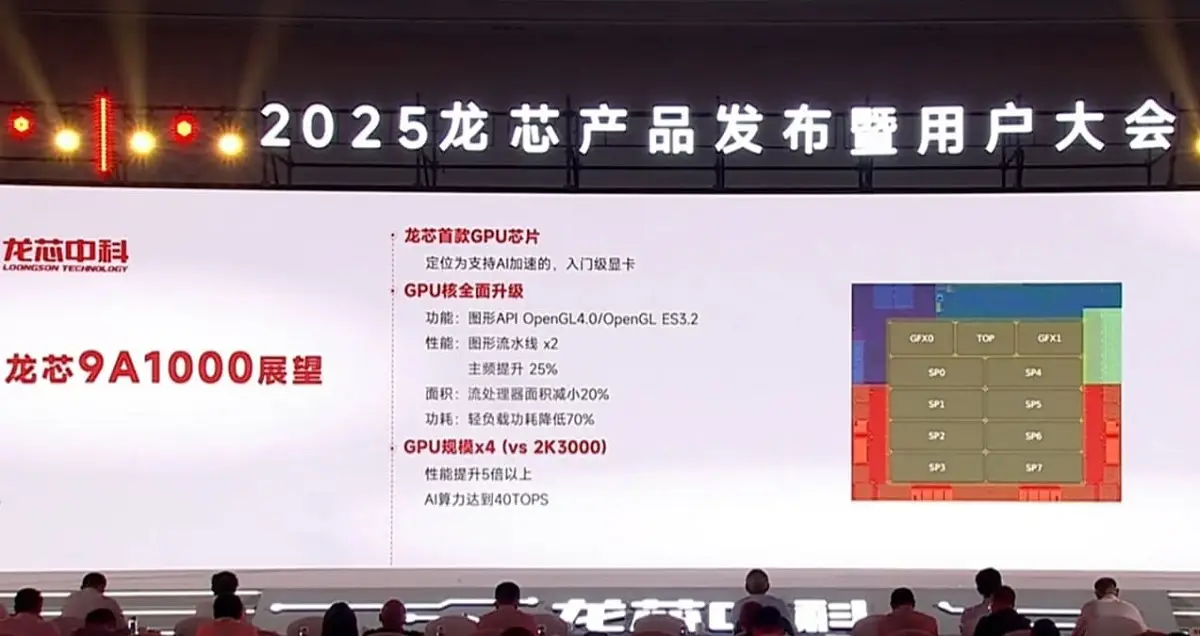
The 9A1000 isn’t just playing catch-up, though. It promises five times the performance of Loongson’s previous 2K3000 solution and is capable of up to 40 TOPS of AI computing. Loongson has also committed to delivering Windows-compatible drivers for the card, a move that significantly broadens its potential reach beyond China’s domestic Linux ecosystem.
Looking ahead, Loongson has confirmed the 9A2000 and 9A3000 are already in the design stages. The 9A3000 will target a sub-10nm process node, though development will take time given the required investments in custom PHYs, memory interfaces, and PCIe interfaces.
A domestic chip ecosystem built from the ground up
The bigger picture here isn’t just about specs. For China, self-reliance in chip manufacturing has become far more important than chasing the latest performance benchmarks. Loongson isn’t building chips to compete with Intel or AMD globally, they’re building them so China doesn’t have to depend on foreign silicon for its domestic market.
Beyond consumer products, Loongson is also developing the 3C6000 server CPU with up to 64 cores, and the next-gen 3D7000 lineup featuring 32-plus core chiplets scaling to over 128 cores total. The scope goes well beyond desktops and laptops.
The company is also exploring the Android market, with plans to leverage open-source HarmonyOS as a platform base, and has partnered with domestic manufacturers to develop silicon wafers for HBM chips, potentially paving the way for future Loongson GPUs to use in-house memory solutions.
It’s a long-term play, and Loongson is methodically filling in the pieces. The 3B6600 and 9A1000 won’t shake the global chip industry, but they don’t need to. What they need to do is work, ship, and keep the momentum going. And by 2027, that’s exactly what Loongson is betting on.
What’s your take, is Loongson’s progress genuinely impressive given the restrictions they’re working under, or is matching 2021 Intel hardware in 2027 just not good enough? Let us know in the comments!