



AMD just confirmed that FSR Upscaling 4.1, its latest machine learning-based upscaling technology, will be officially available for Radeon RX 7000 series graphics cards starting in July, with RX 6000 series support scheduled to arrive in early 2027.
The announcement came from Jack Huynh, AMD’s Senior Vice President and General Manager of Computing and Graphics, through a post on X. Until now, FSR 4 had been exclusive to the RX 9000 series, the company’s latest RDNA 4 generation, leaving millions of owners of perfectly capable RX 7000 and RX 6000 cards stuck on FSR 3.1, a noticeably older upscaling path. That changes this summer, at least for RDNA 3 users.
Huynh’s message addressed the community directly: “My team and I have been working hard to evolve FSR 4 and bring it to more cards. We power over 1 billion gaming devices worldwide. It’s a responsibility we care deeply about. I’m grateful to our fans. Your enthusiasm and ideas inspire us to keep pushing gaming forward.”
When FSR Upscaling 4.1 rolls out for RX 7000 owners in July, it will be supported in over 300 games out of the box, requiring no additional configuration from the user.
Straight from @jackhuynh, SVP & GM, Computing & Graphics at AMD, we finally have news on the FSR4 support on RDNA3 and RDNA2 graphics cards series.
Users for the 7000 series will get FSR4 support starting July 2026 and 6000 series users will get support on early 2027.
It’s… pic.twitter.com/gO6evPjUFz
— Geek Realm Hub (@geekrealmhub) May 14, 2026
RX 7000 series gets FSR 4.1 this July
The technical reason behind the delay has to do with how the hardware handles machine learning. The RX 9000 series, based on RDNA 4, features 2nd Generation AI Accelerators with FP8 (floating point 8-bit) support, which is what AMD’s current FSR 4 implementation was built around.
The RX 7000 series, based on RDNA 3, has 1st Generation AI Accelerators that work with INT8 (integer 8-bit) instructions instead, a different compute path that required AMD to develop and optimize a separate version of the upscaler from the ground up. Huynh described the process as “an exciting challenge.”
The result is an FSR 4.1 build specifically tailored for RDNA 3 hardware, designed to deliver the same quality improvements, sharper visuals, better motion clarity, and improvements to Ultra Performance and DRS modes, without requiring the newer silicon.
It’s worth clarifying what FSR 4.1 actually is within AMD’s broader upscaling ecosystem. FSR Redstone is the umbrella name for AMD’s full suite of ML-powered technologies, which includes Upscaling, Frame Generation, Ray Regeneration, and Radiance Caching. The full Redstone suite remains exclusive to RDNA 4. What’s coming to RX 7000 cards is specifically FSR Upscaling 4.1, the upscaling component alone, which is still a significant upgrade over FSR 3.1 that these cards currently run.
The community had already been pushing for this for months. After AMD published the source code for FSR 4 INT8 on GitHub, modders compiled it into a DLL and used it to enable FSR 4 on older hardware through tools like OptiScaler, effectively beating AMD to its own feature. The frustration among RX 7000 owners had been building since FSR 4 launched alongside the RX 9000 series in early 2025, with no official word on backward compatibility, until now.
RX 6000 series is also confirmed, early 2027
Owners of RX 6000 series cards, based on the older RDNA 2 architecture, will also get FSR Upscaling 4.1, though the timeline extends to early 2027. AMD has not yet published a final compatibility list for RDNA 2, but the announcement covers RX 6000 series desktop and mobile GPUs.
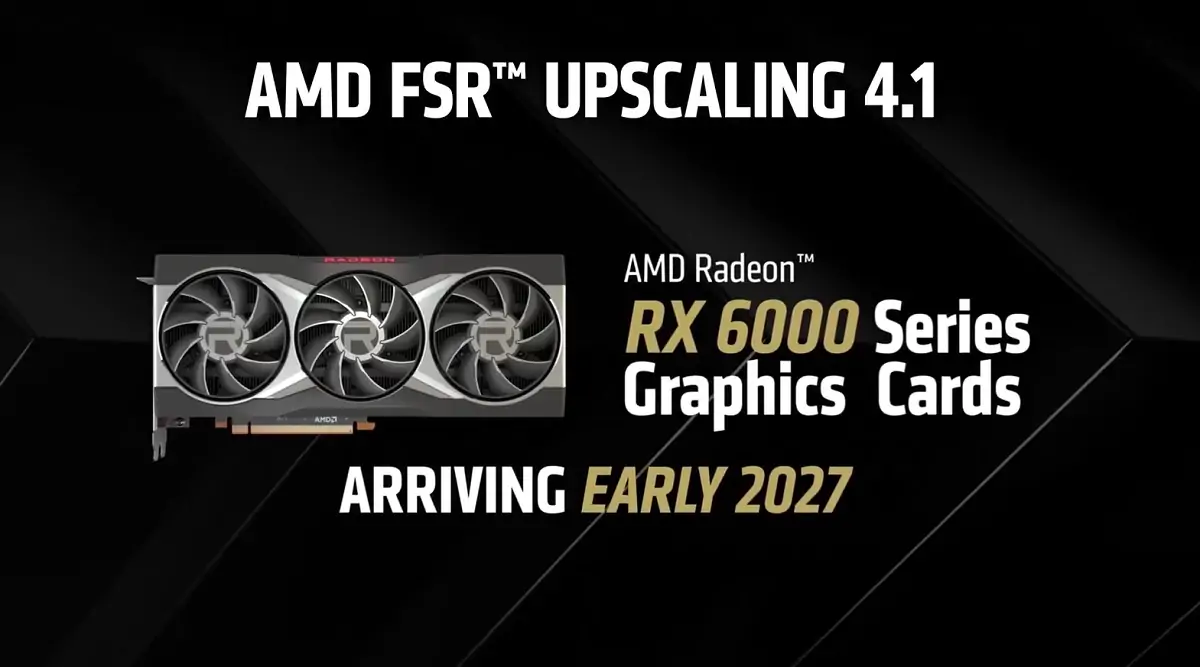
Notably, the RDNA 2 architecture also powers the APU inside the original Steam Deck, which means that device could potentially benefit from the update as well, depending on how Valve approaches it on the software side.
The oldest consumer GPU on RDNA 2 is the Radeon RX 6800 XT, launched in November 2020, making it over five years old by the time FSR 4.1 support arrives. AMD has not shared the specific driver version for the July rollout, an exact release date within the month, or the complete list of supported titles at launch beyond confirming the 300-game figure. Those details are expected closer to the actual release.
What this means for AMD’s position against Nvidia DLSS
FSR 4.1 expanding to older hardware is a meaningful move in AMD’s ongoing competition with Nvidia’s DLSS, which has long held an advantage in image quality thanks to its dedicated Tensor Core hardware in GeForce GPUs.
By bringing ML-based upscaling to a much wider base of Radeon cards, AMD narrows the gap between the two ecosystems significantly. DLSS remains exclusive to Nvidia hardware by design, while FSR, even in its newest form, is being extended backward across multiple GPU generations, which is a genuine differentiator.
Whether the image quality of the RDNA 3 version of FSR 4.1 fully closes the gap with DLSS 3 is something that will be determined once the driver drops and proper benchmarks are available.
For now, RX 7000 owners have a confirmed date and a solid game library to look forward to. RX 6000 owners have a confirmed roadmap. And AMD, after months of community pressure, has finally delivered the announcement people were waiting for.
Are you rocking an RX 7000 and hyped for July, or are you on an RX 6000 crossing your fingers for 2027? Let us know in the comments!