



Western Digital just dropped a roadmap that’s basically saying “hold my beer” to the entire storage industry. At its Innovation Day 2026 event this past Thursday, the company, now officially rebranded as just WD, laid out plans to deliver 100TB hard drives by 2029, along with a bunch of tech that’s about to make spinning rust way more relevant than anyone expected in the AI era.
The announcement isn’t just smoke and mirrors. WD confirmed its 40TB UltraSMR ePMR hard drive is already in qualification with two hyperscale customers, with volume production kicking off in the second half of 2026.
That’s the world’s highest capacity HDD right now, but it’s just the starting line. The company’s dual-path approach splits between energy-assisted perpendicular magnetic recording (ePMR) scaling to 60TB and heat-assisted magnetic recording (HAMR) technology that’ll hit 100TB by 2029. HAMR qualifications are already underway with hyperscale customers, with ramp production scheduled for 2027.
What’s wild is that both ePMR and HAMR are built on a common architecture, which means WD can manufacture them more efficiently and customers won’t have to deal with disruptive technology transitions.
Hyperscalers and enterprises can pick whichever path fits their timeline without rearchitecting their entire infrastructure. It’s flexibility that the industry hasn’t really seen before, and it’s aimed directly at the insane data demands AI is creating.
Performance gets a serious upgrade
WD isn’t just throwing capacity at the wall. The company also unveiled two performance technologies that close the gap between HDDs and SSDs without requiring you to mortgage your data center.
High Bandwidth Drive Technology allows simultaneous reading and writing from multiple heads on multiple tracks, delivering 2x the bandwidth of standard HDDs with zero power penalty. The tech is already with customers for validation, and WD says it can scale to 8x bandwidth gains down the road.
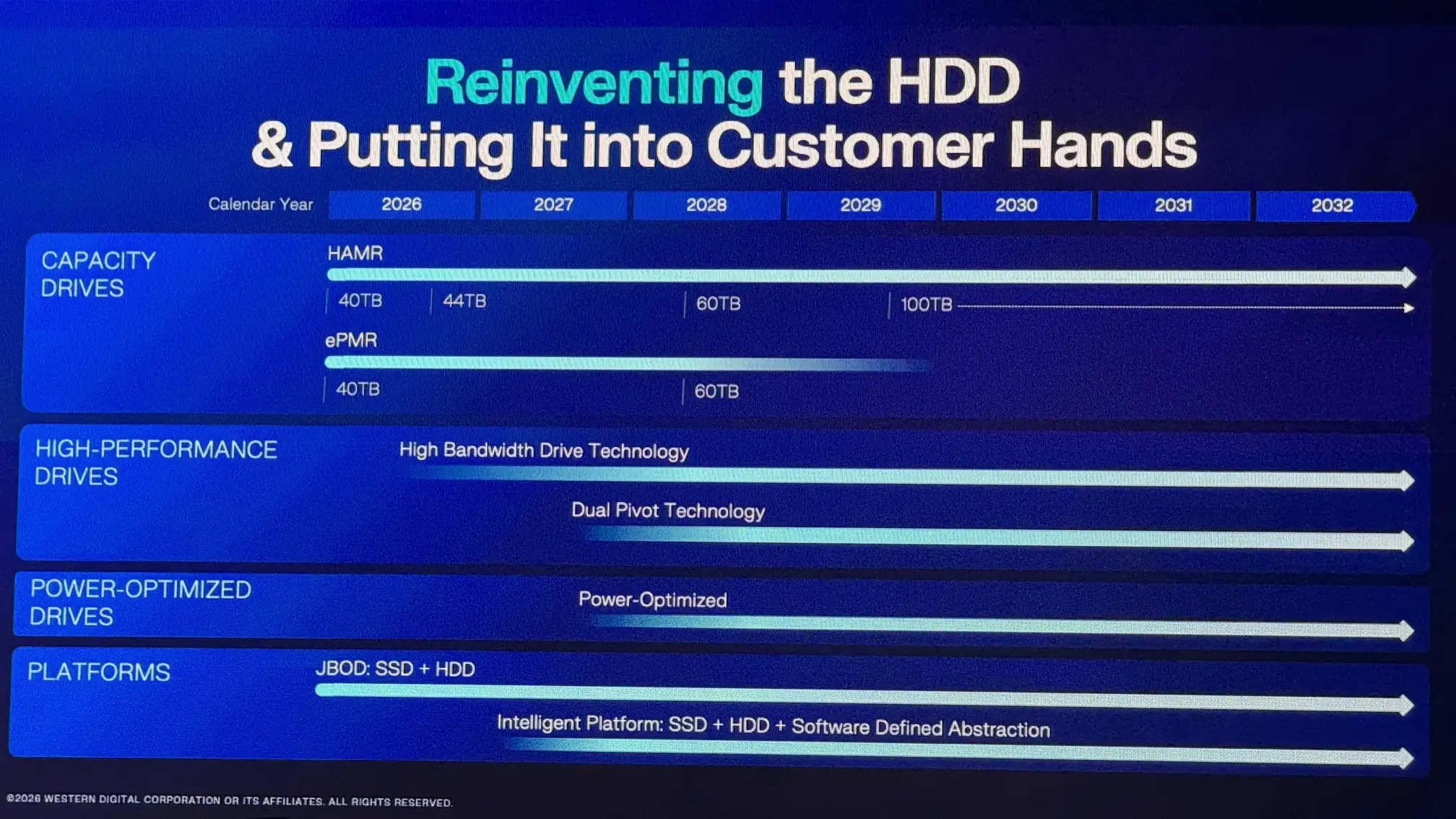
Then there’s Dual Pivot Technology, which adds a second set of independently operating actuators on a separate pivot. Unlike previous dual-actuator designs that sacrificed capacity and forced customers to overhaul their software, Dual Pivot actually reduces spacing between disks, allowing more platters per drive and higher overall capacity while delivering up to 2x sequential IO gain.
Combined, these two technologies push sequential IO to 4x overall, meaning those 100TB drives will maintain the same IO per terabyte performance we get today. Translation: you won’t need to dump cash into more SSDs or rebuild your services as capacity explodes. Drives with Dual Pivot Technology are currently in the lab and will hit the market in 2028.
Power efficiency and platform intelligence
WD also teased power-optimized HDDs that use 20% less power while keeping sub-second access times, targeting that weird middle tier of AI data that’s too active for tape but too expensive for flash.
Those are expected in customer qualification by 2027. The company is expanding its Platforms business with an intelligent software layer through an open API, expected to launch in 2027, designed to give mid-scale customers the same storage efficiency and economics that hyperscalers enjoy today.
The rebrand to WD reflects the company’s full pivot into becoming a storage infrastructure partner for the AI-driven data economy. About 90% of WD’s revenue is now driven by AI and cloud, and they’ve been included in the Nasdaq 100 while ranking among the top S&P 500 performers in 2025.
If you’re still rocking that old 1TB external drive, it might be time to start planning ahead. By 2029, you could theoretically store your entire digital life, and everyone else’s, on a single HDD.
Stay plugged into the latest tech drops and geek news at Geek Realm Hub! Follow us on Facebook for daily updates and join the conversation.