



Remember Steam Machines? Yeah, those quirky Linux-powered boxes from 2015 that promised to revolutionize PC gaming in your living room but ended up collecting dust faster than your gym membership? Well, Valve apparently has a short memory, or perhaps a long one, because they’re bringing the Steam Machine back from the dead. And this time, they might actually pull it off.
After years of quietly perfecting SteamOS through the wildly successful Steam Deck, Valve dropped a hardware bombshell in November 2025: an all-new Steam Machine, a redesigned Steam Controller, and the Steam Frame VR headset. It’s an ambitious trifecta that signals Valve isn’t just dipping its toes back into hardware, it’s doing a full cannonball into the pool.
The redemption arc nobody saw coming
Let’s rewind for a second. The original Steam Machines launched in 2015 with all the fanfare of a wet firecracker. Multiple manufacturers, inconsistent specs, confusing pricing, and an operating system that wasn’t quite ready for prime time. By 2018, Valve quietly pulled the plug, and we all moved on with our lives.
But here’s the thing: Valve never actually gave up. They kept tinkering with SteamOS, refining it, perfecting it. The Steam Deck proved that Linux could run Windows games better than Windows itself, a statement that sounds absurd until you’ve actually used one. Now, with that foundation solid, Valve is ready to take another swing at the living room console market. As Valve engineer Yazan Aldehayyat puts it, “We finally have all the software and the hardware bits to make the original vision a reality.”
The timing is interesting too. While Xbox hardware sales are down and PlayStation is posting modest gains, Valve is charging ahead with a device that doesn’t really compete with traditional consoles, it complements them. This isn’t about exclusives or walled gardens. It’s about giving PC gamers a compact, plug-and-play way to access their Steam library on the TV.
What’s under the hood?
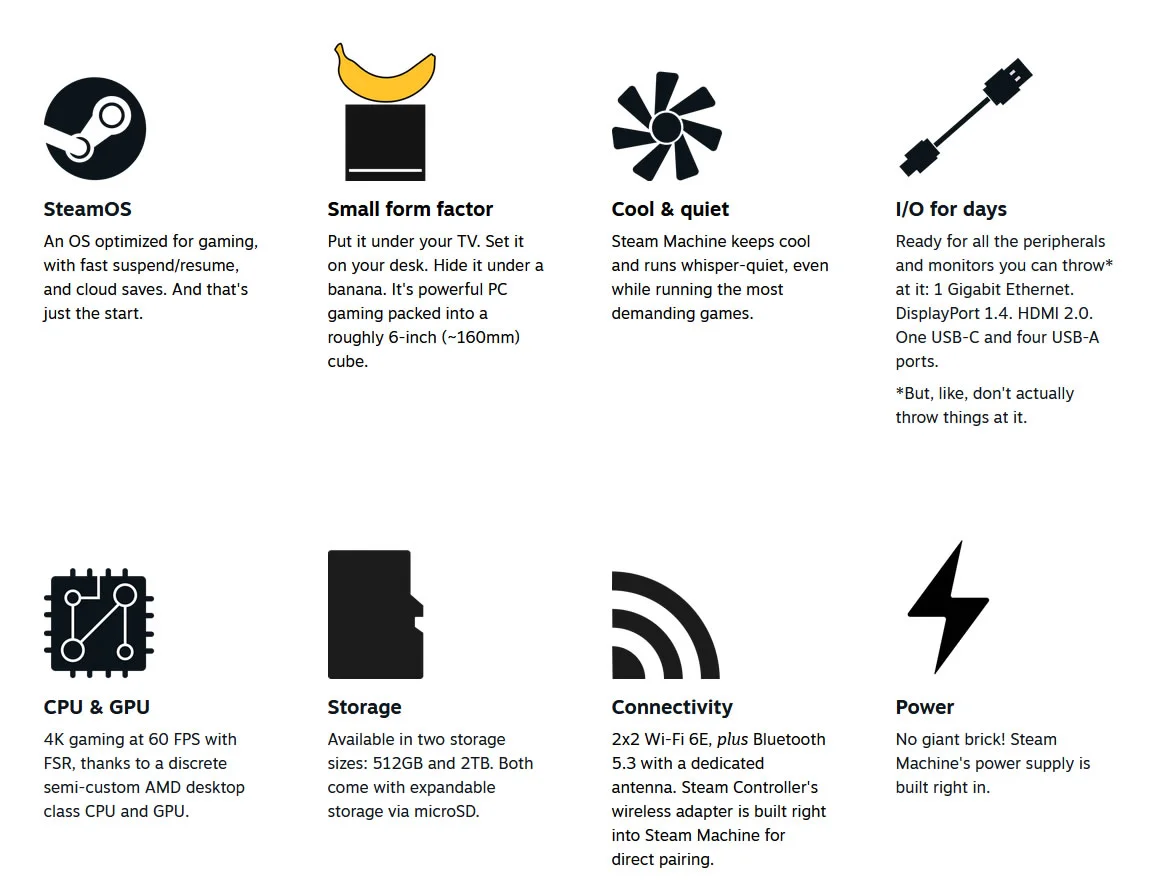
The new Steam Machine is essentially a Steam Deck that hit the gym and got serious about performance. Valve claims it’s over six times more powerful than the handheld, targeting 4K gaming at 60fps with FSR upscaling. That’s a bold claim, but the specs suggest they might actually deliver.
Inside this compact cube, and yes, it’s literally designed as a cube because Valve loves cubes, you’ll find a semi-custom AMD Zen 4 CPU with 6 cores and 12 threads running up to 4.8GHz, paired with a semi-custom AMD RDNA 3 GPU sporting 28 compute units and 8GB of GDDR6 VRAM. Add 16GB of DDR5 RAM, and you’ve got a machine that should comfortably sit between the Xbox Series S and the PS5 in terms of raw power.
During hands-on testing at Valve’s headquarters, journalists ran Cyberpunk 2077 at 4K with ray tracing enabled, averaging around 65fps with FSR upscaling from 1080p. Not bad for a box that’s roughly half the size of a PS5 and uses a fraction of the power, just 200W total compared to the 500W+ monsters most gaming PCs demand.
The GPU is particularly interesting. It’s based on AMD’s Navi 33 architecture, similar to the Radeon RX 7600M mobile chip but with some custom tweaks. While it won’t blow the doors off a high-end gaming PC, it’s perfectly positioned for that “good enough” sweet spot where most gamers actually live.
A cube that actually makes sense
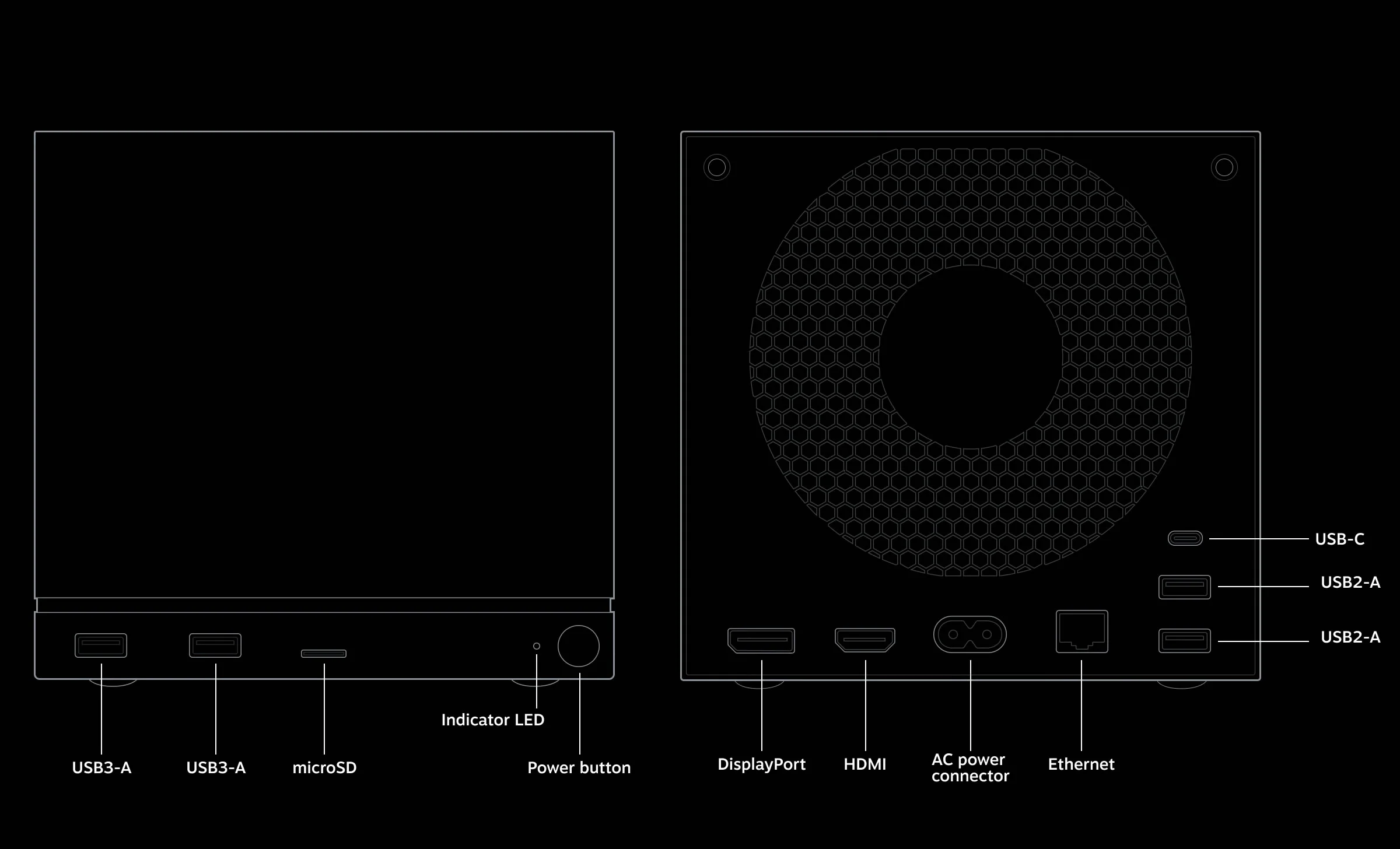
Let’s talk design, because this is where Valve’s engineering obsession really shines. The Steam Machine is a 6-inch cube that looks like someone cut an Xbox Series X in half and polished it up. But unlike the Xbox’s monolithic tower or the PS5’s “alien router” aesthetic, this thing is designed to actually fit in your entertainment center.
The entire system is built around a single 120mm fan with custom blade geometry. Valve claims they spent more time on computational fluid dynamics than an F1 team in a calendar year, which is either impressive dedication or a hilarious admission of over-engineering. Either way, the result is a whisper-quiet system that pulls air through multiple vents, making it nearly impossible to choke off airflow even if you stuff it in a cabinet.
Inside, it’s a masterclass in space efficiency. The power supply doubles as the chassis and RF shielding. The massive heatsink cools everything, CPU, GPU, memory, power delivery, while also serving as additional RF shielding. There’s barely a wasted millimeter in there. It’s the kind of design that makes you appreciate the engineering even if you never crack it open.
The front panel is magnetic and removable, primarily for cleaning but also for potential customization. Valve showed off prototype faceplates including wood grain, Team Fortress 2 themes, and even one with an e-ink display showing system stats. Whether these will actually be sold or just released as 3D-printable CAD files remains to be seen, but the option is there.
There’s also a customizable LED light bar at the bottom that can show download progress, system status, or just glow in whatever color matches your setup. If you hate it, you can turn it off. Dead simple.
The controller that should’ve been
The original Steam Controller was… let’s call it “ambitious.” Dual trackpads, minimal buttons, a learning curve steeper than Dark Souls. It had its fans, but most people just plugged in an Xbox controller and called it a day.
The new Steam Controller takes a different approach: give people what they actually want, then add the fancy stuff on top. It looks like a standard gamepad, two thumbsticks, four face buttons, D-pad, triggers, bumpers, but with canted trackpads above the sticks and four assignable grip buttons on the back. It’s the controller the Steam Deck should’ve had from the start.
The thumbsticks use TMR (Tunnel Magnetoresistance) sensors, which are more precise and significantly more resistant to stick drift than traditional potentiometers. If these hold up in the real world, it could be a genuine game-changer for controller longevity.
Connectivity is handled three ways: USB-C for wired play, Bluetooth for general wireless use, and a proprietary 2.4GHz connection via the included Steam Controller Puck. The puck supports up to four controllers simultaneously with 8ms latency and 250Hz polling rate, and it doubles as a charging dock. Battery life is rated at 35+ hours, which should be plenty for even the most marathon gaming sessions.
The controller will work with basically everything, Windows, Mac, Linux PCs, Steam Deck, Steam Machine, even iOS and Android via Steam Link. It’s the kind of universal compatibility that makes you wonder why more companies don’t do this.
The price question
Here’s where things get murky. Valve hasn’t announced pricing yet, and when pressed, they said the Steam Machine will be “priced comparable to a PC with similar specs” and positioned “closer to the entry level of the PC space.”
That’s… not super encouraging. A DIY PC with similar specs would run around $800-$1,000, not including labor or the operating system. The PS5 Pro costs $700. If Valve prices this thing north of $600, it’s going to be a tough sell for anyone who isn’t already deep in the PC gaming ecosystem.
But there’s reason for optimism. Valve has consistently undercut expectations with Steam Deck pricing, and they’re offering two storage options, 512GB and 2TB, which suggests a range of price points. The 512GB model bundled with the Steam Controller could potentially hit that magical $500-$600 sweet spot where it becomes an impulse purchase rather than a major investment.
Should you care?
The Steam Machine launches in Spring 2026, which gives Valve plenty of time to finalize pricing and iron out any remaining kinks. It’ll be available everywhere the Steam Deck currently ships, purchased directly through Steam or Komodo depending on your region.
So is this the console PC gaming has been waiting for? Maybe. If you’ve got a massive Steam library and you’re tired of being chained to a desk, the Steam Machine offers a genuinely compelling alternative to building a full gaming PC. It’s compact, quiet, powerful enough for modern games, and runs an OS that’s actually designed for gaming rather than fighting you every step of the way.
The real test will be price. Nail that, and Valve might finally achieve what they set out to do a decade ago. Miss it, and we’ll be writing another “remember Steam Machines?” article in 2035.
Either way, it’s good to see Valve swinging for the fences again. The gaming industry needs more companies willing to try weird, ambitious hardware projects. Even if they occasionally face-plant, at least they’re trying something new.
And hey, if nothing else, we’ll always have the memes.