



An open-source developer going by Korthos Software just released a new project called low_latency_layer, a Vulkan layer that enables both NVIDIA Reflex 2 and AMD Anti-Lag 2 to work on any GPU under Linux, including AMD and Intel graphics cards, without requiring official driver support from any hardware vendor. The project was developed by Nicolas James and is hosted on GitHub under the MIT license.
The tool works as an implicit Vulkan layer that implements the VK_NV_low_latency2 and VK_AMD_anti_lag device extensions, which allows games to expose latency reduction features completely independent of the GPU installed in the system.
When paired with DXVK-NVAPI, it bypasses the need for proprietary driver-level support entirely, making both technologies hardware-agnostic for the first time on Linux. The project is also compatible with Steam Play, extending its reach to most Windows games running through Proton.
Nicolas James started the project earlier this year after growing frustrated with the state of Anti-Lag 2 on Linux. Mesa’s existing Anti-Lag 2 implementation had stability issues and was disabled by default, and his own testing confirmed it wasn’t delivering the same level of latency reduction as the proprietary Windows version.
After discovering that NVIDIA’s VK_NV_low_latency2 extension could be intercepted through a custom Vulkan layer, he built a solution that makes both technologies work correctly regardless of the GPU being used.
Benchmark results that speak for themselves
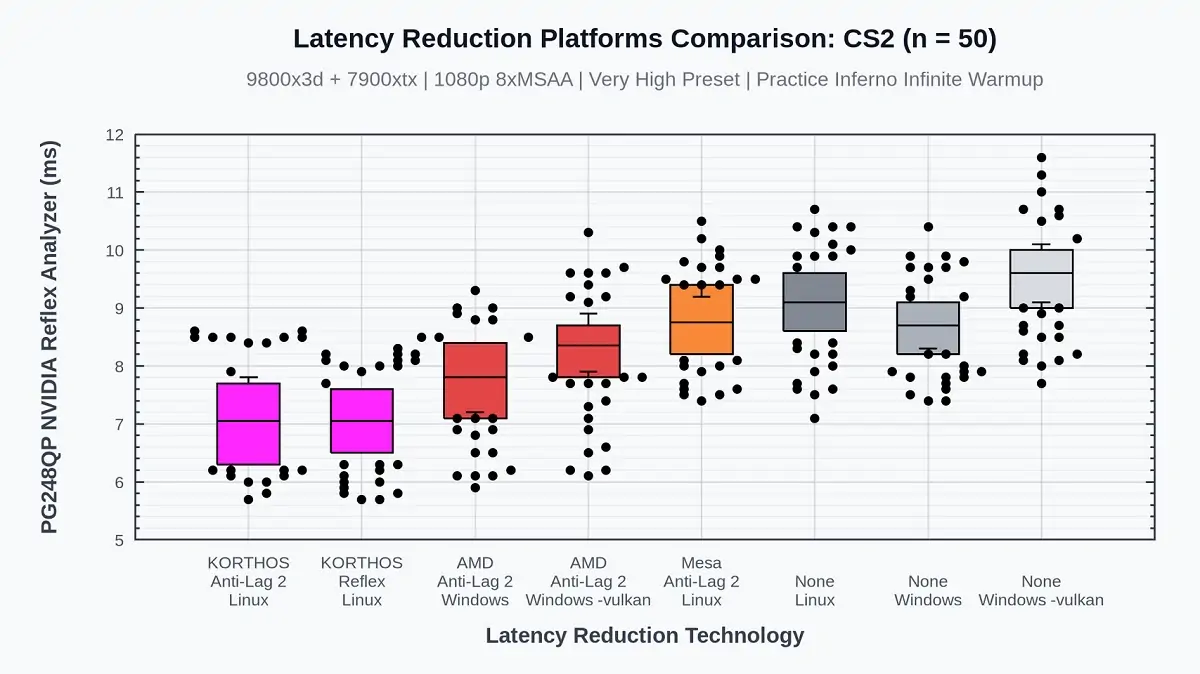
The developer ran exhaustive testing across six games, The Finals, Counter-Strike 2, Cyberpunk 2077, Resident Evil: Requiem, Marvel Rivals, and Overwatch 2, with hundreds of test runs per game. The results show the layer performing as well as or better than the proprietary Windows implementations of both Reflex and Anti-Lag 2 on the same hardware, which is a remarkable result for a community-built open-source project.
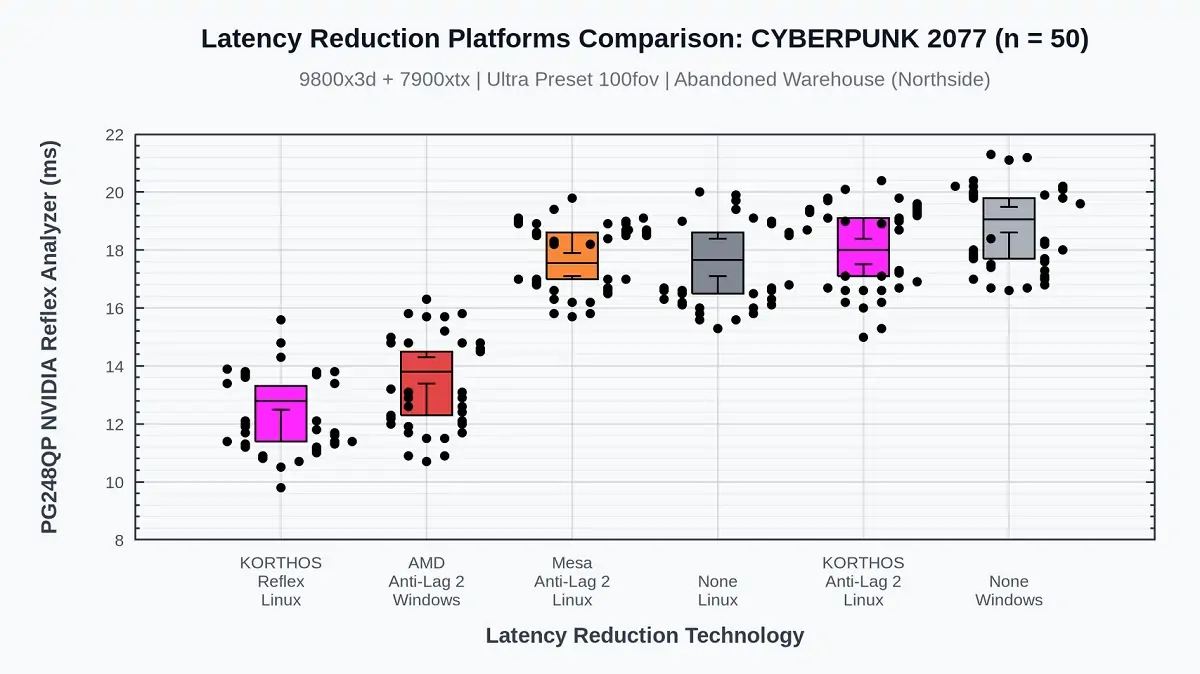
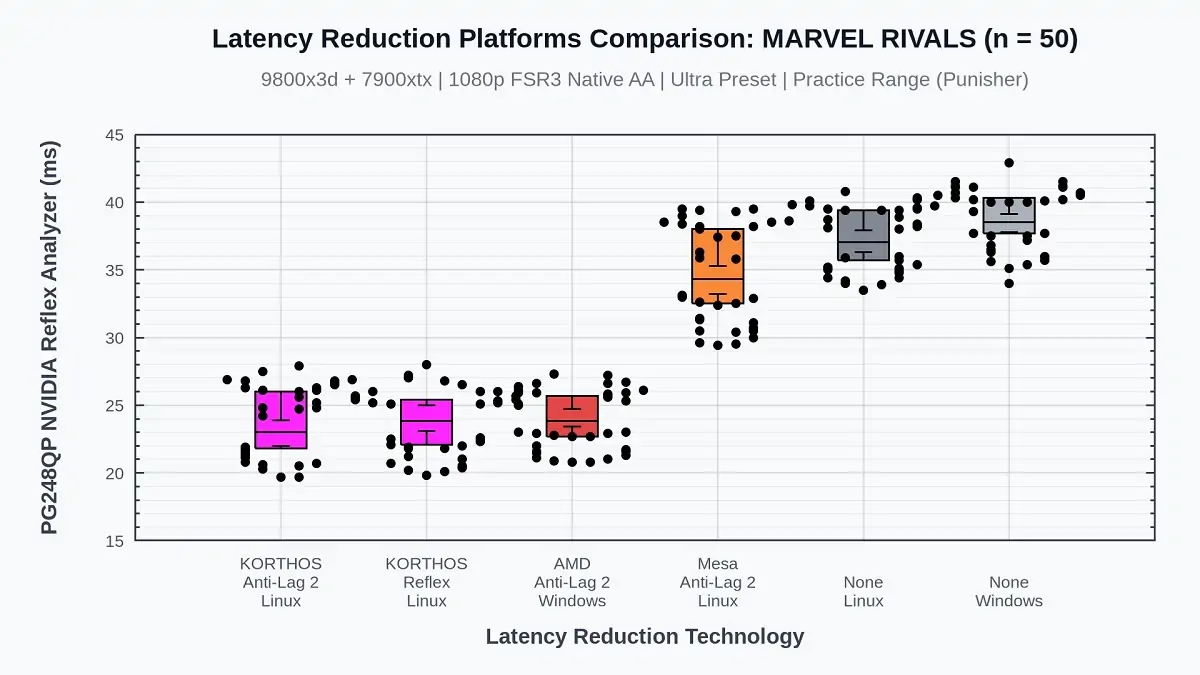
In Marvel Rivals, input latency on an AMD Radeon RX 7900 XTX dropped from around 40ms down to as low as 20ms using NVIDIA Reflex through the layer, more than a full frame of latency saved. In Counter-Strike 2 and Cyberpunk 2077, the results were equally strong, with latency matching or beating native Windows numbers in both cases.
In Marvel Rivals specifically, AMD Anti-Lag 2 and NVIDIA Reflex performed identically through the layer, which confirms the implementation is solid across both technology paths.
One additional detail worth highlighting: because far more games support NVIDIA Reflex than AMD Anti-Lag 2, AMD and Intel GPU users on Linux have historically been left out of latency reduction features in many titles. This layer closes that gap completely by allowing Reflex to run on non-NVIDIA hardware.
Steam Deck users can benefit too
The implications for Steam Deck and Steam Machine users are significant. Since the layer works under SteamOS, users who manually install it can enable either AMD Anti-Lag 2 or NVIDIA Reflex in any supported game running on Valve’s handheld or on SteamOS-based systems.
The installation does require basic familiarity with the Linux terminal, but the GitHub page includes clear instructions to walk users through the process.
This is also not the first time the Linux gaming community has pulled off something like this. Projects like VKD3D-Proton have previously brought AMD FSR4 and Anti-Lag support to DirectX 12 games on Linux, and the community has consistently found ways to bring features to the open platform that were previously exclusive to Windows.
The low_latency_layer follows that same tradition, and in some tested cases, it actually surpasses what Windows can offer natively with the same hardware.
The project is available now on GitHub under the Korthos-Software organization. For competitive Linux gamers who have been missing out on low-latency features, this is one worth installing.
Are you a Linux gamer who’s been waiting for something like this? Tell us in the comments what GPU you’re running and if you’re going to give it a shot!