



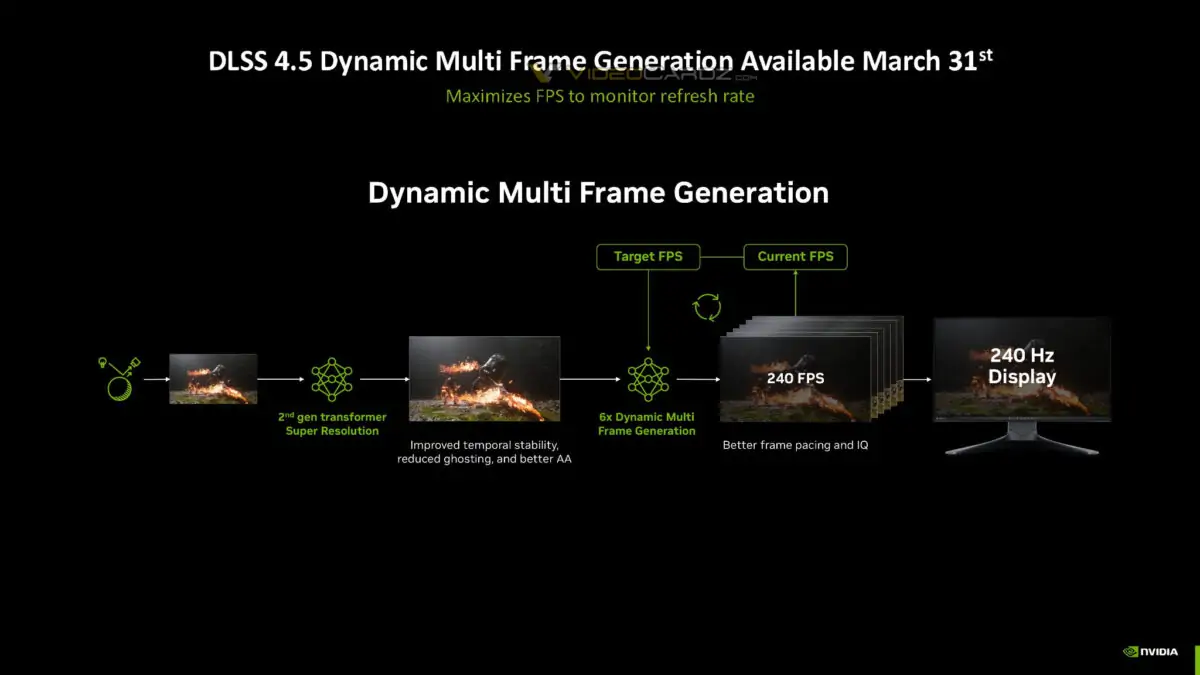
NVIDIA confirmed this March 10 that DLSS 4.5 Dynamic Multi Frame Generation will arrive on March 31, narrowing down what had been a vague “Spring 2026” window announced at CES 2026 back in January. The feature had also been previously reported as targeting April, so this update actually moves things ahead of schedule, a rare move in the PC hardware world, where delays are far more common than early arrivals.
The rollout will happen through the beta channel of the NVIDIA App, meaning RTX 50-series owners who want in on day one will need to head over to the Settings > About section before the end of the month and enable beta releases. Over 200 games will support the feature at launch, which is a solid starting point for something this new.
What Dynamic Multi Frame Generation actually does
Multi Frame Generation has been around since DLSS 4 debuted at CES 2025, letting GeForce RTX 50-series GPUs generate additional AI-synthesized frames on top of each traditionally rendered one. The original version worked with a fixed multiplier, you picked 2x or 4x and stayed there no matter what was happening on screen. Dynamic Multi Frame Generation changes that logic completely by making the system adaptive in real time.
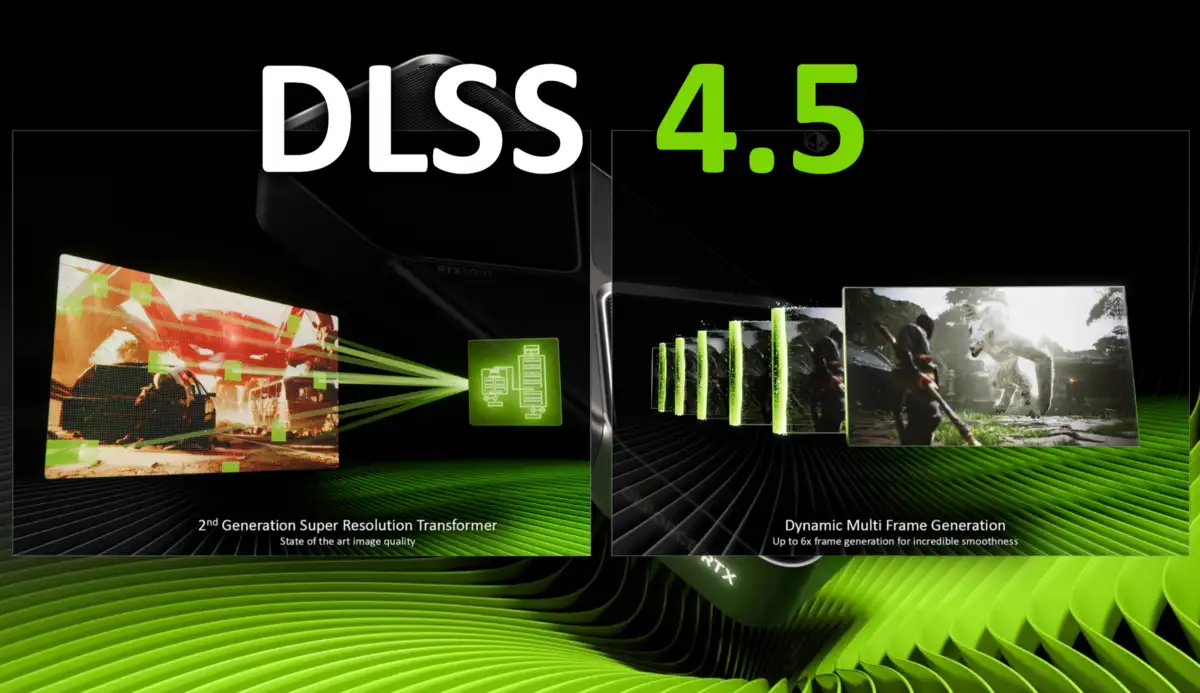
Instead of locking in on one multiplier, the technology adjusts automatically based on how demanding the current scene is and what refresh rate your monitor is targeting. If your frame rate is already hitting 200 FPS in a calm outdoor area, it backs off and stops generating frames you don’t actually need.
The moment things get heavier, a packed action sequence, a dense city environment, a path-traced scene full of dynamic lighting, it ramps back up to keep output smooth. An NVIDIA rep explained it well during the CES 2026 demo: “If you went to a scene where it went up to 300 FPS, you’d see it lowering the multiplier because you’d be generating frames that are just being thrown out. This is a smarter way to use it.”
Alongside Dynamic Multi Frame Generation, the new 6X mode launches on the same date. That means five AI-generated frames for every one that the GPU renders traditionally, a combination that NVIDIA says can push 4K path-traced gaming well past 240 FPS on RTX 50-series hardware. Both features are exclusive to the RTX 50-series lineup, so if you’re on an RTX 40 or older card, these specific upgrades won’t apply to you.
The full DLSS 4.5 picture
Dynamic Multi Frame Generation is the feature everyone’s been waiting on, but it’s worth remembering that DLSS 4.5 as a whole has already been partially available since January. The 2nd generation transformer model for Super Resolution rolled out to all NVIDIA App users at CES 2026, bringing improved image quality to over 400 games and apps across every GeForce RTX generation, not just the RTX 50 series.
This new Super Resolution model is the result of eight years of continuous research, and it uses five times the compute power of the original transformer model introduced with DLSS 4. It was trained on a significantly larger and higher-quality dataset, which gives it a much better grasp of how game scenes actually look, sharper edges, cleaner motion, and improved lighting detail compared to what the previous model delivered.
One of the more interesting technical changes is how it handles lighting. Previous DLSS models processed images in logarithmic space to reduce flickering, but that approach had a side effect of compressing colors and dimming high-contrast scenes, making bright neon lights and vivid reflections look muted. The new model processes images in linear space, the same space the game engine uses natively, which means glowing lights and reflections retain their actual color range and intensity rather than getting flattened.
For those on RTX 20 and RTX 30 series cards, there’s a catch: those GPUs don’t support FP8 precision processing, which is what allows the new model to run efficiently on RTX 40 and 50 series hardware.
On older cards, the 2nd generation transformer does carry a more noticeable performance hit, and some community tests have recorded drops of 20% or more compared to DLSS 4.0 in certain scenarios. NVIDIA itself recommends that users on those older cards stick to Model K, the DLSS 4.0 preset, for a better balance between quality and performance.
How it held up at CES and what comes next
Hands-on time with Dynamic Multi Frame Generation at the NVIDIA booth during CES 2026 left a good impression on those who got to try it. The demo ran on The Outer Worlds 2, moving between a relatively light cockpit environment that needed only 2x to 4x frame generation to hit its target, and a denser interior scene that required 6x to keep up. Rapidly switching between the two areas didn’t produce any visible stuttering or jarring transitions, the system handled the shift smoothly even under deliberate stress testing.
That kind of stability matters because frame generation has always had a reputation for introducing ghosting and artifacts during fast motion or abrupt scene changes. The cleaner behavior seen in the demo is encouraging, though the real test will come once the feature is in the hands of thousands of players across hundreds of different game configurations.
On the competitive side, NVIDIA’s position in the upscaling space continues to look strong. A recent blind image quality test conducted by German outlet ComputerBase across six titles, including Cyberpunk 2077, ARC Raiders, and Horizon Forbidden West, put DLSS 4.5 at 48.2% of all votes, ahead of both AMD’s FSR 4 and native TAA rendering. AMD and Intel are both pushing their own frame generation solutions this year, but that kind of result in a blind test is hard to argue with.
March 31 is shaping up to be a meaningful update for anyone who invested in an RTX 50-series card, the piece that was still missing from DLSS 4.5 since January is finally about to land.
Are you excited to try out Dynamic Multi Frame Generation when it drops on March 31? Tell us what you think in the comments, we’d love to hear from the community!