

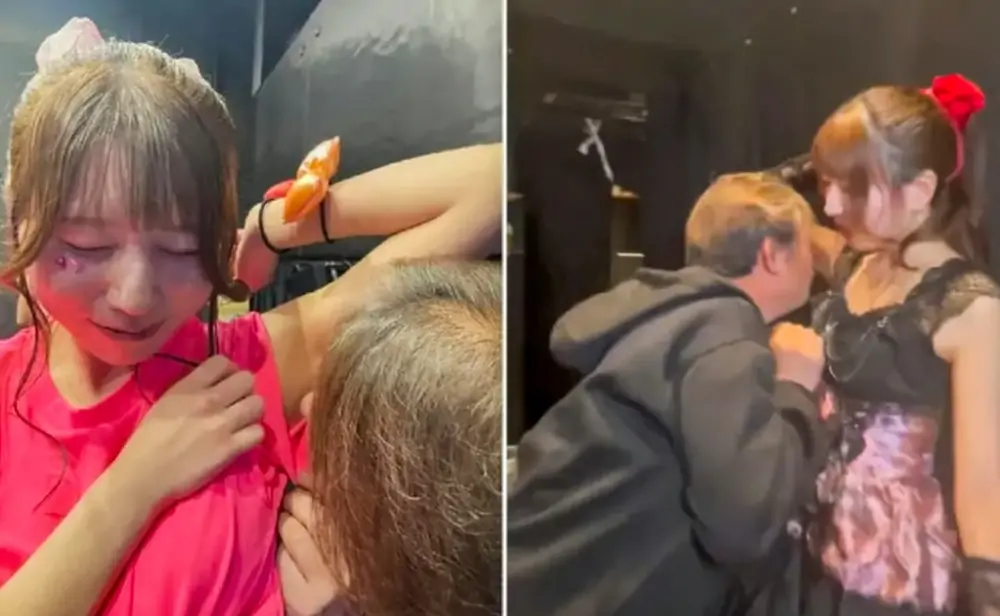

Hari Matsumoto, an underground idol from Wakayama on Japan’s Honshu island, is at the center of one of the most bizarre controversies to hit the internet this week. The singer has built a following of over 400,000 people on social media thanks to her bubbly personality and approachable charm, but her latest move to keep fans loyal has triggered a massive wave of outrage online.
Matsumoto decided to ditch the traditional post-show handshakes and hugs and replace them with a paid armpit-sniffing service during her meet-and-greet sessions. The videos spread fast, and the internet, predictably, lost its mind.
A devoted fan even shared a photo with the caption: “I really like your scent. The reason I was born was to meet Hari. I love you.” Others went further, reportedly signing what some described as “loyalty contracts,” pledging to hand over their income and cut off relationships with other women. That level of devotion might be hard to wrap your head around, but in Japan’s underground idol world, it’s not as far outside the norm as it sounds.
What it actually means to be an underground Idol
To understand how a story like this even happens, you need to know what being an underground idol in Japan looks like from the inside. These idols usually perform in small theaters, livehouses, and shopping centers, and unlike top-tier celebrities on TV, they build their base through direct, and sometimes unconventional, fan interactions to stand out in a crowded scene. There’s no major label backing, no prime-time TV slots, no magazine covers. Their entire career depends on how close they can get to their fans, literally.
The financial reality of that world is rough. While the average monthly income of a typical Japanese worker sits around $1,880 USD, underground idols usually earn less than half of that, below roughly $753 USD per month. Some agencies are known to not pay basic salaries at all, withhold wages, and unfairly dismiss idols for arbitrary reasons. That’s not a side hustle gone wrong, that’s the standard operating condition for most of these performers.
The mental health toll is just as severe. A survey conducted by a Japanese company involving 102 idols revealed that more than half of respondents experienced mental health issues while active. Additionally, 48% reported workplace harassment, and 12% experienced sexual harassment.
According to the documentary The Youth of Japanese Underground Idols, about 80% of Japanese idols work under these kinds of difficult conditions. That context doesn’t excuse anything, but it does explain why someone might feel cornered into crossing lines they probably never imagined crossing.
The viral clips and the internet’s very divided reaction
The whole thing blew up when the videos started circulating. In one widely circulated clip, an older male fan is seen mimicking a puppy, excitedly raising his fists before leaning in to sniff Matsumoto’s armpits with her consent. She then holds him in a comforting gesture. It’s the kind of clip that stops you mid-scroll, stare at your screen, and genuinely wonder what you just watched.
The reaction online split into two very clear camps. On one side, hardcore fans doubling down on their loyalty. On the other, a much louder majority calling it out. The approach was called “disgusting” by several users. “It is better to think of it as low-priced adult entertainment rather than idols,” one commenter said. Another user expressed something closer to sadness: “I feel sad for Matsumoto,” noting that the underground idol industry frequently condones actions that would be unethical in other professions, such as selling body fragrances or disclosing private lives.
That last point is actually worth sitting with for a second. Selling sweat-soaked items, bottled personal fragrances, and hyper-intimate fan experiences isn’t new in this scene. The armpit sniffing is just the version that finally broke through to international headlines.
The phenomenon isn’t limited to Japan either, similar underground idol cultures are beginning to emerge in cities like Shanghai and Hong Kong, fueled by the growth of live-streaming and fan-driven economies. So this isn’t just a quirky, isolated story from Japan, it’s a signal of where parasocial relationships and extreme fan monetization are heading on a much larger scale.
What adds another layer to the whole thing is that Matsumoto herself hasn’t said a word publicly about why she introduced this. The reason behind Matsumoto’s decision has not been made public. Was it her choice? Her agency’s idea? A calculated move to go viral and grow her numbers? Nobody knows, and that silence is only feeding the debate.
A large part of Matsumoto’s 400,000 followers continue to support her despite the controversy, which tells you something about the nature of this kind of fandom. When fans reach the level of devotion where they’re signing lifetime loyalty contracts, a viral scandal isn’t going to shake them loose. If anything, it probably pulls them closer.
What this story keeps coming back to, underneath all the shock and outrage, is a much more uncomfortable conversation about what the underground idol industry is actually asking of its performers. The system is built on proximity, devotion, and financial dependency, and the people who end up paying the steepest price aren’t the fans.
What do you think, is this just another wild chapter of fan culture, or has the underground idol industry crossed a line it can’t walk back? Tell us in the comments!