



Intel kicked off Embedded World 2026 with a bold announcement. On March 9 in Nuremberg, Germany, the company officially launched the Intel Core Series 2 processor with P-cores, a chip designed from the ground up for industrial computing, edge AI, robotics, and healthcare technology. This is not a consumer chip. It was never meant to be.
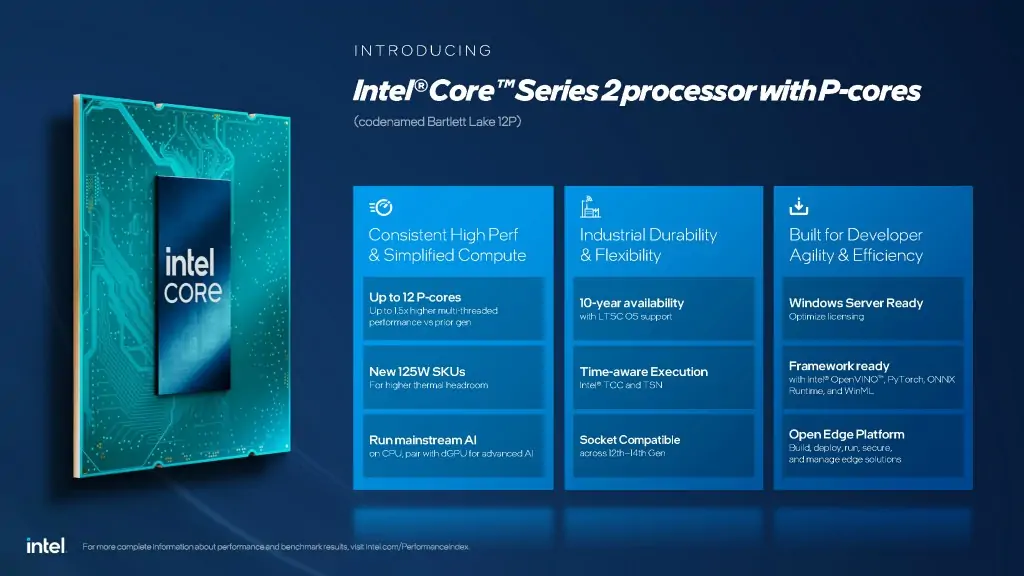
The processor family, formerly codenamed Bartlett Lake 12P, packs up to 12 performance cores, all P-cores, no efficiency cores anywhere in the architecture. That’s a very deliberate decision, and it signals exactly what kind of workloads this chip was built for.
What makes the Core Series 2 different
In industrial and edge computing, the challenge isn’t just speed, it’s consistency. Systems running factory floors, safety-critical controls, or real-time data pipelines can’t afford a processor that performs brilliantly 95% of the time and stutters the other 5%. They need a CPU that responds predictably, every single time, no exceptions.
That’s precisely what Intel engineered here. The Core Series 2 delivers up to 12 cores and 24 threads with clock speeds reaching 5.9 GHz. It supports up to 192 GB of DDR5 memory at 5,600 MT/s with ECC support, meaning the chip can detect and correct memory errors on the fly, which is non-negotiable in mission-critical environments. Connectivity includes up to 16 PCIe Gen 5 lanes, 4 PCIe Gen 4 lanes, support for up to four 4K displays, discrete Wi-Fi 7, Bluetooth 5.4, and an integrated 2.5-GbE MAC.
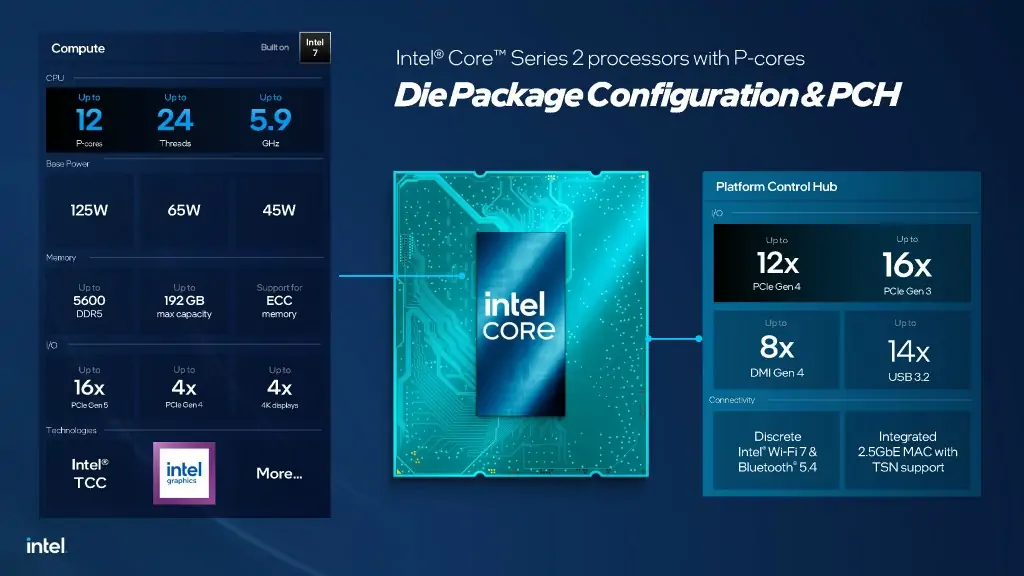
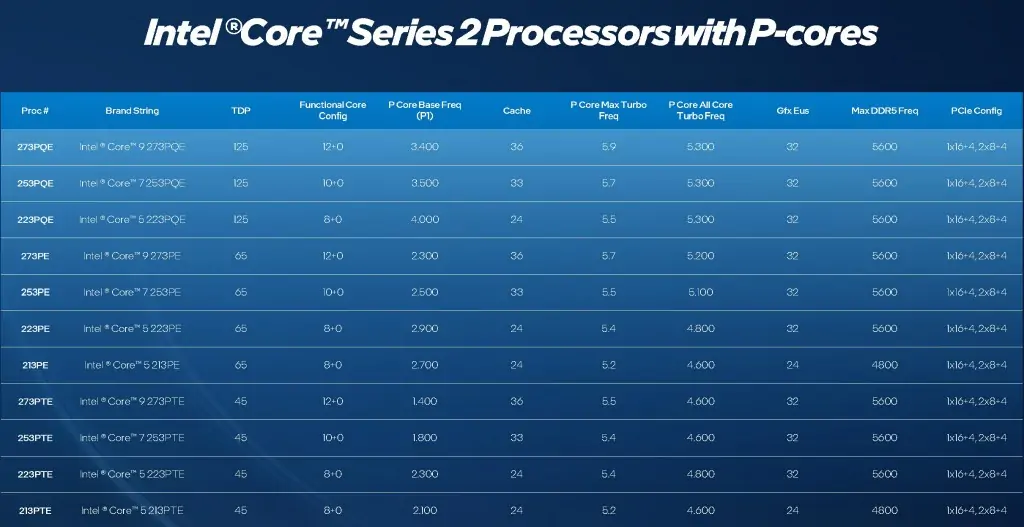
It comes in three TDP configurations: 45W, 65W, and 125W, giving system designers real flexibility. It’s also compatible with 12th through 14th generation LGA sockets, which means existing platforms can be upgraded without starting from scratch. And for the kind of long-haul industrial deployments where stability matters as much as performance, Intel is backing the chip with up to 10 years of availability guarantee.
Intel’s time-coordinated computing and time-sensitive networking support are what really set it apart from standard x86 options. Those two technologies are what allow the chip to achieve what Intel calls deterministic performance, the ability to process workloads with precise, reliable timing, not just raw throughput.
The numbers Intel is putting on the table
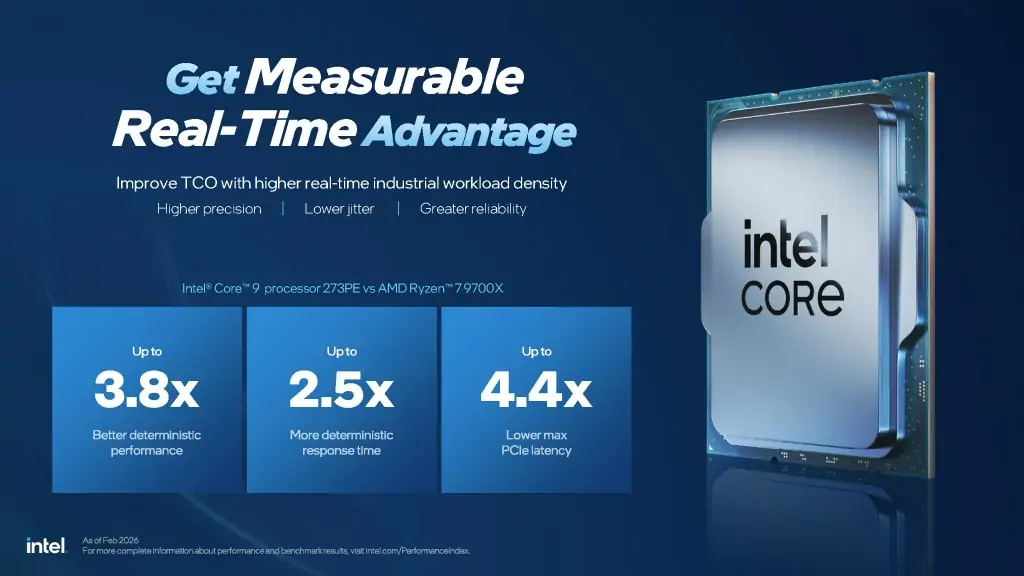
Intel came to Nuremberg with benchmarks aimed directly at AMD. Compared to the Ryzen 7 9700X at the same 65W TDP, Intel claims the Core Series 2 delivers up to 4.4x lower max PCIe latency, up to 2.5x more deterministic response time, up to 3.8x better deterministic performance, and up to 1.5x higher multi-thread performance. These are Intel’s own internal numbers, so they’re best taken as positioning rather than independent validation, but they paint a clear picture of where Intel wants this chip to live in the market.
Michael Masci, vice president of product management at Intel, put it plainly: the chip was built “for industrial and edge deployments where consistency, longevity, and real-time performance matter just as much as raw compute.” And Dan Rodriguez, Intel’s corporate VP and general manager of the Edge Computing Group, added that edge computing remains “one of our fastest-growing business segments“, a signal that this launch is not a side project for Intel, but a core part of where the company is heading.
Stephen Sopko, analyst-in-residence for HyperFrame Research, offered a more measured read: “Intel’s bet is that predictable timing matters more than raw AI throughput. In mission-critical environments like healthcare and industrial, they may be right.”
Intel also has a play for healthcare AI
The Core Series 2 wasn’t the only thing Intel unveiled in Nuremberg. Alongside the chip, the company launched its sixth Edge AI Suite, this one focused on Health & Life Sciences. The suite provides validated reference pipelines and benchmarking tools built specifically for AI-powered patient monitoring solutions, covering workloads like AI-based ECG arrhythmia detection, remote photoplethysmography for vital-sign monitoring, and anonymous 3D patient tracking.
The idea is to give medical device manufacturers, OEMs, ODMs, and independent software vendors, a way to evaluate platform performance using real-world scenarios instead of synthetic benchmarks. That matters because the certification and development cycle for medical AI devices is long and expensive. Anything that shortens it is a meaningful advantage.
Healthcare systems are under real pressure right now, with rising patient volumes and constrained staffing pushing demand for smarter, edge-based monitoring solutions. Intel is positioning itself as the infrastructure backbone for that shift, with a platform that can run AI workloads locally, without needing to send data to the cloud.
Edge systems powered by Intel Core Series 2 and the previously announced Core Ultra Series 3 processors are available now. The Health & Life Sciences Edge AI Suite is accessible in preview on GitHub, with general availability planned for Q2 2026.
Intel showed up to Embedded World with a very specific answer to a very specific problem. Whether the industry buys it, literally and figuratively, is the next question.
Do you think Intel’s all P-core bet is the right move for edge AI, or is AMD still in the fight? Tell us what you think in the comments!