



Intel officially announced the Arc Pro B70 and Arc Pro B65 on March 25 at its Pro Day 2026 event in New York. These are the first GPUs based on Intel’s new BMG-G31 chip, also known internally as “Big Battlemage,” and they sit at the top of the Arc Pro B-Series lineup, above the B60 and B50 that were already on the market. The B70 is Intel’s most powerful discrete GPU to date, period.
The previous Arc Pro B-Series cards were built on the BMG-G21 chip and topped out at 24GB of memory. The BMG-G31 is a larger chip built on the same TSMC N5 process node, but it brings significantly more cores and memory capacity to the table. Intel is positioning both new cards entirely for professional workloads, AI inference, content creation, engineering, and software development. This is not a gaming launch.
The B70’s specs are serious
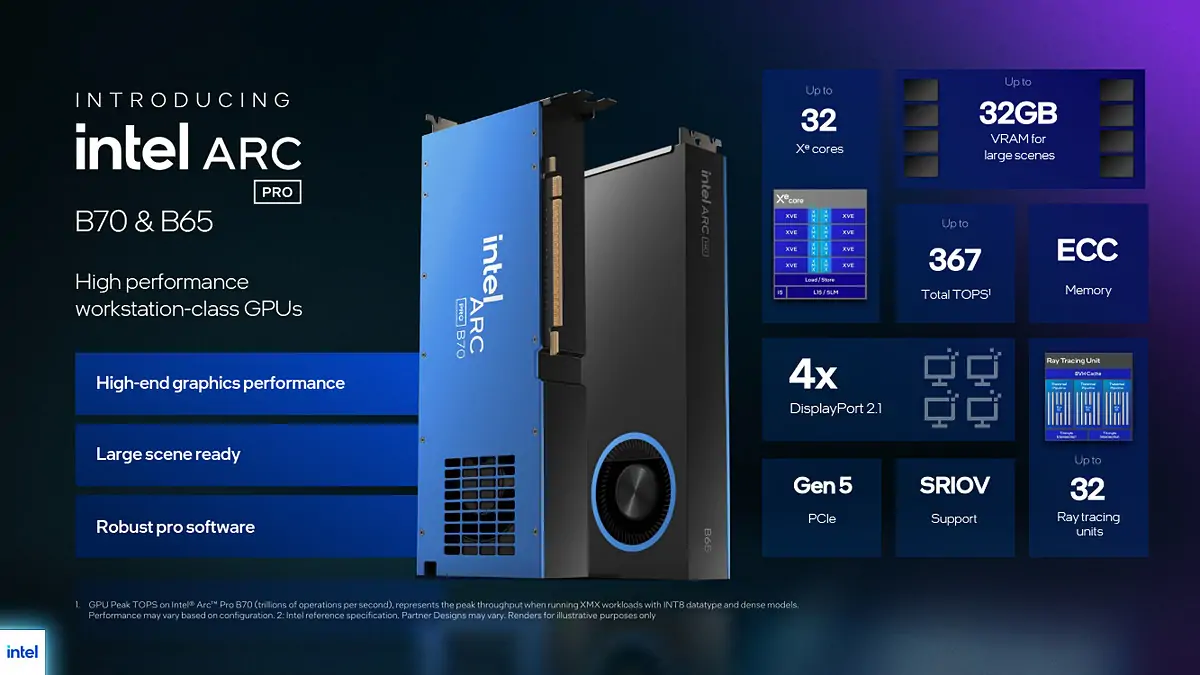
The Arc Pro B70 packs 32 Xe2-HPG cores, 256 XMX Engines, 32 ray tracing units, and delivers up to 367 INT8 TOPS for AI workloads. It carries 32GB of GDDR6 memory on a 256-bit bus interface, clocked at 19 Gbps for a total bandwidth of 608 GB/s. The GPU clock hits 2800 MHz. For display output, the card has four DisplayPort 2.1 connections and connects to the system via PCIe 5.0 x16.
On the power side, Intel’s own branded variant runs at 230W through a single 16-pin connector. AIB partner models can range from 160W up to 290W, giving manufacturers flexibility to design cards for different workstation form factors. The card supports multi-GPU configurations on Linux, which means teams can chain multiple B70s together to run AI models that exceed the 32GB VRAM limit of a single card.
API support covers DX12 Ultimate, oneAPI, OpenCL 3.0, OpenGL 4.6, Vulkan 1.3, and OpenVINO, along with hardware-accelerated encode and decode for AV1, HEVC, H.264, and VP9. The card also comes with ECC memory support, which is a requirement in enterprise environments where data integrity matters.
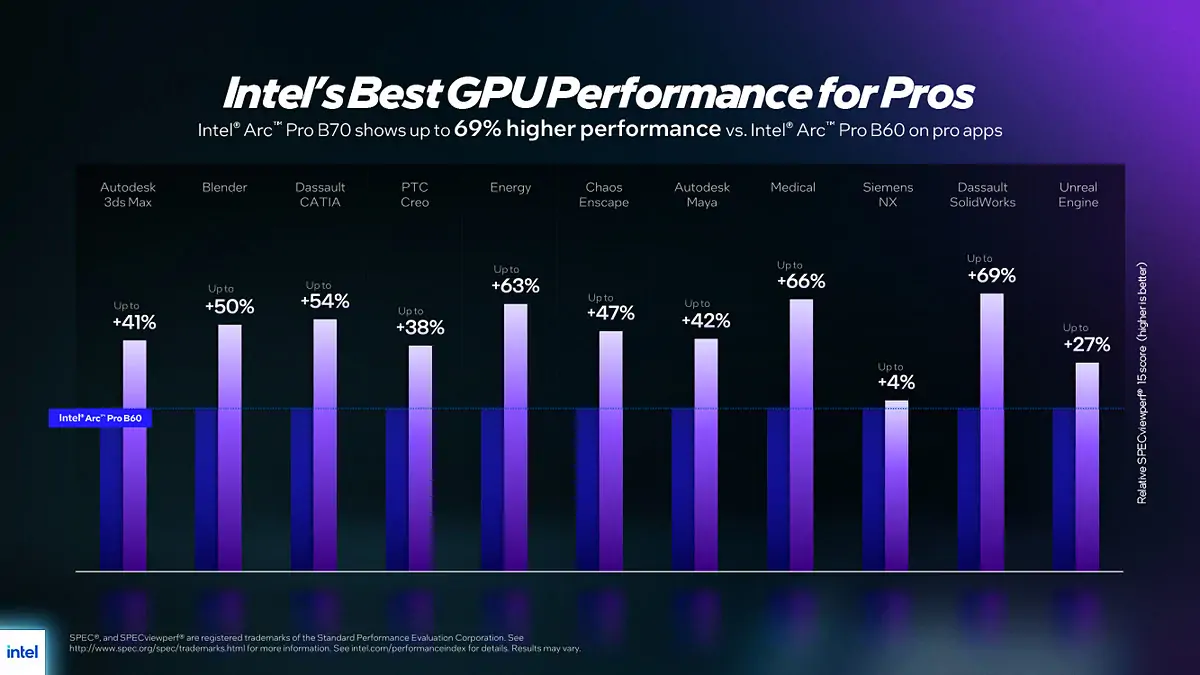
Compared to the Arc Pro B60, the B70 brings 60% more Xe cores and 50% more memory, translating into up to 69% higher performance across professional workstation applications measured in SPECviewperf 15. Intel also certifies the Arc Pro B-Series with independent software vendors, covering tools like AutoCAD, SolidWorks, Maya, 3ds Max, Inventor, Revit, and Enscape, which is an important checkbox for any professional shop.
Intel is going after NVIDIA’s RTX Pro 4000 head-on
The main competitor Intel is targeting with the B70 is NVIDIA’s RTX Pro 4000. The core advantage Intel is pushing is VRAM, 32GB on the B70 versus 24GB on the RTX Pro 4000, and that difference shows up significantly in local AI inference workloads.
For Llama 3.1 8B, the Arc Pro B70 achieves a context window of approximately 93K tokens, compared to 42K on the RTX Pro 4000, roughly 2.2 times larger.
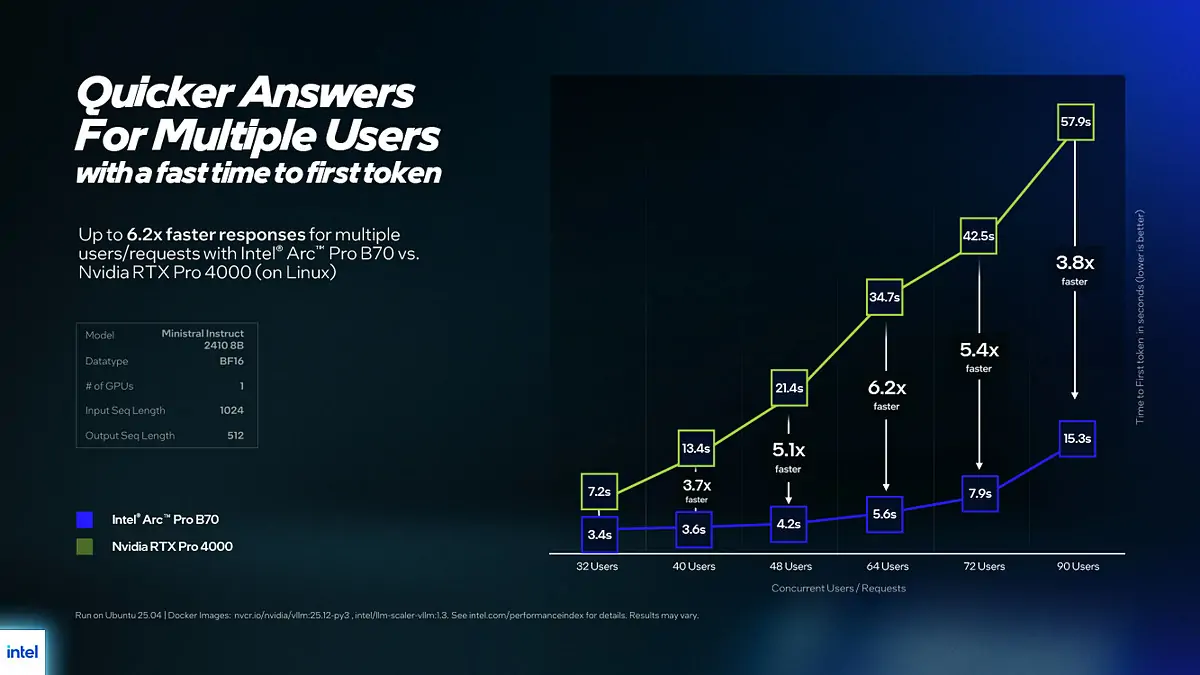
Intel also claims up to 85% higher token throughput in multi-user workloads, up to 6.2 times faster time to first token output, and up to 2 times better tokens per dollar. These are Intel’s own benchmark numbers, so independent testing will be necessary to confirm them in real-world conditions, but the direction is clear, Intel built this card specifically to win the local AI inference argument.
The pitch makes sense given where the industry is heading. More companies are moving AI workloads out of the cloud and onto local hardware for privacy, cost, and latency reasons. A card with 32GB of ECC VRAM at a $949 starting price is a legitimate option in that conversation, especially for teams that can’t justify the cost of dedicated data center hardware.
What about the B65, and what’s next?
The Arc Pro B65 uses a cut-down version of the same BMG-G31 chip. It has 20 Xe2-HPG cores, 160 XMX Engines, 20 ray tracing units, and delivers up to 197 TOPS. It runs at 2400 MHz and carries 32GB of GDDR6 memory on a 192-bit bus at a 200W TDP.
Think of it as a more accessible entry point for teams that need the memory headroom but not the full compute power of the B70. The B65 launches in mid-April 2026 exclusively through AIB partners, there is no Intel-branded version, and pricing will come in below the B70.
Intel also previewed a future GPU called “Crescent Island,” built on the newer Xe3P architecture and aimed at even larger-scale LLM inference tasks. No specs or release date were shared, but it signals Intel has a longer roadmap planned for this space.
One question still hanging in the air is whether Intel will release a gaming version of the BMG-G31 chip. The Arc B770 that gamers have been waiting for remains unannounced, and Intel made no mention of it at Pro Day 2026. For now, Big Battlemage is strictly a professional product.
The Intel Arc Pro B70 is available starting today from Intel and AIB partners including ARKN, ASRock, Gunnir, Maxsun, and Sparkle, starting at $949. The Arc Pro B65 follows in mid-April.
Do you think Intel has what it takes to take on NVIDIA in the workstation GPU market, or is it too little too late? Tell us in the comments!