



Google released Gemma 4 on April 2 and AMD didn’t wait a single day to respond. The company announced Day Zero support for the complete Gemma 4 model family across its entire hardware lineup, Instinct GPUs for data centers, Radeon GPUs for workstations, and Ryzen AI processors for AI PCs. All of them, ready from day one, no waiting around.
For anyone who hasn’t been following the AI model scene lately, Gemma 4 is Google’s latest family of open-weights models, built from the same research behind Gemini 3. It comes in four sizes ranging from 2 billion to 31 billion parameters, and every single variant supports text, image, and video input. The two smallest models, E2B and E4B, also handle audio. All of them support context windows of up to 256,000 tokens, understand more than 140 languages, and are released under the Apache 2.0 license, meaning developers can use them commercially without any restrictions or caps.
One of the more technically interesting pieces of this launch is the 26B A4B variant, which uses a Mixture of Experts architecture. It has 26 billion total parameters but only activates 4 billion of them during each inference pass. In practical terms, you get the reasoning quality of a much larger model while using a fraction of the compute. That matters a lot for anyone running these locally.
The entire software stack is already ready
AMD didn’t just flip a switch and call it compatibility. They came with a full list of tools already working on day one. Gemma 4 runs on AMD hardware through vLLM, SGLang, llama.cpp, Ollama, Lemonade, and LM Studio. That covers pretty much every tool that developers and enthusiasts actually reach for when they want to run local AI models.
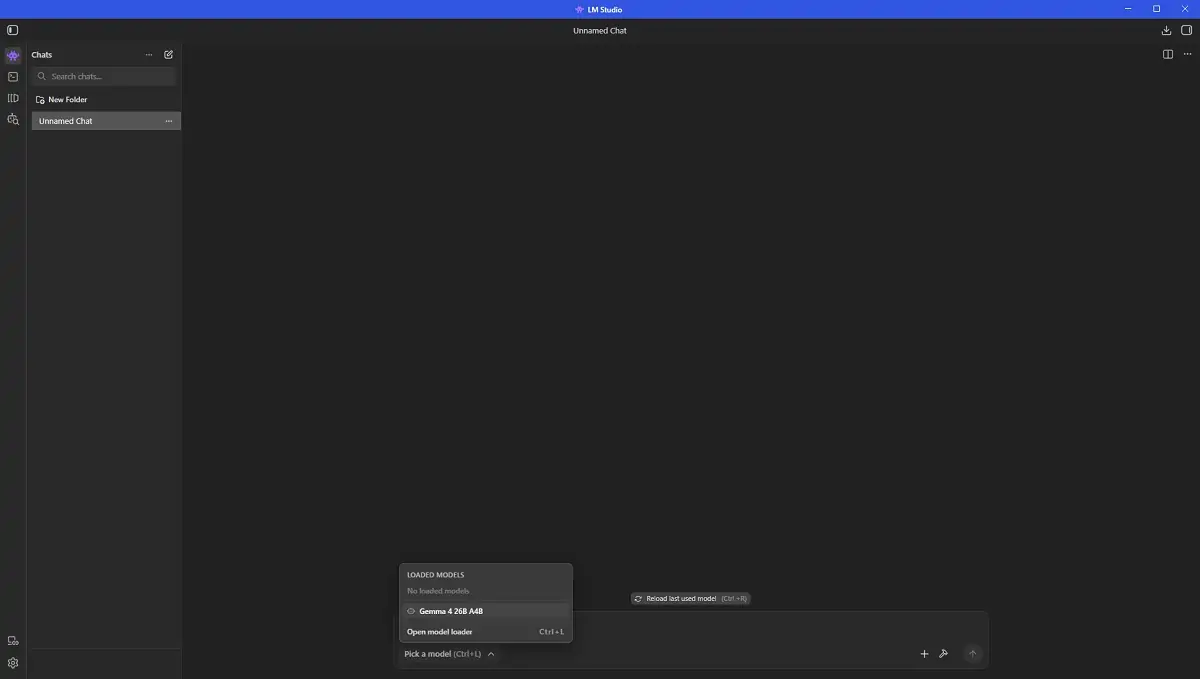
For anyone who wants the simplest possible path to running Gemma 4 locally, LM Studio is the answer. Users with Ryzen AI or Ryzen AI Max processors, or with Radeon and Radeon PRO graphics cards, can download LM Studio and pair it with the latest AMD Software: Adrenalin Edition drivers. That’s genuinely it, no complex setup, no command line wizardry required.
For developers who need more control, vLLM covers them. AMD confirmed that the whole range of its GPUs supported by vLLM, spanning multiple generations of both Instinct and Radeon cards, works with Gemma 4 models. That’s a meaningful detail because it means people aren’t forced onto the newest hardware to participate. Older Radeon cards are part of the equation too.
SGLang is also supported, specifically for AMD MI300X, MI325X, and MI35X GPUs, which are the datacenter-grade Instinct accelerators. The entire Gemma 4 family works with it, including both dense models and the MoE variant. A single MI300X with its 192GB of HBM memory can run the full model at maximum context length without needing any multi-GPU setup.
Ryzen AI and NPU users are getting their moment too
This is where AMD’s announcement gets interesting for everyday users who aren’t running server hardware. Lemonade Server, an open-source local LLM server with OpenAI-compatible APIs, supports Gemma 4 deployment on Radeon and Radeon PRO GPUs via ROCm, and also on Ryzen AI processors through the XDNA 2 NPU.
NPU support, meaning the Neural Processing Unit built into Ryzen AI chips, is coming specifically for the Gemma-4 E2B and E4B models with the next Ryzen AI software update. Once that lands, the update will be integrated directly into Lemonade and also available as OnnxRuntime APIs for developers who want lower-level access. Running a compact AI model on the NPU instead of the GPU means significantly better power efficiency, which is a big deal for laptop users who don’t want their fans spinning constantly.
AMD put it clearly in its announcement: the company covers everything from small models running on the NPU all the way to orchestrating multiple models across Instinct GPUs simultaneously. That’s a range that goes from a thin-and-light laptop all the way to a data center rack, which very few companies can actually claim with a straight face.
The timing of all this matters. Since Google launched the first generation of Gemma models, developers have downloaded the model family more than 400 million times and built over 100,000 variants. Gemma 4 launching under Apache 2.0 for the first time is expected to accelerate that even further, and AMD clearly wants Radeon and Ryzen AI hardware to be the home base for as much of that activity as possible.
ROCm, AMD’s open-source GPU compute platform, has matured considerably over the past couple of years. More frameworks now include first-class AMD support without requiring workarounds, and announcements like this one are evidence that the gap between AMD and NVIDIA in the AI software ecosystem is getting smaller. When a major model drops and AMD is ready on day one across consumer and enterprise hardware, that’s not a coincidence, that’s a strategy.
For users sitting on a Radeon GPU or a Ryzen AI laptop wondering whether their hardware can actually keep up with the AI wave, this announcement is a clear yes. The models are there, the tools are ready, and the drivers are already out.
Are you planning to run Gemma 4 on your AMD hardware? Tell us in the comments, we want to know what you’re building!