



If you own an AMD Radeon RX 6000 or RX 7000 series GPU, this story concerns you directly. FSR 4, AMD’s newest and most impressive upscaling technology, officially only supports RDNA 4 cards, the Radeon RX 9000 series. But here’s the thing: it also runs on your older card. AMD knows it. The community proved it. And AMD has been responding with the same line for almost a year: “We have no information to share.”
This is the full story of how that happened.
AMD’s own code leak proved the technology works
When FSR 4 launched, AMD’s official explanation for limiting it to RDNA 4 made sense on the surface. FSR 4 was built around FP8 instructions, a hardware feature exclusive to RDNA 4. It was the same reasoning NVIDIA has used for years to tie DLSS to specific Tensor Core generations. Most people accepted it and moved on.
Then came August 20, 2025.
While releasing the FidelityFX SDK 2.0, AMD accidentally published the full FSR 4 source code on GitHub. Among those files was a version of FSR 4 built to run on INT8 instructions instead of FP8. INT8 is supported by virtually all modern GPUs, including RDNA 2 and RDNA 3. AMD pulled the files within hours, but it was already too late.
A Reddit user known as AthleteDependent926 compiled the leaked INT8 files into a working DLL. Since FSR 3.1 already supported DLL swaps, enabling FSR 4 on older cards was as simple as dropping the file into a game’s directory. Within days, the community had FSR 4 running on an RX 7900 XTX, an RX 6800, and even NVIDIA RTX 30 series cards.
Hardware Unboxed, VideoCardz, and ComputerBase all ran independent tests in October 2025. Their findings were consistent: FSR 4 INT8 delivers noticeably better image quality than FSR 3.1 on older hardware. Fine details like vegetation, fences, and character models showed clearer, more stable results.
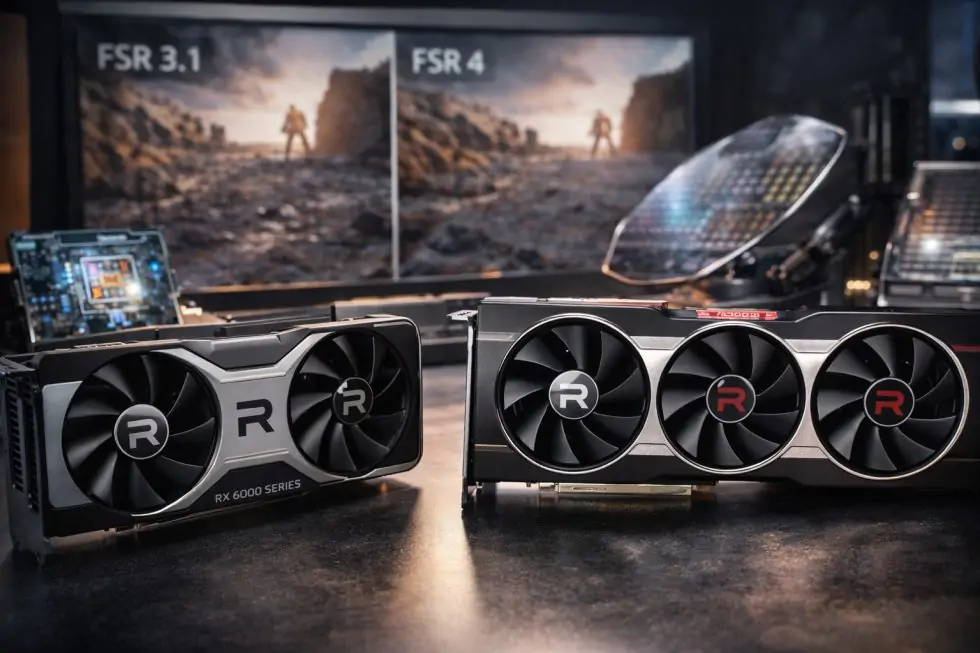
The trade-off is a 9 to 13 percent performance hit compared to FSR 3.1 on RDNA 2 and RDNA 3, roughly 6 to 7 fewer frames per second on an RX 7900 XTX at 1440p in testing. Hardware Unboxed concluded the technology was ready for an official release.
That was in October 2025. As of early 2026, AMD still hasn’t shipped it.
NVIDIA went in the opposite direction
In December 2025, AMD released FSR Redstone, a major update that added ML-powered frame generation and ray regeneration. FSR 4 INT8 for older GPUs was not included.
A few weeks later, at CES 2026, NVIDIA announced DLSS 4.5. The update introduced a second-generation transformer model with substantially improved image quality. It’s available on GPUs all the way back to the RTX 20 series, which launched in 2018, over seven years of continued feature support.
The performance cost on older hardware is real. RTX 30 series users see around 20 percent lower frame rates with DLSS 4.5 compared to DLSS 4.0, and NVIDIA recommends sticking with the previous version on older cards if performance is a priority. But NVIDIA gave users a choice. AMD hasn’t given Radeon owners anything.
When Hardware Unboxed asked AMD directly in February 2026 about the status of FSR 4 INT8 for RDNA 2 and RDNA 3, the official response was: “No updates to share at this time.” Andrej Zdravkovic, AMD’s Senior Vice President of GPU Technologies and Engineering, was asked at CES 2026 whether AMD could release a beta version of Redstone for RDNA 3. His response: “That’s currently not in the plan, but thanks for the hint.”
That was the official acknowledgment after months of community requests.
The community is losing patience
RDNA 2 launched in November 2020. RDNA 3 launched in December 2022. Neither architecture is old enough to justify being left behind, especially when the technology to support them exists and has been sitting in leaked files since August.
The r/radeon subreddit has been vocal. Multiple threads have users saying their RX 7900 XTX will be their last AMD card and that the trust built over years is gone. The frustration is notable because it’s not coming from NVIDIA fans, it’s coming from people who specifically chose Radeon to avoid NVIDIA’s pricing and ecosystem lock-in, and who now feel AMD is doing the same thing.
There is one thread worth following. In early March 2026, an FSR 4.1 DLL leaked from an internal AMD Vanguard driver build, version 26.3.1. According to early community testing, FSR 4.1 shows improved foliage detail and sharper textures compared to FSR 4.0.3, with some informal comparisons suggesting Ultra Performance mode quality approaches FSR 4.0.3’s Quality mode, though these are community observations, not controlled benchmarks.
The leak also confirms FSR 4.1 runs on RX 7000 series hardware with workarounds.
Crimson Desert launches March 19 as the second FSR Redstone-supported title, and some are hoping AMD uses that window to officially release FSR 4.1, possibly with expanded architecture support. That remains speculation for now.
What isn’t speculation: AMD has the technology, the community has proven it works, and the only thing missing is the decision to release it. Loyal Radeon owners are still waiting for more than a “thanks for the hint.”
What do you think, should AMD stop stalling and just release FSR 4 INT8 for RDNA 2 and 3? Let us know in the comments!