



If you woke up this morning and thought your internet was having a meltdown, don’t worry, it wasn’t just you. League of Legends players couldn’t get their ranked matches in, X users were left shouting into the void, and even ChatGPT decided to take an unscheduled coffee break. The culprit? A massive hiccup in Cloudflare’s cloud services that sent ripples across the digital universe.
For a few chaotic hours, some of the internet’s biggest platforms went dark, leaving millions of users staring at error messages and wondering if they’d forgotten to pay their internet bill. Spoiler alert: your Wi-Fi was fine. The problem was much bigger than that.
The domino effect nobody wanted
Cloudflare isn’t exactly a household name, but it’s the invisible backbone holding up a massive chunk of the internet. Think of it as the stage crew of a Broadway show, you don’t see them, but without them, the whole production falls apart. When their content delivery network stumbled, it took down everything from social media giants to gaming servers and AI chatbots.
The casualty list read like a who’s who of digital life: League of Legends, X (formerly Twitter), ChatGPT, DownDetector (ironically, the site people use to check if things are down), BlueSky, Spotify, and countless other platforms. Gamers couldn’t game, social media addicts couldn’t scroll, and people trying to get work done with AI assistants were suddenly on their own.
The reason these outages spread so fast? Cloudflare operates a massive network of data centers scattered across the globe. When something goes wrong on their end, it doesn’t just affect one region, it’s a worldwide problem. One domino falls, and suddenly half the internet is displaying error screens.
What actually happened?
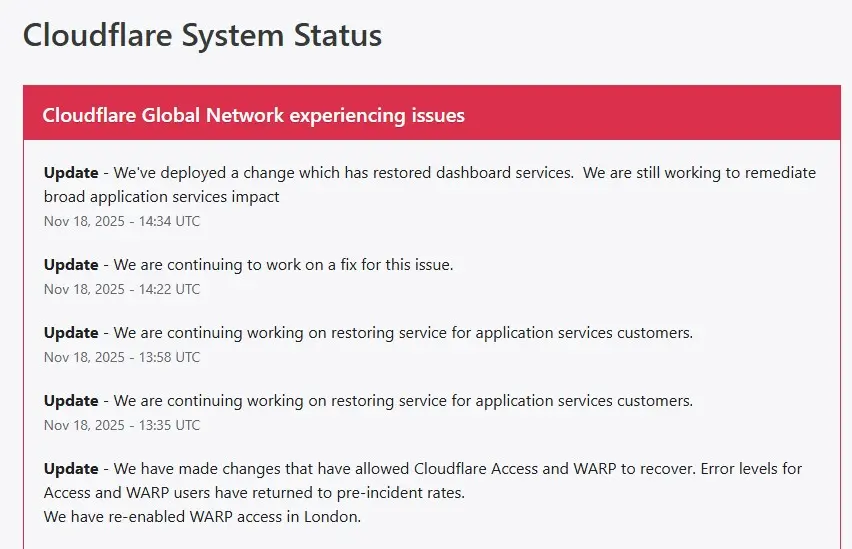
According to Cloudflare’s official statement, the company experienced what they diplomatically called “internal service degradation.” In plain English: something broke on their end, and it broke hard. The technical team identified the issue and scrambled to fix it, but not before millions of users encountered the dreaded message: “Please unblock challenges.cloudflare.com to continue.”
“Cloudflare is experiencing internal service degradation. Some services may be affected intermittently. We are working to restore service. We will keep you informed as soon as we can resolve the issue. More updates coming soon,” the company announced.
While some services started coming back online within the hour, the disruption served as yet another reminder of how fragile our digital infrastructure really is. We’ve built an internet where a handful of companies control the pipes, and when those pipes burst, everyone gets wet.

This keeps happening
Here’s the uncomfortable truth: massive internet outages are becoming disturbingly routine. Just a few weeks ago, Amazon Web Services had its own moment of chaos, taking down Fortnite, Roblox, Genshin Impact, Apex Legends, and a laundry list of other games. PlayStation Network went offline, Epic Games Store became unreachable, and even streaming services like Crunchyroll and Amazon Prime Video hit the pause button.
The pattern is clear. As more of our digital lives get concentrated in the hands of a few massive cloud providers, we’re all just one technical glitch away from a collective timeout. It’s the price we pay for convenience, everything works seamlessly until it doesn’t, and then nothing works at all.
For now, the Cloudflare situation appears to be resolving itself. Services are gradually coming back online, error messages are disappearing, and the internet is returning to its normal state of controlled chaos. But the next time you can’t log into your favorite game or social media platform, remember: it might not be your internet connection. Sometimes, the problem is way bigger than your router.
And maybe, just maybe, it’s a good excuse to finally touch some grass.