

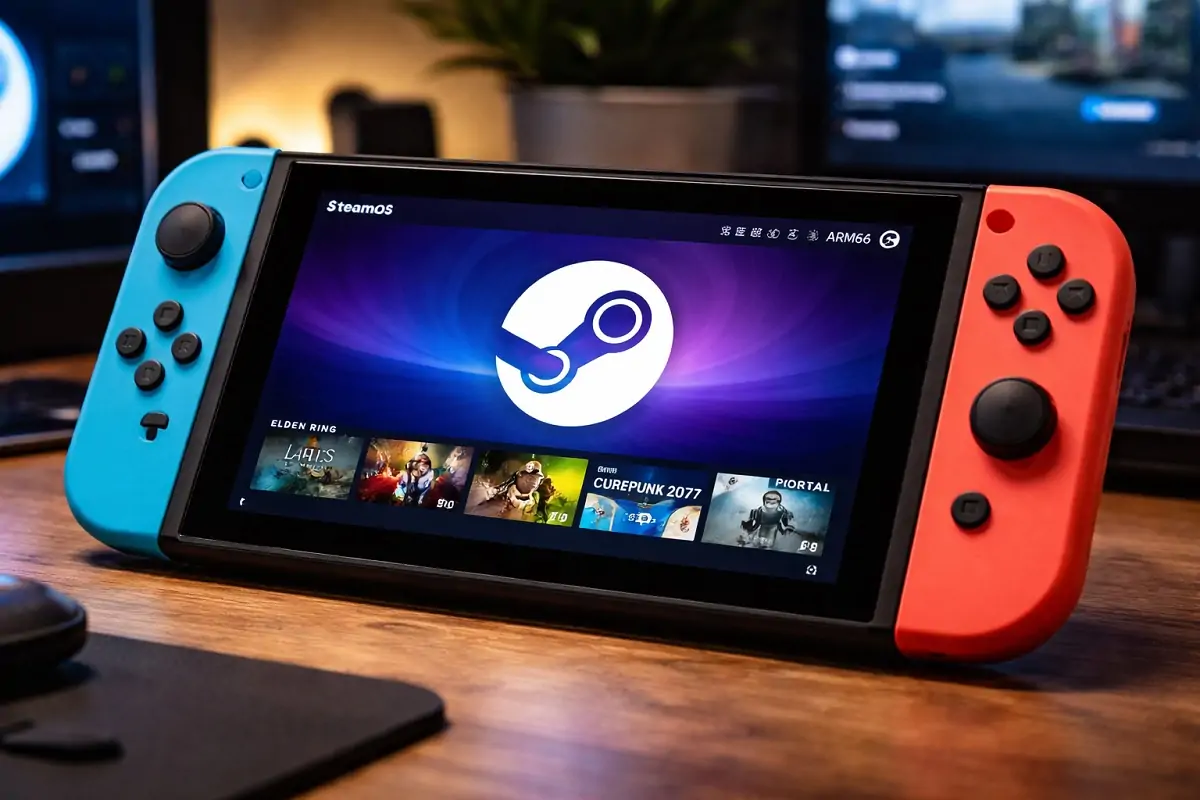

Valve’s decision to expand Proton support to ARM64 hardware is already generating its first real-world experiments, and the results are exactly as wild as the handheld gaming community was hoping for. On April 16, 2026, a developer known as AAGaming, also a contributor to the Decky Plugin Framework, posted a video on Bluesky showing the Steam Linux ARM64 beta client running on an original Nintendo Switch.
The device was running Ubuntu 24.04.2 LTS, with the ARM64 version of Steam injected directly onto the hardware. It was the first public demonstration of Valve’s new ARM-compatible tooling running on Nintendo’s iconic handheld, and it immediately spread across gaming forums and tech publications worldwide.
The experiment came just one day after Valve released Proton 11.0-Beta1, the next major update to its Windows-to-Linux compatibility layer. Alongside a long list of game fixes and improvements, the release included a separate ARM64 build, and buried in its patch notes was a single line that caught the attention of every Linux gaming enthusiast paying attention: “Added FEX-2604 for ARM64EC builds.”
FEX is an open-source emulator designed to translate x86 code so it can run on ARM-based Linux devices, and Valve has been funding the project since its early days. That one patch note effectively opened the door for Steam to run on any ARM Linux device, and AAGaming walked right through it.
Steam Linux ARM64 beta on Switch
— aagaming (@aagaming.me) April 16, 2026 at 4:18 PM
A difficult process with a clear proof of concept
Getting Steam to actually boot on the Switch was not straightforward. According to AAGaming, the process is hard to replicate: they had to locate the correct manifest, download each individual zip file, extract them on top of each other in sequence, and then write a custom launch script to get the client to start.
There is no installer, no simple guide, and no shortcut. That said, AAGaming also shared a working copy of Proton ARM combined with the Steam Runtime ARM that can be dropped into the compatibilitytools.d folder, and mentioned they are working on packaging everything up to make it easier for others to replicate.
The Steam client boots and the interface is functional, but no games can actually be launched yet. The reason comes down to the age of the Switch’s hardware. The original Switch runs on a Nvidia Tegra X1 chip released in 2015, and its Linux kernel is too outdated to support FEX’s requirements.
Without FEX working, there is no x86-to-ARM translation layer, which means PC games through Proton cannot run. Whether this limitation can be worked around on the original Switch remains an open question, but for now the experiment proves the concept: SteamOS ARM64 can boot on the hardware, even if actual gaming is still several steps away.
Why Valve is pushing ARM support now
The timing of this development is not coincidental. Valve has an ARM64 device of its own arriving in 2026: the Steam Frame, a standalone VR headset powered by a Qualcomm Snapdragon 8 Gen 3 processor running SteamOS. The headset relies on FEX to translate x86 Windows game code on the fly so it can run on the ARM-based chip, making FEX integration into Proton a direct requirement for the product to function as advertised.
The ARM64 build of Proton 11 is essentially infrastructure work for the Steam Frame, and developers like AAGaming are already stress-testing it on whatever ARM hardware they have available, in this case, a jailbroken Nintendo Switch.
The broader implication is significant for the handheld gaming market. Proton has historically been limited to x86 hardware, which meant SteamOS could only run on devices with Intel or AMD processors, like the Steam Deck. With ARM64 support now in active development, the pool of compatible devices expands considerably.
Android-based handhelds from manufacturers like AYN, AYANEO, and Retroid, all of which run ARM chips, could eventually run SteamOS natively, turning them into something closer to portable Steam Decks than Android gaming devices. The Nintendo Switch experiment, messy and limited as it is, is an early glimpse of where that path leads.
FEX itself is worth understanding in this context. Paired with Proton, it is theoretically capable of making thousands of Windows PC games available on ARM Linux devices without developers needing to port or optimize anything for the new architecture.
That removes one of the biggest barriers to ARM gaming adoption, which has historically required either native ports or significant developer effort to make existing software work on non-x86 hardware. If Valve continues refining this pipeline, and the Steam Frame gives them every reason to, the gap between a traditional gaming handheld and a portable PC will continue to close.
The Nintendo Switch demo is still firmly in experimental territory. No games run, the setup requires significant technical knowledge, and the hardware limitations of the Tegra X1 may prove difficult to overcome entirely. But someone booted Steam on a Nintendo Switch using Valve’s own ARM64 tooling, within 24 hours of that tooling becoming publicly available. That alone says a great deal about where things are headed.
Do you think SteamOS on ARM will eventually turn any handheld into a portable Steam Deck? Leave your take in the comments!