



The clock is ticking, and according to OpenAI CEO Sam Altman, it’s ticking a lot faster than most people think.
Speaking at the India AI Impact Summit 2026 in New Delhi, Altman delivered one of the most consequential speeches in recent tech history, warning world leaders, policymakers, and pretty much everyone else: early forms of superintelligence could arrive as soon as 2028, and the world is simply not ready for it.
“On our current trajectory, we believe we may be only a couple of years away from early versions of true superintelligence,” Altman said. He was careful to add “we could be wrong,” but the weight of that statement lingered in the room long after he finished. And honestly, it should.
More brainpower inside data centers than inside human skulls
Here’s the stat that really hit different: Altman claimed that by the end of 2028, more of the world’s intellectual capacity could exist inside data centers than outside them, meaning the combined processing power of AI systems would surpass that of the entire human population. Let that sink in for a second.
We’re not talking about a smarter Siri or a better autocomplete. We’re talking about systems that, according to Altman, could outperform human CEOs and leading research scientists.
Nobel Prize-level breakthroughs generated by a machine humming in a server room. Corporate strategy decided by an algorithm with a better track record than any living executive.
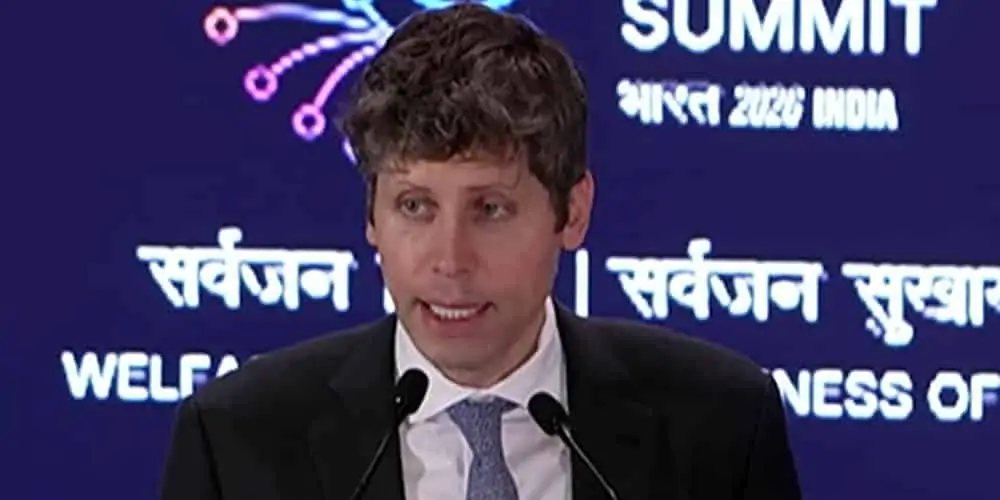
And Altman didn’t spare himself from this reality either, he openly admitted that AI superintelligence would be capable of doing a better job as CEO of a major company than any executive, “certainly me.”
That’s a remarkably honest thing to say when you’re the guy building the very system that could replace you.
The progression has been almost dizzying to watch. Just over a year ago, AI systems struggled with high-school-level math. Today, they’re contributing to theoretical physics and research-level mathematics.
“It’ll be very hard to outwork a GPU,” Altman said, half joking, half warning. The cost of intelligence, he argued, is dropping so fast that it could eventually approach the cost of electricity, abundant, accessible, and reshaping everything in its path.
Your job might be next, and that’s not a drill
Beyond the philosophical implications, there’s a very practical question on everyone’s mind: what happens to work?
Altman didn’t sugarcoat it. He confirmed that real displacement by AI of different kinds of jobs is coming, and that the impact will begin to be palpable within the next few years. He acknowledged that some companies are currently engaging in “AI washing”, blaming unrelated layoffs on AI, but was clear that the real wave of disruption hasn’t fully hit yet.
Experts predict a transition period where AI automates specific tasks like coding or customer service, potentially displacing up to 20% of white-collar roles, while simultaneously creating new jobs around managing, directing, and collaborating with these systems.
Jobs that require deep human connection, complex negotiation, and genuine creativity are expected to be the most resilient. The ones that don’t? Well, Altman was blunt about those too, some categories of work will simply be gone, full stop.
Still, he’s not entirely doom and gloom about it. “We always find new and better things to do,” he said, framing this as just the latest chapter in a long history of technological revolutions that humanity has ultimately adapted to, even if the ride was bumpy.
The world needs an AI watchdog, right now
The bigger conversation that came out of New Delhi wasn’t just about timelines. It was about control. Altman called for international cooperation on AI governance, proposing a global regulatory body similar to the International Atomic Energy Agency, essentially a nuclear-era-style watchdog, but for artificial intelligence.
The logic is straightforward: if one country or one company ends up holding the keys to superintelligence, things could go very wrong, very fast.
“Some people want effective totalitarianism in exchange for a cure for cancer. I don’t think we should accept that trade-off,” Altman said bluntly.
His argument is that AI should expand human agency, not replace it, and that concentrating this kind of power in a single entity would be catastrophic. Without a unified global front, experts warn we risk a “race to the bottom” where companies simply move their development to the least restrictive jurisdiction.
Sound familiar? It’s the same playbook we’ve seen with tax havens and data privacy, and it never ends well.
The geopolitical stakes are enormous. The EU is already moving with its binding AI Act. The US leans toward industry self-regulation under the current administration. And everyone else is scrambling to figure out where they fit in a world where the most powerful technology in human history is being built at breakneck speed with no unified rulebook.
OpenAI itself has acknowledged that stopping the creation of superintelligence would be extraordinarily difficult, given that the costs of building it decrease every year and the number of actors pursuing it keeps growing. In other words, this train has already left the station.
To his credit, Altman is also putting action behind his words. He announced a major strategic partnership with India’s Tata Group to build sovereign AI infrastructure, and rolled out over 100,000 ChatGPT Edu licenses to top Indian universities, a direct effort to prevent AI from becoming a toy exclusively for wealthy nations and corporations.
“No one country should be in charge of superintelligence,” he reiterated, calling for a world where multiple nations and cultures have a genuine stake in how this technology develops.
“The next few years will test global society,” Altman concluded, urging policymakers and citizens alike to engage in shaping AI’s trajectory before the decisions get made without them.
The window is open, but it won’t stay open forever.
Do you think the world’s governments are actually ready to handle something this powerful, or are we already behind? Drop your take in the comments, this one’s too big not to talk about!