



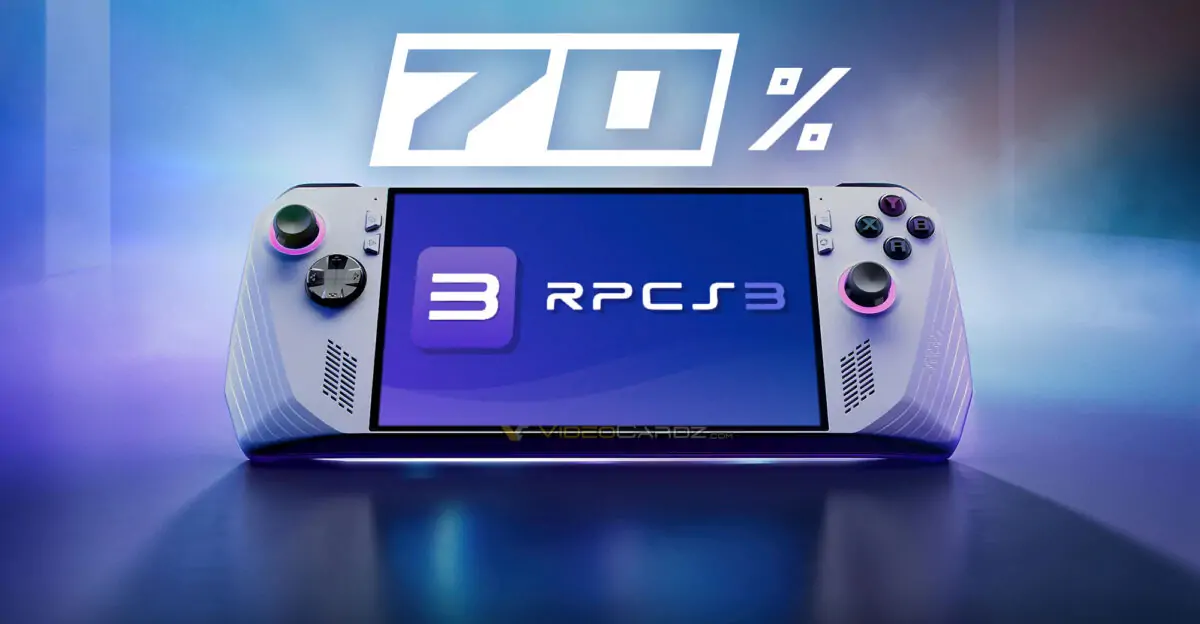
The PlayStation 3 emulator RPCS3 just crossed a threshold that once seemed like pure fantasy. According to their official compatibility database, over 70% of the entire PS3 library is now fully playable on PC, a number that’s been climbing steadily and quietly reshaping how we think about game preservation.
For context, this is massive. When RPCS3 first launched back in 2011, the idea of emulating Sony’s notoriously complex Cell processor was considered borderline impossible.
The PS3’s architecture, built around one PowerPC core and eight specialized co-processors called Synergistic Processing Elements, was so weird and demanding that even major developers struggled with it during the console’s lifespan.
Fast forward to January 2026, and here we are: Metal Gear Solid 4, Gran Turismo 5 and 6, Demon’s Souls, Ratchet & Clank, and God of War III all running smoothly on modern PCs, often at higher framerates than the original hardware ever managed.
Why the cell made emulation a nightmare
The PlayStation 3’s Cell architecture wasn’t like anything on a PC or really any other console. It required developers, and later, emulator creators, to essentially write code for multiple processors at once, with precise synchronization between threads.
The 128-byte cache lines and unique floating-point format made direct translation to modern x86 CPUs brutally CPU-intensive. RPCS3 tackles this by creatively mapping the Cell’s SIMD instructions to modern processors using AVX-2 and AVX-512, essentially abusing x86 instructions in ways they were never originally intended.
It’s clever engineering that’s taken years of trial and error to refine.
One of the RPCS3 developers explained it best: the primary challenge isn’t the GPU, modern hardware handles that easily, it’s accurately replicating the PS3’s internal processing.
That’s why emulation remains extremely CPU-heavy, with constant synchronization making your processor the main bottleneck. But the results speak for themselves.
Racing titles that barely launched before, like Gran Turismo 6 and GRID, now hit 60 FPS on decent hardware. MGS4, which required specialized patches just months ago, runs better than ever.
Game preservation matters more than ever
Here’s the thing about RPCS3 that goes beyond just playing old games: it’s preserving an entire generation of gaming that’s stuck on aging hardware.
Sony’s own backwards compatibility efforts don’t come close, even in 2025, if you want to play God of War 1 or 2 through PSN, you’re getting a version streamed from 2006 PS3 servers because Sony can’t emulate the PS2 well enough.
Meanwhile, RPCS3 is giving players higher resolution rendering, better controls, and long-term access to games that would otherwise be trapped on consoles that won’t last forever.
The emulator works on Windows, Linux, macOS, and even supports both x64 and ARM64 architectures.
The developers are clear about one thing: they don’t condone piracy. Users need to own legitimate copies of games, either through discs or the PlayStation Store, then dump them legally.
But once you’ve got your own copies running through RPCS3, you’re looking at an experience that often surpasses the original hardware, and one that ensures these games don’t disappear when the last working PS3 eventually dies.
With 26% of games still classified as “in-game” (playable but with crashes or performance issues) and less than 3% totally unplayable, the RPCS3 team isn’t slowing down.
The 70% mark isn’t a finish line, it’s proof that what once seemed impossible is now becoming routine.
Want more stories on emulation, retro gaming, and geek culture? Follow Geek Realm Hub on Facebook and stay plugged into the tech that’s reshaping how we play.