



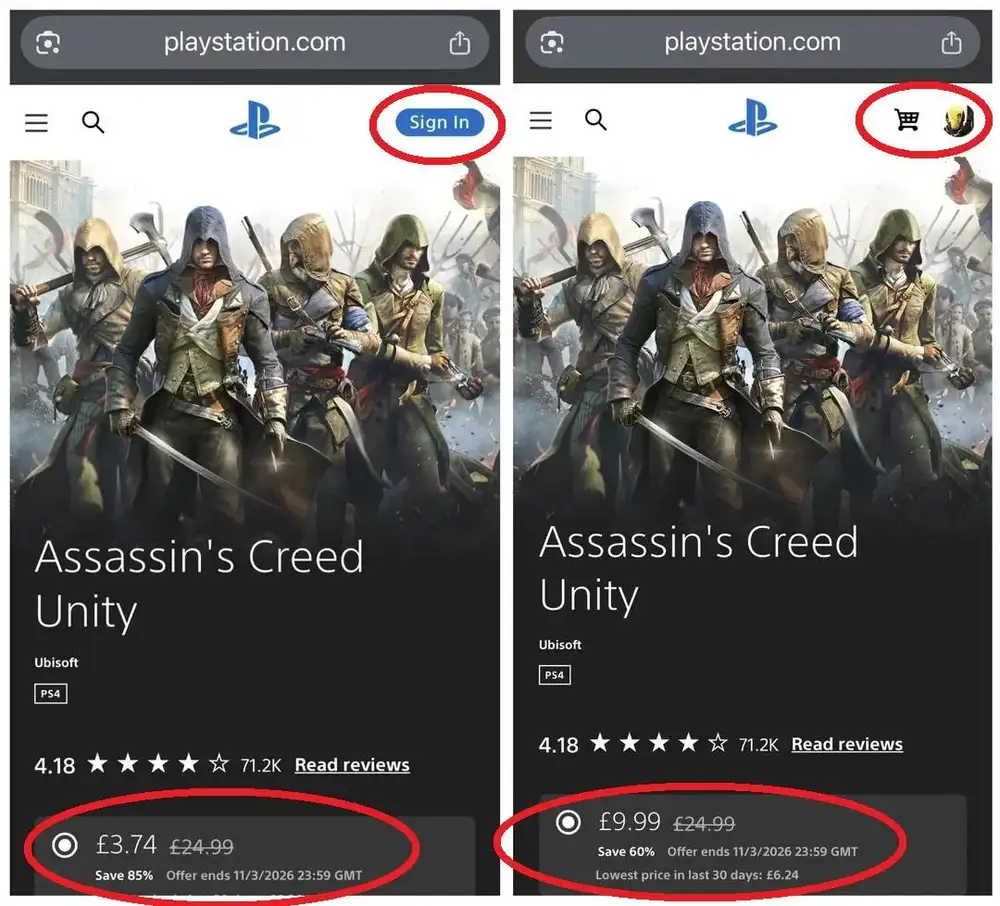
If you’ve been browsing the PlayStation Store recently and something felt off about the prices, you’re not imagining things. Since November 2025, Sony has been running a silent experiment that’s now hard to ignore: two players in the same country can open the exact same game page on the PlayStation Store and see completely different prices for the same title.
The whole thing was uncovered by PSPrices, a price-tracking website that monitors the PlayStation Store across more than 50 regions worldwide. Their system detected unusual offer structures buried inside PlayStation’s API responses, specifically tags labeled “IPT_PILOT” and “IPT_OPR_TESTING”, confirming that experimental prices are being shown exclusively to certain user segments hand-picked by Sony.
The experiment started with around 50 games across 30 regions and has since grown to over 150 games in 68 regions, now including Sony’s own first-party AAA titles: God of War Ragnarök, Marvel’s Spider-Man 2, HELLDIVERS 2, Stellar Blade, Gran Turismo 7, and The Last of Us Part II. Price differences range from 5.3% to 17.6%, and as a concrete example, WWE 2K25 normally sells for €74.99, but some users are seeing it listed at €61.82. The kicker? The players paying full price have no idea others are getting a discount on the exact same product.

Sony is not just testing prices, it’s testing sales too
What makes this experiment bigger than it initially appeared is that Sony isn’t only adjusting base prices. During the February 2026 PlayStation Store sales, PSPrices found that users inside the experiment also received different discount percentages than regular users, meaning Sony is testing personalized sales on top of personalized base prices.
The whole system is built around price elasticity: Sony wants to know exactly how sensitive different users and regions are to price changes, and how much they can adjust a number before a purchase stops happening. It’s a common practice in industries like airlines and concert ticketing, but applying it to a digital storefront where there’s no physical inventory, no shipping cost, and no real-world scarcity is what’s making players uncomfortable.
The community reaction has been swift and sharp. “This is completely anti-consumer. There’s no supply shortage; they can issue out downloads as much as they like. It’s just profiteering, simple as that,” one Reddit user wrote. Others echoed the same frustration, calling the practice “disturbing” and pointing out that even if the intent is to offer discounts to some users, the randomized and opaque nature of the system makes it fundamentally unfair, because there’s no way to know which group you’re in without comparing prices with someone else.
The regional problem nobody is talking about enough
The experiment currently covers Europe, the Middle East, Asia, Latin America, and Africa, while the United States and Japan are notably absent, likely because of stricter regulation and higher market sensitivity in those markets. That geographic spread is where the fairness argument gets thornier. Players in regions where purchasing power is already considerably lower are being subjected to pricing experiments without their knowledge or consent.
Two friends in the same city in Poland, Argentina, or Thailand could be paying different amounts for the same digital file, with zero transparency from Sony about why. There’s also a precedent problem here: Microsoft has been running dynamic pricing on the Xbox storefront since 2021, but their approach is more transparent, personalized prices are explicitly labeled as “Just For You” offers, so users at least know what they’re looking at.
Sony has no such label. There’s no opt-in, no notification, no indication on the store page. You’re either in the test group or you’re not, and the only way to find out is to check prices in an incognito window while logged out and compare them to what you see when logged in. Some analysts are already speculating this could evolve into a permanent feature of the PS6 era, the scale of the rollout, jumping from 50 games in 30 regions to 150 games across 68 in just a few months, suggests Sony isn’t casually experimenting.
They appear to be building infrastructure. And while the current test has only shown price decreases for selected users, dynamic pricing as a model doesn’t stay charitable forever. Once the data is collected and the system is established, there’s nothing stopping prices from moving in the other direction based on purchase history, browsing behavior, or account profile. Sony has made no official statement about any of this.
What do you think, is Sony building something genuinely useful or is this the beginning of a pricing nightmare for PlayStation players? Drop your take in the comments!