



Games launch broken, run at 40 frames per second, and somehow nobody panics. DLSS kicks in, the numbers go up, and players move on. Meanwhile, the real problem, the one developers are very quietly ignoring, keeps getting buried under a layer of AI-reconstructed pixels.
This isn’t some fringe complaint from overclockers on Reddit. It’s a pattern that’s been building for years, and it’s starting to define how games get made.
Not long ago, the deal was simple: you buy a game, it runs. Maybe not maxed out on mid-range hardware, but it ran without needing a software workaround just to hit 60fps. Doom Eternal became a benchmark not just for gameplay, but for how well id Software squeezed performance out of virtually any hardware configuration. Even a GTX 1650 could run it at 1080p with settings nearly maxed out. That was the standard.
Compare that to today, where titles routinely launch struggling to hold acceptable framerates even on high-end rigs, and the official response from developers is increasingly the same: turn on DLSS, enable FSR, use frame generation. Problem solved, at least on paper.
Developers are building games around the workaround
The moment that made this impossible to ignore came in July 2023, when Remnant 2 developer Gunfire Games posted on Reddit that they “designed the game with upscaling in mind.” Not optimized first, then enhanced with upscaling as a bonus. Designed from the start assuming players would need AI assistance just to make it run smoothly. The game launched in a poorly optimized state, and that statement confirmed what a lot of players had already suspected was becoming standard practice.
It only got worse from there. Monster Hunter Wilds launched in February 2025 with severe performance issues across the board, high-end and budget hardware alike struggled. It took nearly a year before Capcom delivered a meaningful fix, with the major Steam-specific performance patch arriving in late January 2026.
For almost twelve months, the standing recommendation was to rely on DLSS Frame Generation to compensate for the game’s problems. Borderlands 4 followed a similar path in September 2025, and Gearbox CEO Randy Pitchford made headlines for telling frustrated players on social media “I’m sorry you don’t like being told to use DLSS, but that is the way,” and suggesting those unhappy with performance should simply request a refund and play something else.
That kind of response would have been unthinkable a few years ago. Now it barely raises an eyebrow.
The reason it barely raises an eyebrow is because players have already normalized upscaling to the point where it’s just another launch setting. NVIDIA has reported that over 80% of GeForce RTX users with compatible hardware already have DLSS enabled. Eighty percent. Turning it on is as automatic as adjusting gamma at the start of a new game. It’s just what you do now.
AI upscaling is impressive, that’s exactly why it’s dangerous
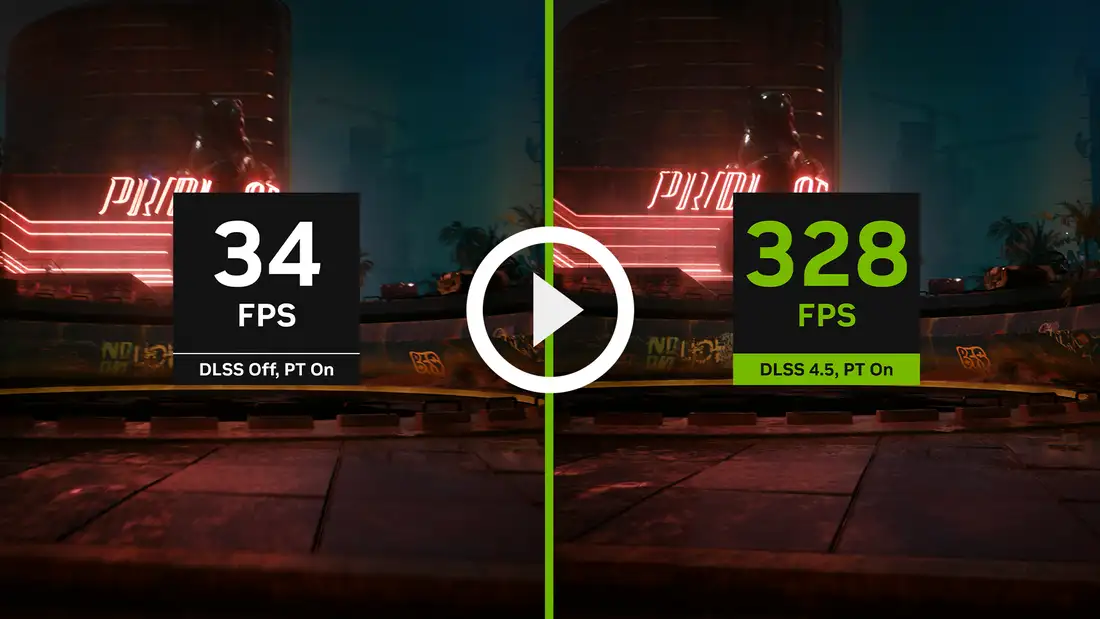
To be clear, DLSS and FSR are genuinely remarkable tools. By 2025, they had moved far beyond optional enhancements and become core parts of how modern games are rendered. NVIDIA’s technology can take a game running natively at 30fps and push it well past 90. AMD’s FSR works across a much wider range of hardware and has improved dramatically with each new version. The technology is real, it works, and it has genuinely extended the lifespan of older GPUs for millions of players.
The problem isn’t the technology. The problem is that the better it gets, the less incentive studios have to actually optimize their games. Why spend months digging into engine bottlenecks when players have a free performance fix sitting in the settings menu? The concern, shared by analysts and players alike, is that the more DLSS improves, the more developers may treat upscaling as the endpoint rather than the safety net.
NVIDIA announced DLSS 5 at GTC 2026, a neural rendering model capable of enhancing lighting and materials at up to 4K in real time, planned for fall 2026. It sounds extraordinary. It also sounds like an even larger cushion for studios to land on when they skip optimization work.

The consequences are already visible. Native resolution gaming, rendering every pixel on screen without AI reconstruction, is quietly becoming a niche experience reserved for people with top-tier hardware. High-end rigs that should dominate any game are now routinely told to enable upscaling just to hit performance targets that would have been unremarkable five years ago.
As one industry analysis put it, in the past, developers were forced to be more conscious of performance because there was no fallback. Now there is, and the craftsmanship that used to come from that pressure is getting harder to find.
Not every studio has abandoned that standard. Kingdom Come: Deliverance 2 launched in February 2025 to consistent praise specifically for how well it runs natively. Warhorse Studios stated directly in interviews that proper optimization should always come before relying on upscaling. God of War Ragnarok remains a reference point for what a polished PC port looks like. These games exist, which proves the bar is still achievable. Studios just need a reason to clear it.
That reason has to come from players. As long as “just enable DLSS” is accepted as a valid answer to performance complaints, developers will keep using it as one. The numbers will look fine in benchmarks, the reviews will move on, and the underlying problems will stay buried, one AI-reconstructed frame at a time.
What do you think, are DLSS and FSR genuinely helping gaming move forward, or are we slowly letting developers off the hook? Drop your take in the comments!