



If you thought MSI’s yellow-tipped 16-pin connector was the definitive fix to the GPU melting nightmare, buckle up, because things just got worse. Several users are now reporting that the connector doesn’t just fail to seat properly, it actively pushes itself out over time, and that changes everything we thought we knew about these incidents.
A safety feature that’s becoming a safety risk
Quick recap for context: when the RTX 40 and RTX 50 series GPUs started showing up with melted 16-pin connectors, MSI rolled out a clever visual solution.
Their yellow-tipped adapter was designed so that the yellow section disappears completely once the connector is fully and properly seated. If you can still see yellow, the cable isn’t in all the way. Simple, smart, effective, at least in theory.
The yellow-tipped design works as a precautionary measure: if the yellow section is still visible after insertion, the connector has not been seated properly. MSI introduced this back in 2023 after identifying improper cable connections as a primary cause of burning connectors on RTX 4090 setups.
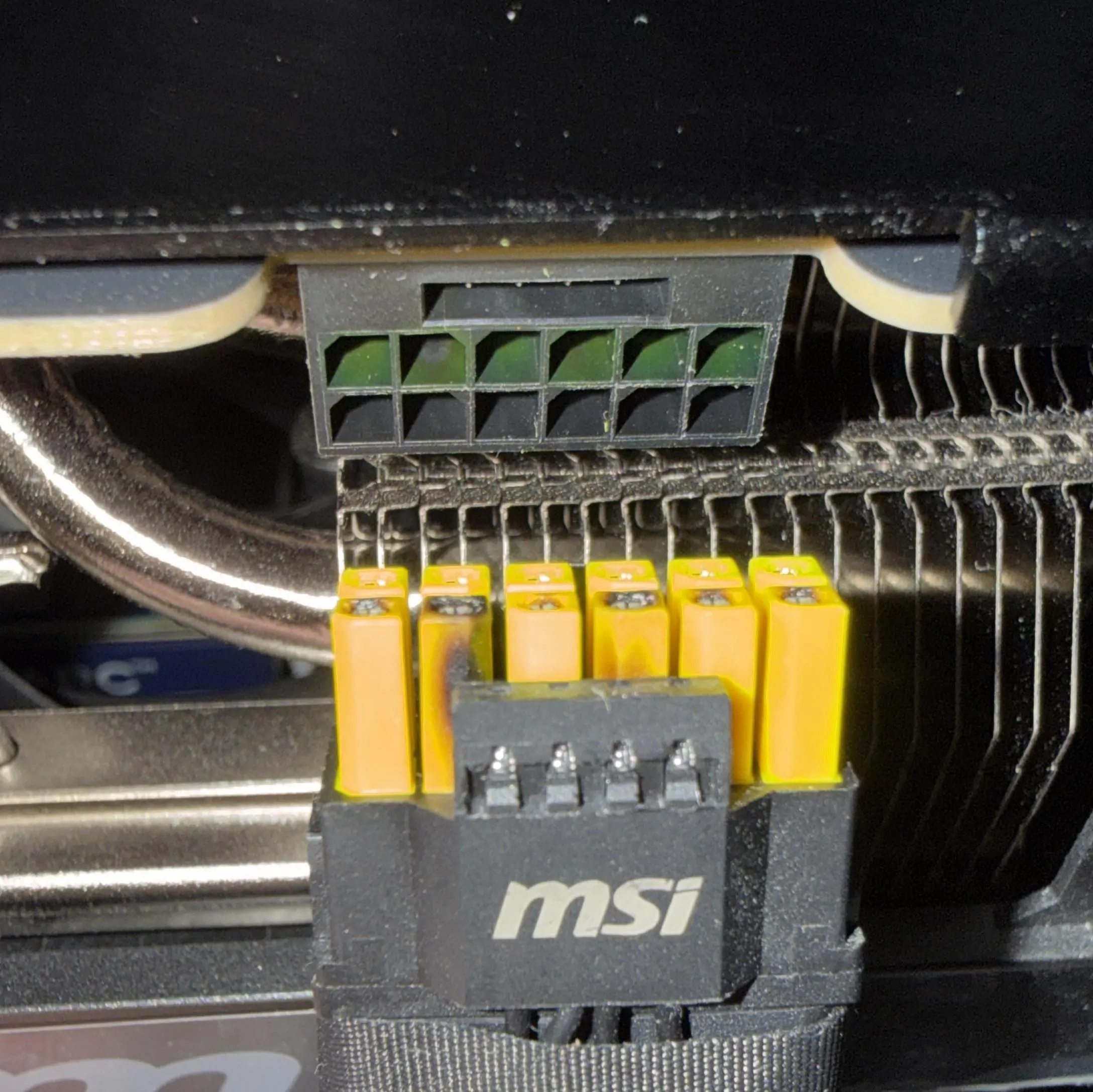
The problem? Users are now finding that even after confirming the connector was fully seated, the yellow section starts reappearing on its own over time. The connector is physically working its way out.


Thermal cycling: The silent culprit
This might be due to thermal cycling, as the connector heats and loosens up a bit with regular usage. Every time your GPU fires up and cools down, those materials expand and contract, and apparently that’s enough to gradually push the connector out of its seated position.
The melting doesn’t happen overnight either, it takes several months before we reach this phase.
This is a critical finding because it reframes a lot of the previous melt cases. Users were blamed for not inserting the cable correctly, but if the connector can unseat itself through normal use, then “user error” isn’t the full story here.
To make matters more complicated, even in a secure connection where the yellow tip indicator is fully seated, the adapter may still not provide proper current distribution across all pins, which could eventually lead to overheating and melting. So you could do everything right and still end up with a charred connector after a few months.
In one of the more recent cases reported on Reddit, an MSI RTX 5090 Gaming Trio died in an idle state after seven months of use. The posted images clearly show a burnt top row on the MSI yellow-tipped connector, with the top row of the GPU connector also turning yellow from the damage.
What should you do right now?
The safest move at this point is to ditch the adapter entirely if you can. It’s advisable to use a 16-pin to 16-pin power cable shipped with the PSU, and it’s recommended to get a PSU with a native 12V-2×6 connector to avoid such instances.
For flagship cards like the RTX 5090, which can pull up to 600W, running through a multi-rail adapter is a gamble that’s increasingly not worth taking.
If you’re stuck using the yellow-tip adapter for now, check it periodically. Don’t just verify it at install and forget about it. If that yellow tip has started showing itself again after weeks of use, reseat it immediately.
The broader issue, of course, lies with the 16-pin standard itself and how Nvidia’s Blackwell architecture handles power delivery, but that’s a conversation for another day (and probably a few more melted GPUs down the line).
Your GPU’s connector might be plotting against you right now, and we need to talk about it. Have you had any issues with MSI’s yellow-tip adapter? Did your connector ever start creeping back out on its own? Drop your experience in the comments below. The community needs to hear your story, and honestly, so does MSI.