



If you’ve ever wondered where Akira Toriyama got the idea for the Dragon Balls, the answer goes back almost 200 years, and it comes from a Japanese epic novel that most Dragon Ball fans have never heard of. Toriyama didn’t hide it either. He confirmed it himself in a 1987 Q&A published in the Dragon Ball Adventure Special, a collector’s guidebook released alongside Weekly Shōnen Jump.
When asked about the origin of the Dragon Balls, he said plainly that there are eight balls in a story called Hakkenden, and that he changed the number to seven specifically so it wouldn’t be exactly the same. That one answer cracked open one of the most fascinating pieces of Dragon Ball trivia that rarely gets talked about.
The novel is called Nansō Satomi Hakkenden, written by author Kyokutei Bakin and published in Japan between 1814 and 1842, making it one of the longest-running publications in the history of Japanese literature, consisting of 98 chapters spread across 106 booklets.
Bakin was already in his 70s and had gone blind by the time he finished it, dictating the final chapters to his daughter-in-law. It is widely considered the largest novel ever written in Japanese, and its influence on manga and anime has been enormous, yet outside of Japan, almost nobody talks about it.
So what is it actually about, and why does it matter for Dragon Ball?
The story behind the balls you never knew about
At the center of Hakkenden is Princess Fusehime, a noblewoman who is given a set of Buddhist prayer beads inscribed with the Eight Confucian Virtues, things like filial piety, justice, and loyalty, as a protective charm. She ends up in a cave with a giant dog named Yatsufusa, who is possessed by a vengeful spirit.
Through her recitation of Buddhist sutras, she slowly purifies that spirit, absorbing the evil within her own body, a process that is strikingly similar to what Son Wukong goes through in Journey to the West, which is, of course, the other major literary foundation of Dragon Ball.
Their connection is spiritual, leading to a mystical pregnancy. Later, when Fusehime sacrifices herself and slits her belly to prove her chastity and release the spirits, the inscriptions on the prayer beads momentarily shift to a Buddhist aphorism: “thus can a beast conceive a heart to know truth.”
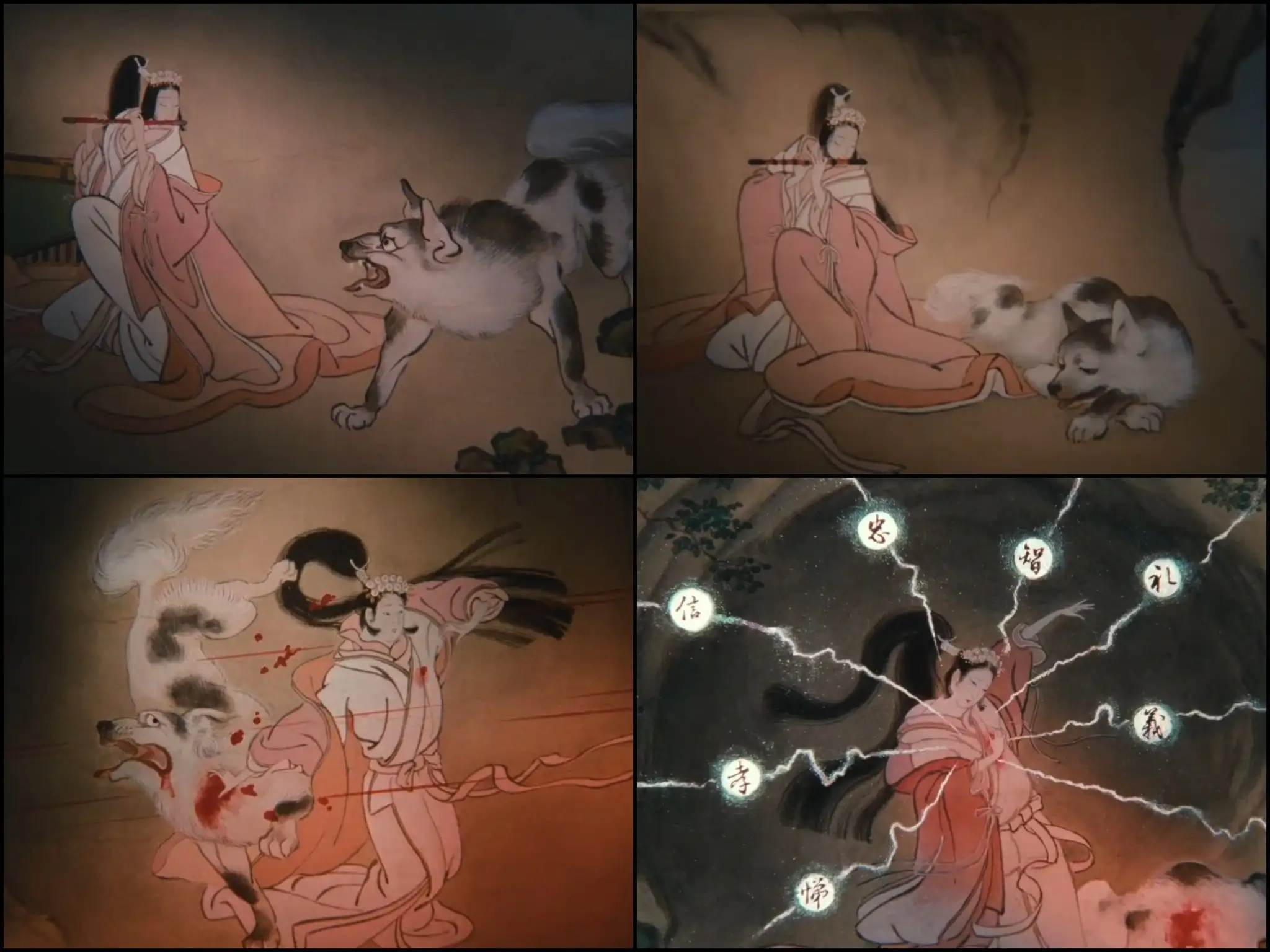
The eight spirits then enter the beads, which scatter across the land and are hunted throughout the rest of the novel, exactly like the Dragon Balls. The end result of that hunt is the eight Dog Warriors, the Hakkenshi, who are born across different regions of Japan, each carrying one of the scattered beads, and who eventually unite as martial heroes and protectors of the Satomi clan.
The parallel to Dragon Ball is direct and undeniable. Scattered magical orbs, a quest to collect them all, warriors born from the spiritual energy contained within them. Toriyama took that framework, compressed eight orbs into seven, and built one of the most iconic adventure setups in manga history around it.
The buddhist thread that connects Hakkenden to Goku
What makes this connection more interesting is that it goes beyond just the orbs. The philosophical core of Hakkenden, the idea that even a beast can develop a heart that understands truth and moral awareness, is essentially the same arc that defines Son Goku across Dragon Ball.
The aphorism “thus can a beast conceive a heart to know truth” exists in the novel because the eight warriors are descended from a dog and a human princess. It’s the novel’s central moral statement: that something wild and animalistic can become noble, virtuous, and spiritually aware. Goku starts out as a feral child raised in isolation, with a monkey tail and almost no understanding of human society, and grows into the greatest protector humanity has ever had.
Son Wukong, the monkey king from Journey to the West who is Goku’s most direct literary ancestor, follows the same arc through Buddhist discipline. Toriyama was drawing from both wells at once.
The Hakkenshi themselves, martial heroes who protect others, born from the purified spirit of a beast, also echo something fundamental about Goku’s relationship with Bulma, and more broadly about the way Dragon Ball frames its heroes as protectors who come from unexpected, impure, or wild origins and grow into something greater.
Hakkenden even influenced other major franchises. Rumiko Takahashi drew directly from it when creating Inuyasha, another story about a half-dog, half-human protagonist on a quest to collect magical shards scattered across Japan. One novel from 1814, two of the most beloved franchises in anime history.
Toriyama was not shy about any of this. He acknowledged the Hakkenden connection openly, explained exactly why he changed eight to seven, and left behind enough clues in the DNA of Dragon Ball that fans who dig into the source material can trace the lineage clearly.
The Dragon Balls didn’t come out of nowhere. They came from an 800-year-old story about a princess, a possessed dog, scattered sacred beads, and a Buddhist lesson about the heart of a beast, and Toriyama turned all of that into something that shaped the childhoods of hundreds of millions of people around the world.
That’s the kind of origin story that makes you appreciate Dragon Ball on a completely different level.
Did you already know about this connection, or did this blow your mind? Drop it in the comments, we want to know how deep your Dragon Ball lore goes!