



UPDATE:
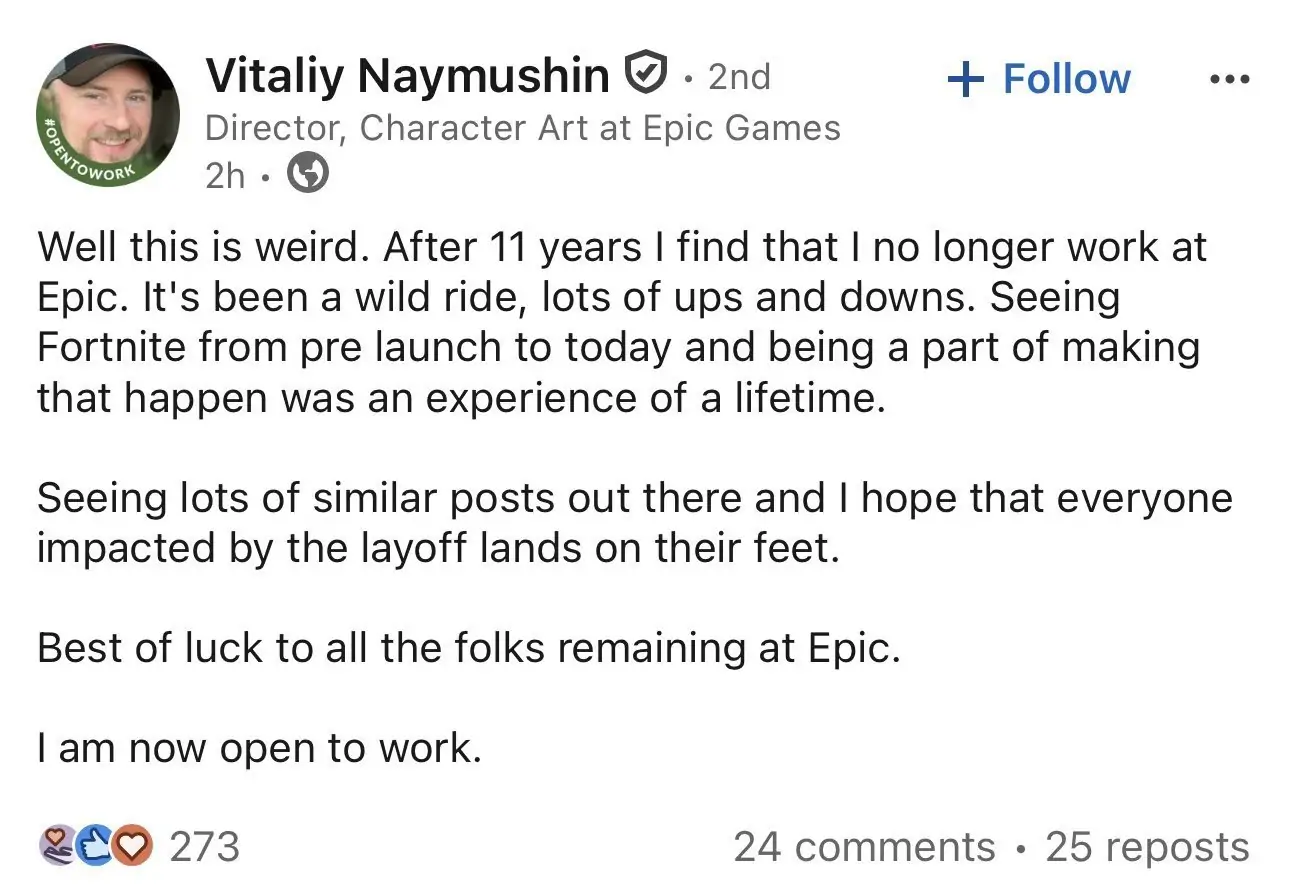
Vitaliy Naymushin, the character artist who created the design of Jonesy, was one of the affected by the layoff by Epic Games today.
Epic Games CEO Tim Sweeney confirmed today the layoff of more than 1,000 employees across the company in a message sent internally before being posted publicly on the Epic Games website. Sweeney opened the announcement with a blunt admission: “I’m sorry we’re here again.”
He pointed directly at declining Fortnite engagement as the root cause, stating that the downturn that began in 2025 has left the company spending significantly more than it earns, forcing leadership to make major cuts to keep Epic financially stable.
The layoffs come alongside an additional $500 million in identified cost savings across contracting, marketing, and the closure of open roles. Together, Sweeney said, these measures put the company in a more stable position. Affected employees will receive severance packages that include at least four months of base pay, with more depending on tenure, six months of healthcare coverage in the US, and extended stock options.
Sweeney was also direct about one thing the layoffs are not connected to: artificial intelligence. “Since it’s a thing now, I should note that the layoffs aren’t related to AI,” he wrote. “To the extent it improves productivity, we want to have as many awesome developers developing great content and tech as we can.”
Fortnite is still on top, but players are spending less time in it
The situation carries an obvious irony. Fortnite is not a dying game, not even close. According to data from Circana’s Player Engagement Tracker, Fortnite led Monthly Active Users in the US across both PlayStation and Xbox in February 2026, with 35% of PlayStation actives and 31% of Xbox actives playing the game that month. The problem is not the number of players, it’s how long they’re staying.
The average PlayStation player spent 16 hours on Fortnite in February 2026, compared to 21 hours in February 2025. Xbox players dropped from 19 hours to 15 hours in the same period. For a company whose revenue model depends heavily on sustained player engagement and in-game spending, even a gradual decline like this translates directly into a financial problem.
Sweeney acknowledged the challenge in his statement, noting that despite Fortnite remaining one of the most successful games in the world, Epic has struggled to consistently deliver what he called “Fortnite magic” with every season. He also pointed out that the company is still in the early stages of returning to mobile, with the goal of optimizing Fortnite for the billions of smartphones worldwide, a process that has moved slower than expected.
The engagement drop didn’t come as a complete surprise to those paying attention. Just weeks before the layoffs, Epic raised the prices of Fortnite’s in-game currency, V-Bucks, openly telling players the move was necessary to “help pay the bills.” And on the same day the layoffs were announced, Fortnite posted an update confirming that three of its game modes, Rocket Racing, Ballistic, and Festival Battle Stage, will be going offline.

Rocket Racing will shut down in October 2026, while Ballistic and Festival Battle Stage will go offline on April 16. The original Fortnite Festival mode will remain active. Separately, Save the World, the original cooperative PvE mode that predates Battle Royale, will go free-to-play on April 16 in an effort to attract new players.
This is the second time Epic has been here, and Sweeney knows it
The phrase “I’m sorry we’re here again” carries weight precisely because this is not the first time. In September 2023, Epic laid off approximately 830 employees, around 16% of its workforce at the time.
In that announcement, Sweeney had already warned that Epic had been “spending way more money than we earn,” and that efforts to build a metaverse-inspired creator ecosystem had not produced the financial returns the company needed. The gaming industry largely treated those cuts as a one-time correction. The current announcement makes clear it was not.
Adding to the financial pressure over the years have been Epic’s prolonged legal battles against Apple and Google over app store payment practices and third-party distribution. Fortnite was temporarily removed from both the App Store and the Play Store during those disputes, costing the company a significant amount of revenue and momentum. Sweeney referenced the ongoing battle indirectly in his statement, noting that Epic has “taken a lot of bullets” as the industry’s vanguard in a fight that is only beginning to pay off.
To contextualize the current situation within a broader company history, Sweeney pointed to three previous turning points at Epic: the shift from 2D to 3D gaming in the 1990s with Unreal 1, the move into console game development in the 2000s with Gears of War, and the pivot to online gaming in 2012 with Paragon and Fortnite.
Each transition was painful, he said, but each time the company rebuilt its foundations and came out with a stronger position. Sweeney framed current market conditions as the most extreme the company has faced since those early days, but also as an opportunity for the companies that navigate them successfully.
The road forward, according to Sweeney, involves building stronger Fortnite experiences through better seasonal content, gameplay updates, story, and live events, while accelerating the development of tools as Epic transitions from Unreal Engine 5 and UEFN toward Unreal Engine 6. He also mentioned that Epic is planning major launches toward the end of the year, though no specific projects were announced. A company-wide meeting was scheduled for Thursday to go over the roadmap in more detail.
The gaming industry has been hit by a relentless wave of layoffs throughout 2025 and into 2026, affecting studios of all sizes. Epic now joins a long list of major companies that have been forced to restructure amid slower growth, reduced consumer spending, and intensifying competition for players’ time across all forms of entertainment.
What do you think, is Fortnite’s decline really enough to justify cutting over 1,000 jobs, or does Epic have a bigger management problem on its hands? Let us know in the comments!