



NVIDIA rolled out DLSS 4.5 this week, the latest version of its AI-powered upscaling tech promising better stability and image quality. Early testing confirms what many feared: the upgrade delivers sharper visuals, but it comes at a performance cost, especially brutal for older GeForce RTX cards.
According to reports from ComputerBase and Hardware Unboxed, the new version does exactly what NVIDIA promised on the visual front, fixing several long-standing issues.
However, the frame rate penalty varies wildly depending on your GPU generation, with some users seeing drops that might not be worth the trade-off.
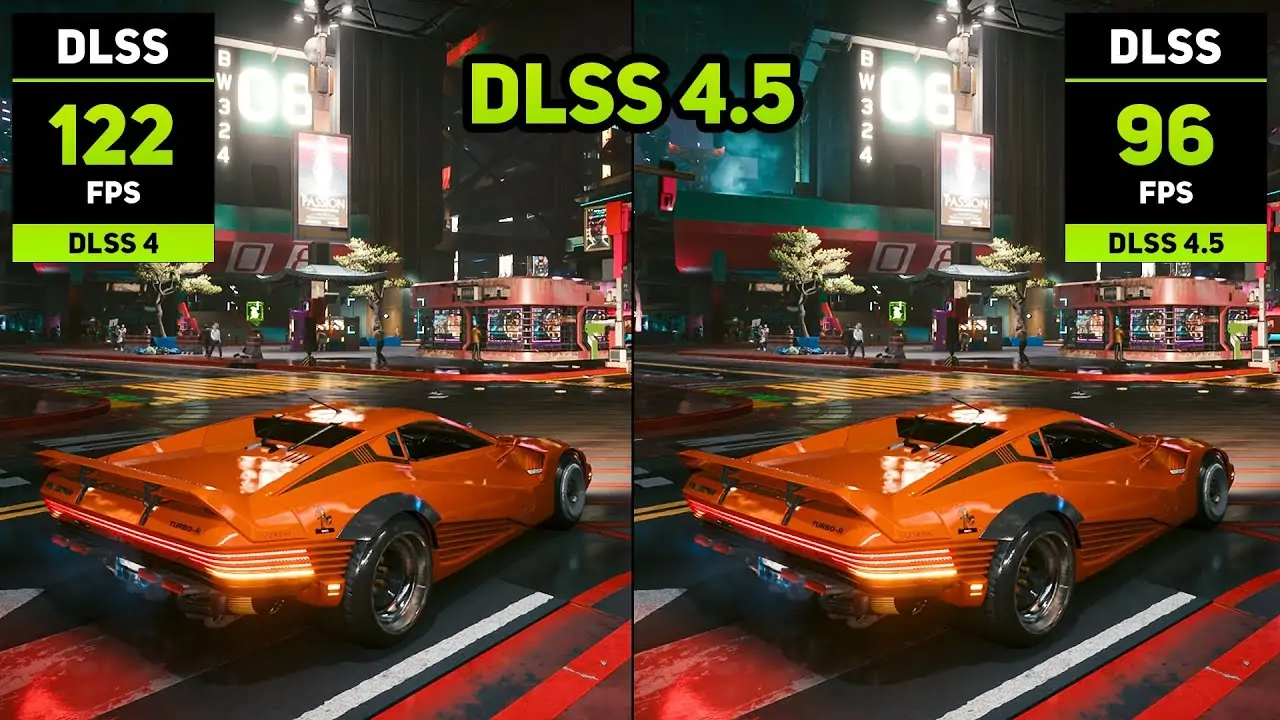
RTX 40 and 50 handle the load
If you’re rocking an RTX 40 or RTX 50 series card, you’re in relatively good shape. Testing shows the performance hit averages between 4% and 5% across most titles, with peaks hitting around 7% in specific games. That’s pretty much within margin of error territory, and most users won’t notice the difference during actual gameplay.
The visual improvements, better water rendering, reduced shadow noise in Unreal Engine 5 with ray tracing, and improved temporal stability, make the slight FPS dip an acceptable trade.
The newer architectures handle DLSS 4.5’s AI models efficiently thanks to FP8 acceleration, which is why the impact stays manageable. NVIDIA clearly optimized this version with these cards in mind.
Older RTX cards take a beating
Here’s where things get rough. RTX 30 (Ampere) and RTX 20 (Turing) series cards face significantly steeper drops. Testing on GPUs like the RTX 3090 Ti and RTX 2080 Ti shows an average performance loss of 12%, with some games pushing that number to 15% or even 16%.
The culprit? Lack of FP8 acceleration, a feature exclusive to newer architectures that DLSS 4 and 4.5 rely on heavily.
On the visual side, DLSS 4.5 addresses several complaints from DLSS 4. Water looks better, disocclusion artifacts are noticeably reduced (though still not quite DLSS 3 levels), and ghosting improves slightly without fully disappearing.
Distant vegetation gains stability and flickers less, but it also appears blurrier in some cases, losing definition compared to previous versions. Ray-traced reflections that depend on in-game denoisers remain a weak point with no clear improvements.
With this landscape, DLSS 4.5 feels more like a fine-tuning update than a generational leap. For RTX 40 and 50 owners, the balance between quality and performance is reasonable and worth enabling if you can accept a small FPS loss.
For RTX 20 and 30 users, NVIDIA itself recommends sticking with DLSS 4, since the performance cost might be too steep for modern demanding titles.
Want more GPU news and gaming tech updates? Follow Geek Realm Hub on Facebook and stay in the loop with everything that matters in the geek world!