

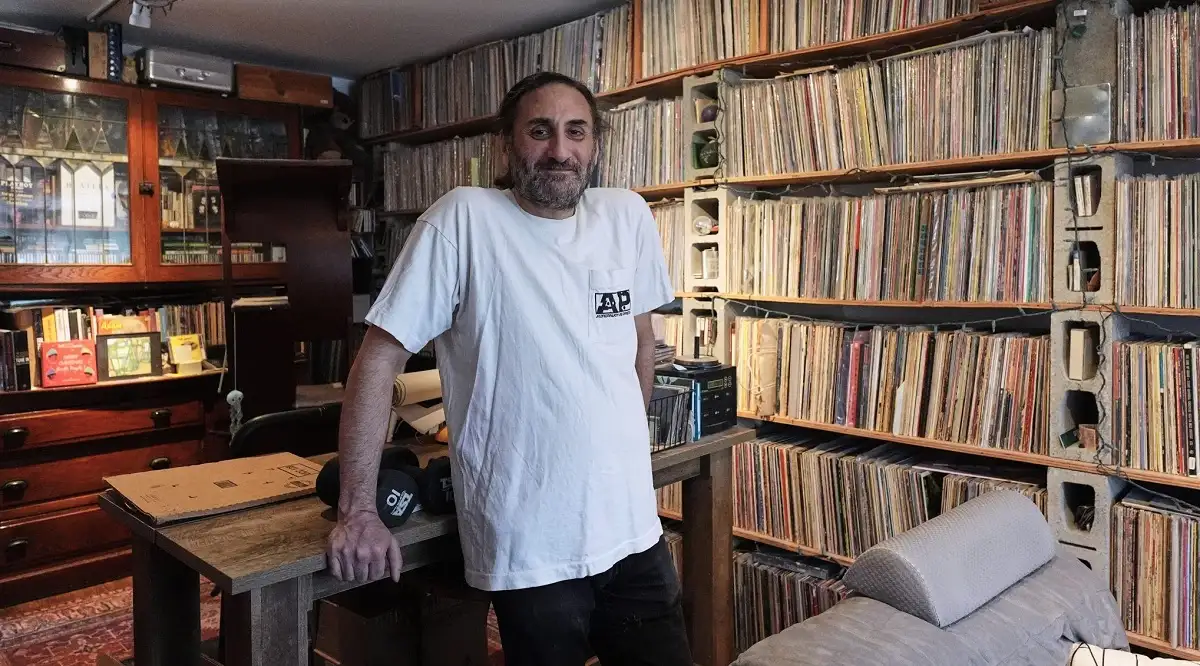

On July 8, 1989, a young music fan named Aadam Jacobs walked into a small Chicago club called Dreamerz with a compact Sony cassette recorder hidden in his pocket. He was there to see an up-and-coming band from Seattle making their Chicago debut. After a blast of guitar feedback, a 22-year-old Kurt Cobain announced to the crowd: “Hello, we’re Nirvana. We’re from Seattle.” The band launched into their first song of the night, “School,” and Jacobs quietly hit record, capturing the group more than two years before their global breakthrough with Nevermind.
That tape, now cleaned up and remastered, is available online for free. And it’s just one of more than 10,000 concerts Jacobs recorded over four decades across Chicago and other cities. Now a group of volunteers in the U.S. and Europe is methodically cataloging, digitizing and uploading them one by one to the Internet Archive, where anyone in the world can stream or download them at no cost.
The growing collection is a goldmine for fans of indie and punk rock from the 1980s through the early 2000s, featuring early-career performances from artists like R.E.M., The Cure, The Pixies, The Replacements, Depeche Mode, Stereolab, Sonic Youth and Björk. There’s also a 1988 hip-hop concert by rap pioneers Boogie Down Productions, and a previously uncirculated 1990 Phish show that sent jam band devotees into a frenzy when they discovered it was in there.
How a teenager with his grandmother’s recorder started it all
Jacobs didn’t set out to become one of Chicago’s most important music archivists. As a teen, he started by taping songs off the radio. The real turning point came when a stranger tipped him off that sneaking a recorder into a concert was entirely doable. “And I eventually met a fellow who said, ‘You can just take a tape recorder into a show with you, just sneak it in, record the show.’ And I thought, ‘Wow, that’s cool.’ So I got started,” recalled Jacobs, now 59.
His first concert recording in 1984 was made on a tiny Dictaphone-type device borrowed from his grandmother. He later bought a Sony Walkman-style recorder, and when that broke, he stuffed his home console cassette machine into a backpack, a generous soundman even let him plug it in. “I was using, at times, pretty lackluster equipment, simply because I had no money to buy anything better,” he said. Over the years he graduated to digital audio tape and eventually solid-state digital recorders as technology improved.
In the early years, club owners frequently tried to stop him from taping. But over time, as Jacobs became a fixture in the Chicago music scene, many of them simply let the “taper guy” in for free. Author Bob Mehr, who wrote about Jacobs for the Chicago Reader in 2004, calls him one of the city’s cultural institutions. “He’s a character. I think you have to be, to do what he does,” Mehr said. “But I think he proved over time that his intentions were really pure.”
Jacobs himself doesn’t see what he did as obsessive or archival. He was going to a few concerts a week anyway, recording them just made sense.
A race against deteriorating tapes, fought by a team of volunteers
The push to digitize the collection started after filmmaker Katlin Schneider made a documentary about Jacobs in 2023. A volunteer with the Internet Archive saw it and reached out with a proposal to preserve everything online. Jacobs, aware that time was working against him, agreed. “Before all the tapes started not working because of time, just disintegrating, I finally said yes,” he said.
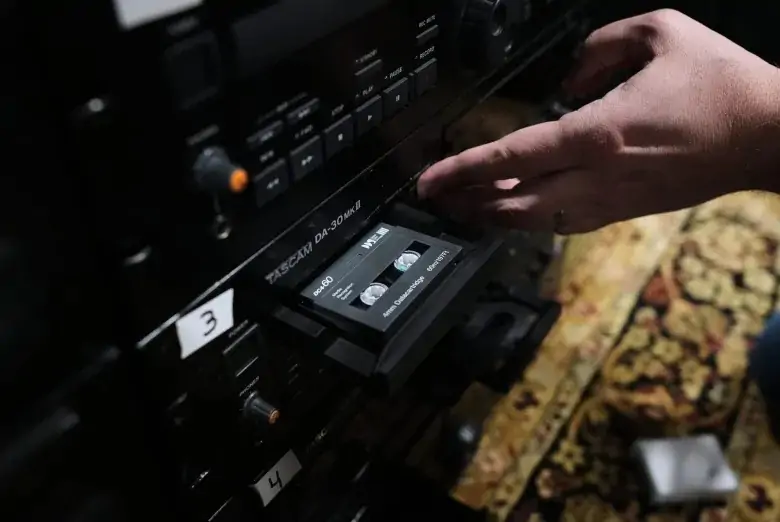
The operation is now run by about a dozen volunteers across the U.S., U.K. and Germany. Every month, Brian Emerick drives from the Chicago suburbs to Jacobs’ house to pick up 10 to 20 boxes, each packed with 50 to 100 tapes. He transfers every recording to digital in real time, running 10 cassette and DAT decks simultaneously in a room dedicated entirely to the project. Many of the machines were broken when he found them, Emerick learned to fix them himself. He’s digitized at least 5,500 tapes since late 2024 and estimates it will take a few more years to finish.
The digital files then go to volunteer engineers who clean up the audio and document the setlists, a task that sometimes takes days of research and even direct contact with the artists. Neil deMause, a Brooklyn-based engineer on the project, said the audio quality has consistently surprised him. “Especially after the first couple years, he’s got it so dialed in that some of these recordings, on, like, crappy little cassette tapes from the early 90s, sound incredible,” deMause said.
The Replacements are a prime example of just how valuable this material is. The band was so impressed with Jacobs’ tape of their 1986 show that they mixed it with a soundboard recording and released it in 2023 as a live album inside a box set. Most artists in the collection are happy to have the recordings exist, only one or two have ever asked for their material to be taken down. On the legal front, a copyright attorney consulted on the matter noted that since neither Jacobs nor the archive profit from any of this, lawsuits are unlikely.
Jacobs stopped attending concerts a few years ago as health issues slowed him down, but he keeps up with live music online. He sees the current generation of smartphone-toting concert fans as a natural continuation of what he started with his grandmother’s Dictaphone back in 1984. “Since everybody’s got a cellphone, anybody can record a concert,” he said. The entire Aadam Jacobs Collection is available for free at the Internet Archive.
Have you already gone down the rabbit hole of the Aadam Jacobs Collection? Tell us which recording you found first, or which artist you’re hoping is hiding somewhere in those 10,000 tapes!